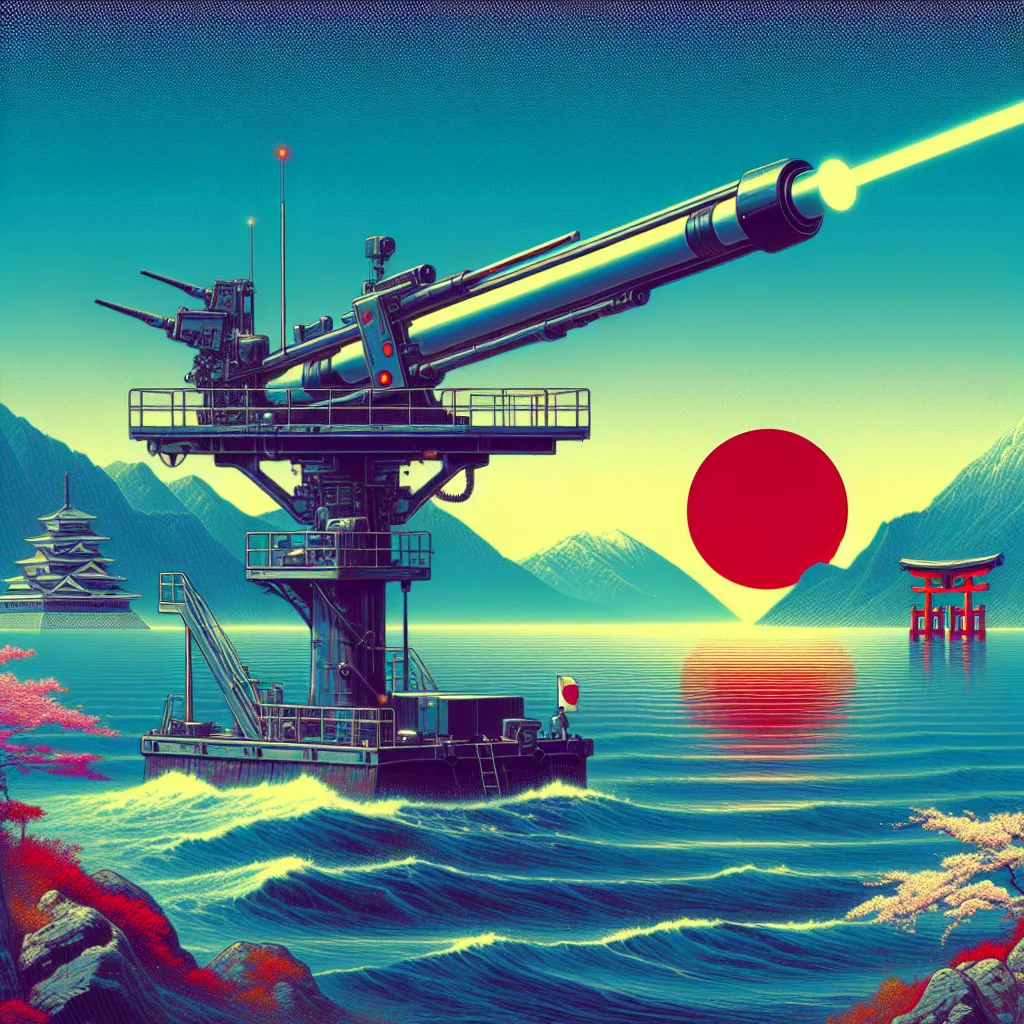
Japan’s Sea-Based Railgun: A New Era in Naval Warfare
In a striking demonstration of technological advancement, Japan has unveiled its ship-mounted electromagnetic railgun, a development that could redefine naval warfare. The prototype was showcased on April 18, 2025, during an inspection by Admiral Katsushi Omachi, commander of the Japan Maritime Self-Defense Force (JMSDF), aboard the experimental vessel JS Asuka. This moment not only marks a significant milestone for Japan’s military capabilities but also raises critical questions about the future of maritime security in the Asia-Pacific region.
The introduction of the railgun comes at a time when Japan is increasingly focused on enhancing its defense posture amid rising regional tensions. The electromagnetic railgun, which utilizes magnetic fields to launch projectiles at hypersonic speeds, represents a leap forward in weaponry that could alter the balance of power at sea. As nations around the world invest in advanced military technologies, Japan’s move signals its intent to remain a formidable player in the evolving landscape of global defense.
Historically, Japan has maintained a pacifist constitution since World War II, limiting its military capabilities. However, recent geopolitical developments, including North Korea’s missile tests and China’s assertive maritime claims, have prompted a reevaluation of this stance. The Japanese government has gradually shifted its defense policy, allowing for greater military engagement and modernization. The railgun project, developed by Japan’s Acquisition, Technology & Logistics Agency, is a testament to this strategic pivot.
Currently, the railgun is still in the prototype phase, with the JMSDF conducting tests to assess its operational viability. The weapon’s ability to strike targets at unprecedented speeds and distances could provide Japan with a significant tactical advantage, particularly in scenarios involving anti-ship and anti-air operations. Official statements from the JMSDF emphasize the railgun’s potential to enhance deterrence capabilities and protect Japan’s maritime interests.
Why does this matter? The implications of Japan’s railgun extend beyond mere military capability. As the nation strengthens its defense systems, it also raises concerns among neighboring countries. China, in particular, has been vocal about its apprehensions regarding Japan’s military expansion. The introduction of advanced weaponry could exacerbate regional tensions, prompting an arms race that may destabilize the delicate balance of power in East Asia.
Experts in defense technology and international relations highlight the dual-edged nature of such advancements. On one hand, the railgun could serve as a deterrent against potential aggressors, reinforcing Japan’s security. On the other hand, it may provoke adversaries to accelerate their own military developments, leading to an escalation of hostilities. The strategic calculus for Japan will involve navigating these complex dynamics while ensuring its national security.
Looking ahead, the successful deployment of the railgun could lead to broader implications for Japan’s defense strategy. Observers should watch for potential shifts in military alliances, particularly with the United States, as both nations seek to counterbalance China’s growing influence. Additionally, the technological advancements associated with the railgun may inspire further innovations in naval warfare, prompting other nations to explore similar capabilities.
In conclusion, Japan’s unveiling of the sea-based railgun is not merely a technological achievement; it is a pivotal moment in the evolution of military strategy in the Asia-Pacific region. As nations grapple with the implications of advanced weaponry, one must ponder: will this innovation lead to greater security or heightened tensions? The answer may shape the future of international relations for years to come.



