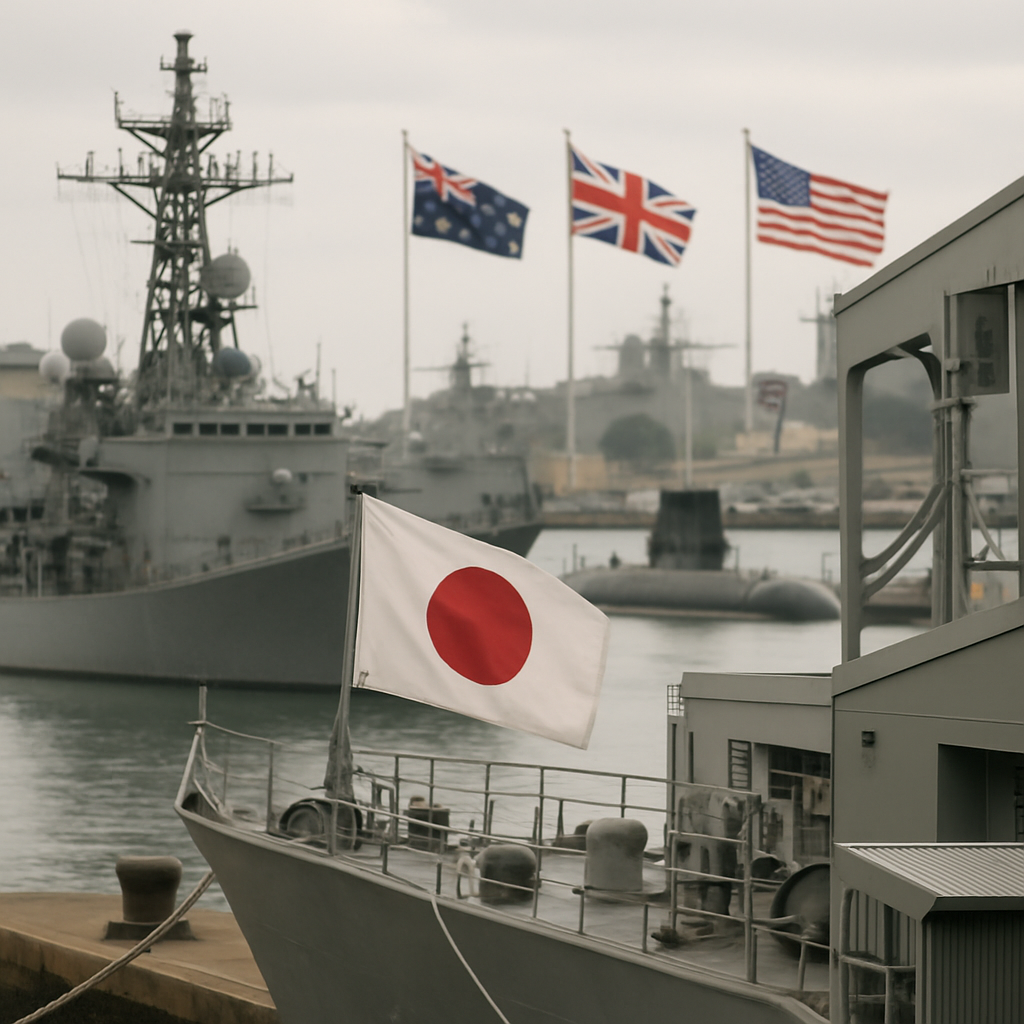
"Japan is unlikely to join the submarine component of the AUKUS defence partnership between Australia, Britain and the United States," an ASPI report released today says — and yet the report argues Tokyo could play a decisive role in preventing a damaging capability gap for Australia.
AUKUS Optimal Pathway: affirmed as the preferred route, but not risk-free
The report frames AUKUS as "the best mechanism for ensuring partner nations’ future defence" while acknowledging that "all three governments" recognise "substantial risks" within what it calls the AUKUS Optimal Pathway. It stresses that critics who urge abandoning AUKUS rarely present a viable alternative and that Australia has no appetite for restarting a full acquisition to buy a new class of conventional submarines, after a decade-long effort to replace the Collins-class that proved "unsuccessful, costly and politically bruising."
The three principal risks: Collins-class life, Virginia-class delivery, and SSN-AUKUS build
The report identifies three interlocking, high-risk enterprises that could combine to create a prolonged loss of a modern, crewed, sovereign submarine capability. First is the challenge of extending the operating life of Australia's six Collins-class submarines. Second is the United States' ability to deliver between three and five Virginia-class submarines on the timeline needed. Third is the construction of the SSN-AUKUS in Australia and its planned delivery to the Royal Australian Navy from 2040 onwards. Taken together, these risks could "deprive Australia of a modern, sovereign submarine capability for more than a decade," with a capability gap that could "manifest as early as 2030 and extend into the 2040s."

This site is the portfolio.
OSINTSights runs on Cloudflare Workers, D1, R2, and Vectorize, with an AI pipeline on Hetzner ARM. Nubivance designed, built, and operates it. We do the same for clients.
See what we buildJapan as a practical hedging option: leasing to cover an emergent gap
The ASPI analysis makes the case that leasing submarines from Japan offers a pragmatic, lower-effort alternative to a full acquisition process and could be dialled up or down as risk assessments evolve. The report says Japan "possesses a young, large, modern, highly capable submarine fleet," that it "is still producing these submarines and continually upgrading their capability and performance," and that it "likely has excess future production ability and some spare capacity in its existing fleet." Australia and Japan also maintain "excellent relations" across trade, diplomacy and military-to-military links and share a common threat perception in the Western Pacific, the report notes.
What Australia would need to do now — timing, funding, and military talks
Because the requirement for leased platforms could emerge rapidly, the report argues Australia must begin engagement with Japan "immediately." Practical workstreams the report says should be started as soon as possible include determining costs and funding models, establishing industrial production rates, and initiating detailed military-to-military discussions. The piece highlights a decision point on certification to the US Congress by the next US administration as "likely in 2030 or 2031," a milestone that would shape whether leasing remains an interim hedge or becomes unnecessary.
What this means for the Australian government, Japan, and the Royal Australian Navy
- Australian government: The report counsels moving now to preserve optionality — pursuing leasing talks would be a low-initial-resource hedge that "wouldn’t detract from the Optimal Pathway" until delays or failures made that pathway clearly unachievable.
- Japan: As a potential lessor, Japan would be asked to examine costs, production timelines and available spare capacity; the report highlights Japan’s "prudent industrial policies and extensive manufacturing capability" as enabling features.
- Royal Australian Navy: Operational commanders would need to prepare for the integration of leased platforms should a gap appear — a step the report treats as more feasible than restarting a full submarine acquisition and less risky than accepting a decade-long capability shortfall.
The report concludes that "a sovereign submarine capability is a core requirement for Australia’s defence over the next two decades" and that, given the identified risks, "exploring a relatively modest alternative seems prudent." It adds a clear policy prompt: "There is no better time than Takaichi’s visit to Australia." For policymakers and naval planners, the choice is framed not as abandoning the AUKUS pathway but as creating an insurance policy — an insurance policy, the report says, that requires action now if it is to be available when needed.