"I am confident that, as of mid-2026, around 500 J-20s had likely been delivered," Andreas Rupprecht told TWZ.
That single estimate — built from serial-number sleuthing, imagery, and long-term tracking of production batches — captures the shift in the J-20 program from a boutique, symbolic stealth fighter to a mass-produced cornerstone of the People’s Liberation Army Air Force. The debate now is less about whether the J-20 works and more about how many exist, where they are based, and what production tempo means for regional air balances.
Production milestones and serial-number evidence
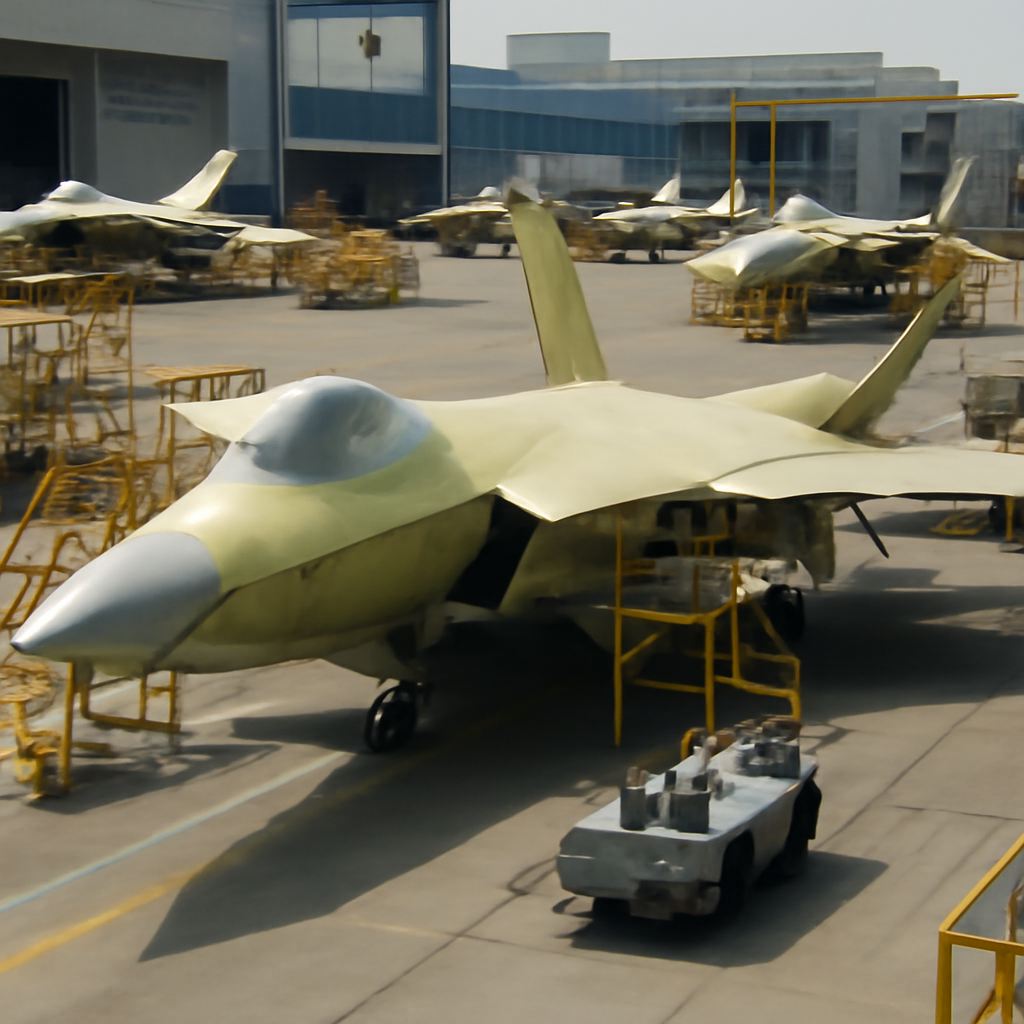
Early Western estimates put total J-20 production at about 50 aircraft at the end of 2019, a figure that likely included pre-production machines. By late 2022, analysts using construction-number methods concluded the PLAAF had received roughly 200 J-20s — a count equated with four production batches. Janes reported in mid-2024 that the PLAAF had inducted more than 70 J-20s during an 11-month period starting July 2023, bringing the total to approximately 195.
Evidence of accelerating output continued into 2025 and 2026. In fall 2025, Andreas Rupprecht identified a J-20 with a serial number indicating the 300th airframe, from the 10th production batch. The Royal United Services Institute (RUSI) assessed that production rates had likely reached around 120 aircraft per year by late 2025 and estimated roughly 300 J-20s in service across at least 13 PLAAF regiments, noting a number of newly produced fighters were still awaiting delivery. Rupprecht’s mid-2026 confidence in a roughly 500-aircraft fleet rests on sightings of jets across 14 frontline units plus three Flight Test and Training Bases.
Variants, engines, and capability evolution
The J-20 entered service in late 2016 after design adjustments following its 2010 debut. Since then the platform has continued to evolve: a domestically produced powerplant has replaced earlier Russian-supplied engines in series-built aircraft; a two-seat J-20S has appeared; and an enhanced J-20A variant is replacing initial-production examples in several units. Incremental upgrades cited in imagery and official releases include expanded weapons loads — notably side weapons bays that carry short-range PL-10 air-to-air missiles — and stepwise improvements in avionics and weapons carriage.

Audit-ready is a season. It shouldn't be.
Evidence in spreadsheets, controls drifting between audits, frameworks multiplying on flat headcount. Nubivance runs continuous compliance on Rapid7 Cyber GRC - SOC 2, HIPAA, ISO 27001, PCI, CMMC.
End the scrambleTheater distribution and brigade-level deployment
Satellite analysis and reporting have documented the widening geographic footprint of the J-20. By May 2024 the PLAAF operated 12 air brigades equipped with the type, of which three were fully equipped, and all five Theater Commands had inducted the aircraft, Janes found. RUSI reported at least 13 regiments operating the J-20 by late 2025; Rupprecht’s mid-2026 tally cites presence across 14 frontline units and three FTTBs. Those numbers suggest the J-20 moved rapidly from selective fielding toward force-wide adoption across multiple commands.
How Pacific Air Forces, the U.S. Air Force, and PLAAF leaders are framing the shift
- Pacific Air Forces: Gen. Kenneth Wilsbach, then head of PACAF, told reporters in 2022, "It’s not anything to lose a lot of sleep over," while adding that the U.S. Air Force had "had a limited opportunity to assess it [the J-20], but it seems okay."
- U.S. Air Force leadership: Brig. Gen. Doug Wickert, head of the 412th Test Wing, warned that the PLA "is the largest and most modern that it has ever [sic; ever] been," calling that condition "risk. That is uncertainty." Wickert also projected that by 2027 China could hold numerical superiority of approximately 12 to one in modern fighter aircraft, and five to three in fifth-generation aircraft, relative to U.S. assets west of the international dateline.
- Force structure context: For comparison within the U.S. Air Force, the source reports 185 F-22 Raptors exist, of which 143 are combat-coded and the remainder are assigned to training or test and evaluation, with a portion routinely down for maintenance.
Production capacity as strategic effect
Analysts cited in the reporting stress that the strategic value of the J-20 increasingly stems from China’s ability to produce it in quantity. RUSI’s late-2025 projection suggested a pathway to roughly 1,000 J-20s by 2030 (alongside about 900 J-16s), though that projection depends on continued production tempo and future procurement choices. The J-35, sixth‑generation crewed designs, and a suite of collaborative combat aircraft and uncrewed combat air vehicles are all highlighted as variables that could alter long-term buys.
The immediate fact is simple and consequential: the J-20 has moved from a handful of prototypes to a large, distributed fleet in a short period. How that quantity is balanced with evolving variants, training, sustainment, and the rest of China’s combat-air inventory will determine whether production alone translates into sustained operational advantage.