"The international system is currently experiencing a period of profound structural upheaval," Asialink Insights wrote — and Tokyo and Canberra are acting on that verdict.
The United States' pivot and the strategic prompt for Tokyo and Canberra
The article frames a trilateral shock to the post‑war order: Russia's invasion of Ukraine, China's economic coercion in violation of World Trade Organization norms, and a marked policy shift in Washington. It says that under the second Trump administration, the US "has pivoted sharply toward a rigorous America First doctrine," citing measures from reciprocal tariffs to military interventions including "the bombings of Iran." For Japan and Australia — nations that have "historically viewed the US as their most important strategic anchor" — this reorientation is described less as policy noise and more as a structural change that compels them to recalibrate.
Mogami-class frigates: first major Japanese defence export and industrial ties in Western Australia
At the concrete end of that recalibration is a defence agreement signed in Melbourne after an April meeting between Defence Minister Shinjiro Koizumi and Deputy Prime Minister and Defence Minister Richard Marles. Australia will purchase three upgraded Mogami-class frigates, marking "Japan’s first major export of sophisticated defence equipment" according to the piece.
The arrangement extends beyond a simple sale. The fourth vessel and subsequent units "are slated for construction in the Henderson Defence Precinct in Western Australia," a move the article highlights as both a boost to Australian manufacturing and a means to ensure interoperable, technologically aligned naval forces. The Reciprocal Access Agreement is cited as enabling upgraded joint exercises and the transformation of the two defence forces into interoperable partners capable of maintaining maritime security in the Indo‑Pacific.

The cyber insurance questionnaire just landed. Now what?
SOC 2, HIPAA, insurance renewals - someone has to own security strategy. Nubivance provides fractional CISO leadership without the full-time salary.
Get a security leadEnergy and critical minerals: securing supply chains during a green transition
The partnership is as much economic as military. The article notes Japan's position as "one of the world’s most resource‑poor advanced economies" and Australia as "a global energy superpower." It emphasises Japan's dependence on Australian coal and liquefied natural gas, and Australia’s reciprocal need for petroleum products and industrial goods from Japan.
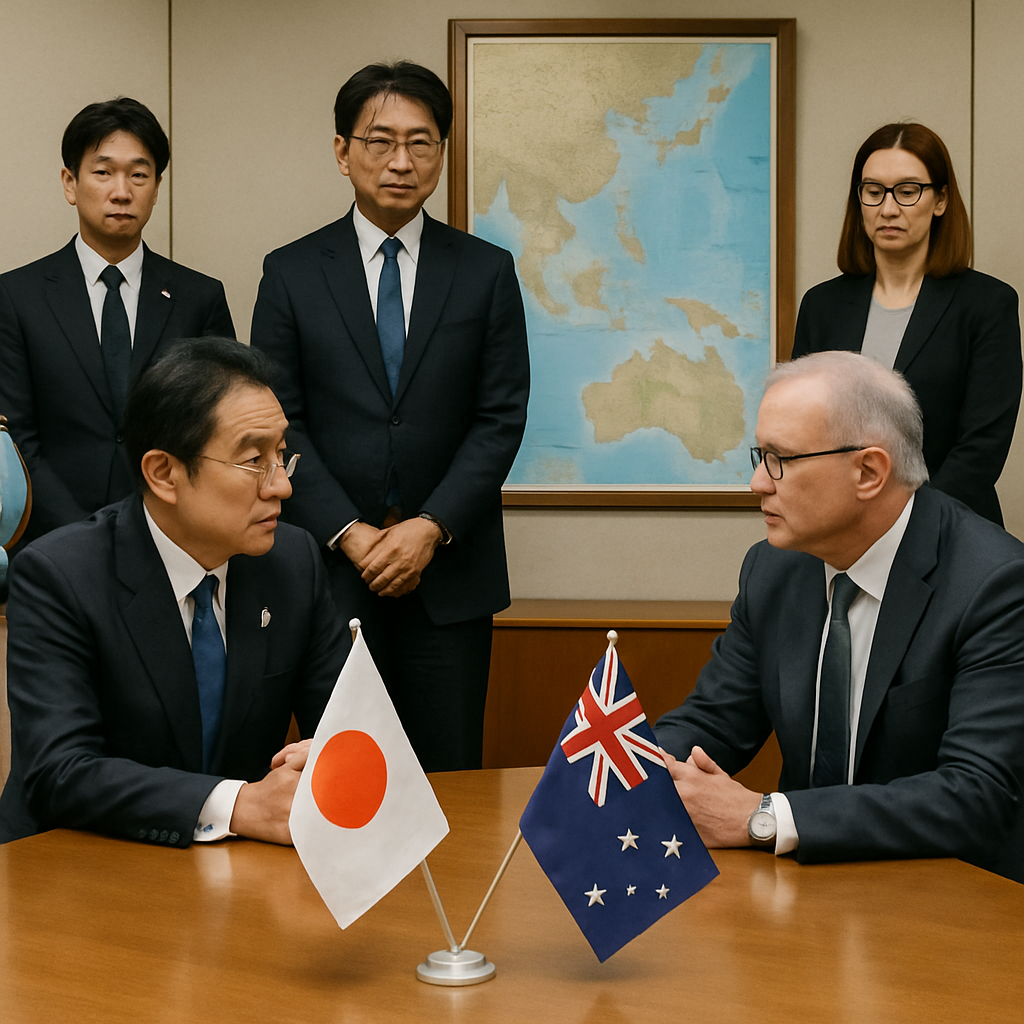
During a May 3–5 visit to Canberra, Takaichi and Prime Minister Albanese moved beyond traditional energy discussions and "reached pivotal agreements regarding the stable supply of critical minerals — the essential ingredients for the green energy transition and advanced high‑tech industries." These agreements are portrayed as steps to "de‑risk" both economies from external over‑dependency.
Complementing that visit, the article records Australian Foreign Minister Penny Wong's trip to Tokyo for talks with Japan’s Foreign Minister Toshimitsu Motegi and Minister for Economy, Trade and Industry Ryosei Akazawa. Their focus, the piece says, ranged across economic security, "spanning cyber security, intelligence sharing and infrastructure development" — a multimodal effort to guard against the economic weaponisation practised by other global powers.
Diplomatic alignment ahead of a scheduled US–China summit
The timing is explicit. With the US and China scheduled for a high‑stakes summit on 14 and 15 May, the article situates Tokyo and Canberra in a "precarious position" and portrays their deepening bilateral ties as an "anchor of stability." It casts both nations as "primary advocates in the region for a rules‑based order at a time when the traditional guardians of that order have turned inward."
What this means for Japan, Australia, and regional partners
- Japan: Gains more secure access to coal and liquefied natural gas and seeks to lock critical mineral supplies crucial for its high‑tech and green sectors; it also advances the export of sophisticated defence technology through the Mogami‑class frigate arrangement.
- Australia: Secures a major industrial stimulus with planned shipbuilding at the Henderson Defence Precinct, deepens interoperability with a technologically advanced partner, and strengthens energy‑export relationships that underpin its economic role.
- Regional partners and the Indo‑Pacific diplomatic environment: See an emergent quasi‑alliance of two advanced democracies aligning military, economic and diplomatic levers to sustain a rules‑based order even as other powers test those norms.
From shipyards in Perth to ministerial offices in Tokyo and Canberra, the policy combination is pragmatic: integrate defence industries, secure critical energy and mineral supply chains, and amplify diplomatic coordination. The article's central claim is straightforward — Japan and Australia "need each other more than ever" — and it sets two immediate markers to watch: construction at the Henderson Defence Precinct and diplomatic choreography around the 14–15 May US‑China summit. Together, these moves illustrate how mid‑sized powers can translate strategic necessity into concrete, mutually reinforcing commitments.
https://www.aspistrategist.org.au/japan-and-australia-need-each-other-more-than-ever/