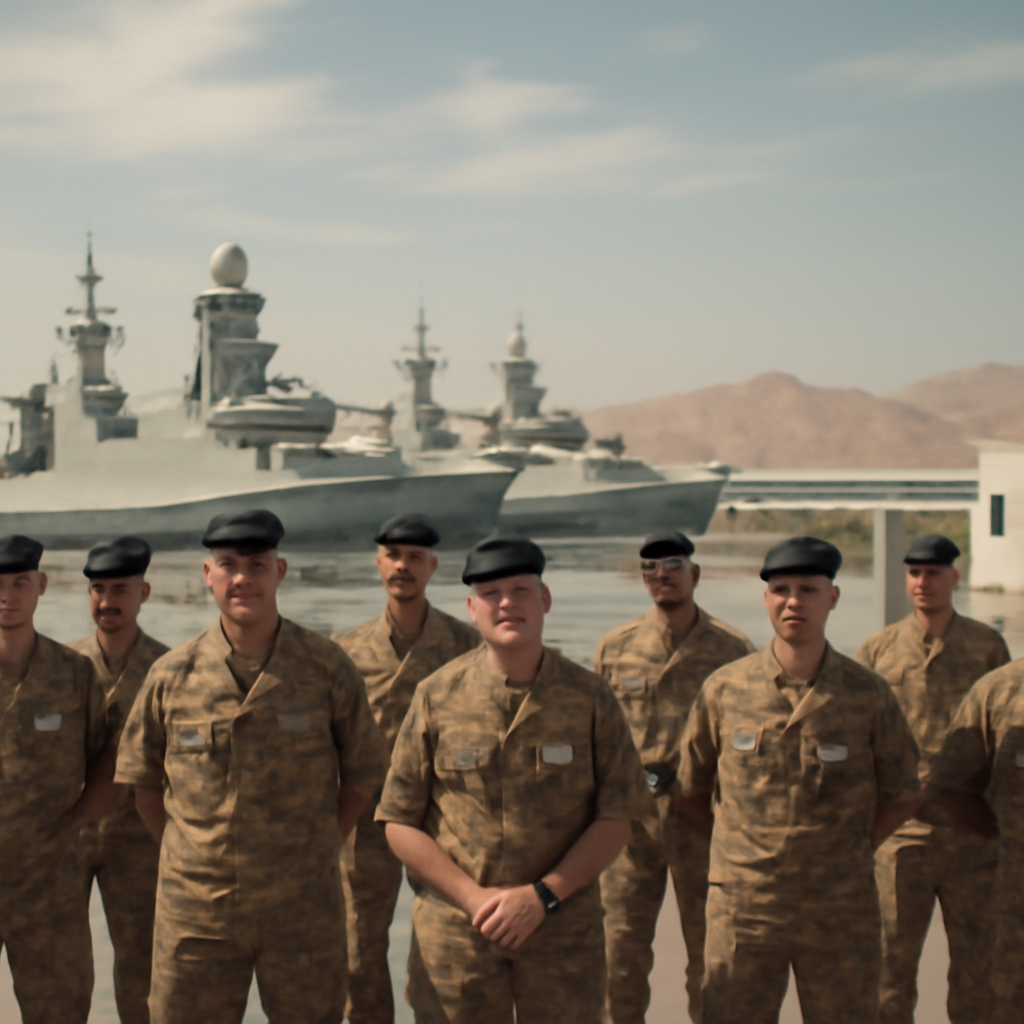
Scope of the deployment: roughly 700 personnel and two task forces
Italy has deployed about 700 military personnel to the Gulf region, the Defense Ministry disclosed on its website. The ministry presented two task forces operating across several Gulf countries to contribute to surveillance and defense against Iranian attacks, a presence first flagged publicly by the Italian newspaper Il Giornale on July 30.
According to the ministry’s posting, roughly 400 Italian Air Force personnel have been in Saudi Arabia, Bahrain and Kuwait since March, following what the ministry described as targeted attacks on those countries from Tehran. In addition, a 260-strong Italian Army component, called Task Force Land-Arabia, brings the overall figure to approximately 700 personnel, a detail highlighted by Mazziotti di Celso, a visiting research fellow at the Center for Military Maritime Studies.
Task Force Air-Arabia: aircraft, early warning and refueling support
Task Force Air-Arabia provides the airborne element of Italy’s contribution. The ministry lists four Eurofighters tasked with supporting defense of assigned airspace, E-550A CAEW aircraft for early warning of air threats, and a KC-130J transport aircraft to provide operational support in what the ministry described as “key theaters of national interest in the Middle East and the Horn of Africa.”
The ministry also named Task Group Kuwait as part of the overall mission, noting it “ensures air surveillance capabilities through an AN-TPS-77 air defense radar.”

This site is the portfolio.
OSINTSights runs on Cloudflare Workers, D1, R2, and Vectorize, with an AI pipeline on Hetzner ARM. Nubivance designed, built, and operates it. We do the same for clients.
See what we buildCounter-UAS and land air-defence: ACUS-E, SAMP/T and Kronos radar
The deployment includes a Task Group C-UAS equipped with the Leonardo-made ACUS-E anti-drone system designed to counter small drones. On the ground, Italian reporting and expert commentary point to higher-end assets: Mazziotti di Celso cited, and the military magazine RID reported, that the land task force includes a SAMP/T air defense battery and a Kronos radar operating in Saudi Arabia.
Mazziotti di Celso warned that many of the systems sent are recently entered into service and available in limited numbers, making any loss or damage to them consequential.
Political push-back: Partito Democratico, Brothers of Italy and ministerial defense
The ministry’s public posting and the subsequent press coverage have prompted criticism from opposition lawmakers. A statement signed by members of Italy’s Partito Democratico said, “Sending hundreds of soldiers to crisis areas, without Parliament’s knowledge, is not only an unacceptable overturning of an already flawed law, but is contrary to every rule of political seriousness.”
The ruling Brothers of Italy party rejected that criticism. Defense Minister Guido Crosetto defended the government’s decision in an interview with Corriere della Sera, citing a parliamentary resolution adopted on March 5 that authorized the government to deploy air-defense and surveillance systems to the Gulf region. The ministry has also argued the deployment should not have come as a surprise, since the mission was approved by parliament in March; however, the source reported that the full scope of what the resolution would entail appeared to have caught some in parliament off-guard.
How the Italian military, Leonardo, and Italian lawmakers are reacting
- Italian military and defense planners: Mazziotti di Celso described the deployment as risky but also an operational opportunity — a chance to gain experience against Iranian capabilities and to learn about air and missile defense, counter-drone operations, and the integration of different sensors and effectors.
- Leonardo and the defense industrial base: The deployment serves an industrial dimension, the expert said — systems such as the SAMP/T and Leonardo’s ACUS counter-drone system are being showcased under demanding operational conditions, demonstrating capabilities in theater.
- Partito Democratico and government actors: The opposition has publicly criticized the deployment for proceeding “without Parliament’s knowledge,” while the government and the defense minister point to a March 5 parliamentary resolution and legislation permitting redeployment of assets within an already-authorized geographic area as the legal basis for the operation.
The public disclosure of the task forces has shifted the mission from quiet implementation to a political and technical spotlight. The deployment combines high-end air- and missile-defence assets, counter-UAS technology, and an army component, and it has prompted a narrow but sharp debate in Rome over parliamentary oversight and the risks of sending scarce, recently fielded systems into an active theater.
Original reporting: Italy’s controversial Gulf military mission enters public spotlight — Breaking Defense