"The American aggressor army... yesterday switched to using B1 planes flying from Fairford Air Base, England," an IRGC-connected Tasnim post declared, warning that "any base that is used to invade Iran’s territory is our legitimate goal."
EA-37B Compass Calls land at RAF Fairford
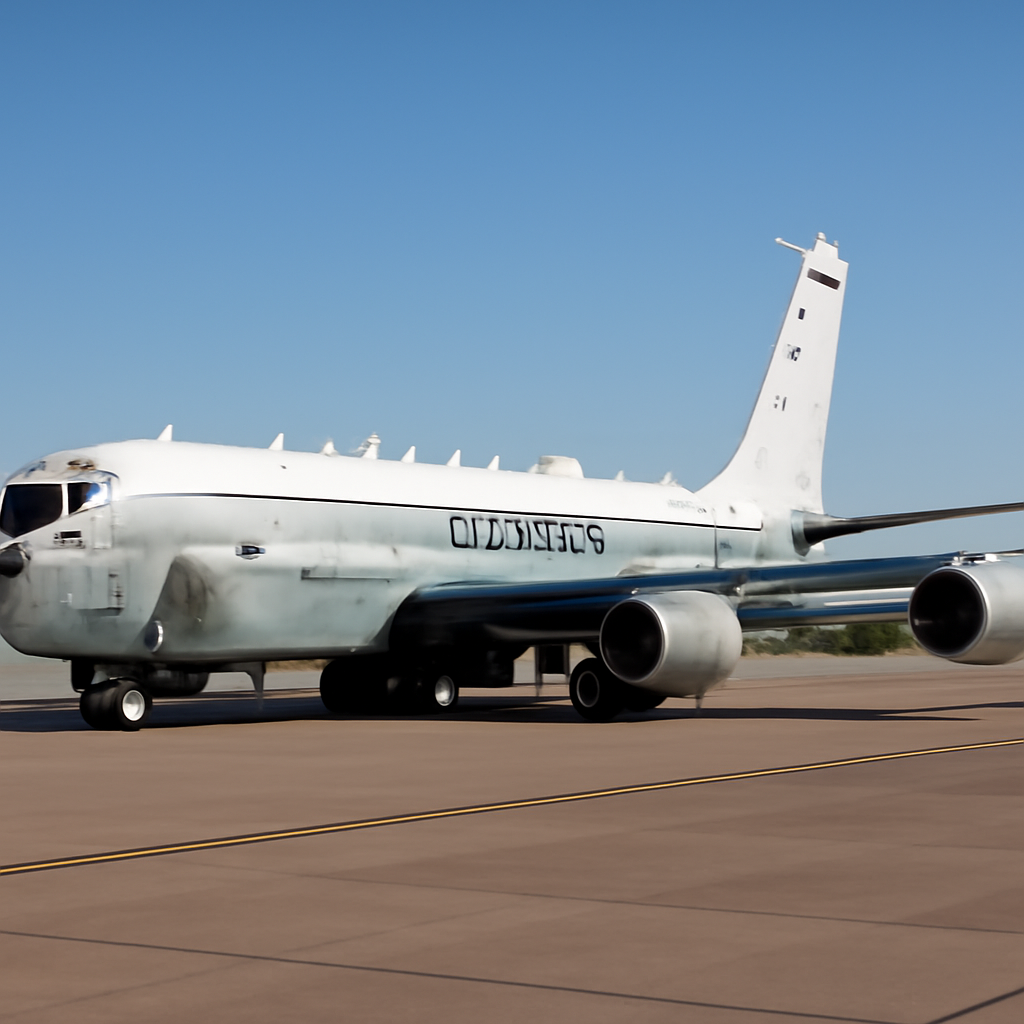
Two EA-37B Compass Call electronic warfare aircraft arrived at RAF Fairford from the United States, touching down shortly after 7 a.m. British Summer Time, aviation photographer Matt Belcher told TWZ and shared photos of the jets. The EA-37B is a heavily modified Gulfstream G550 with a Conformal Airborne Early Warning configuration—distinctive large "cheek" fairings on the fuselage—and many mission systems directly ported from the older EC-130H Compass Call. The U.S. Air Force plans to procure 10 EA-37Bs to replace a shrinking EC-130H fleet, of which only four remain.
How the U.S. characterizes the basing and role of the jets
An Air Force spokesperson told TWZ that "U.S. Air Forces in Europe operating locations, including the 501st Combat Support Wing at RAF Fairford, routinely host transient U.S. military aircraft in accordance with access, basing, and overflight agreements with Allies and partners." The service has described the Compass Call family as providing stand-off jamming against radars and communications with a secondary ISR function capable of spotting, tracking, and geolocating emitters. The 43rd Electronic Combat Squadron flew the EA-37B’s first training sortie on May 2, 2025, and the type made a maiden voyage to Europe this January.

This site is the portfolio.
OSINTSights runs on Cloudflare Workers, D1, R2, and Vectorize, with an AI pipeline on Hetzner ARM. Nubivance designed, built, and operates it. We do the same for clients.
See what we buildIran’s public threat and the question of reach
Tasnim, connected to the Islamic Revolutionary Guard Corps, publicly linked Tuesday’s strikes on Iran to B-1B bombers allegedly operating from RAF Fairford and said bases used against Iran are "legitimate" targets. TWZ reported that Axios published an account that B-1B Lancer bombers from Fairford took part in the strikes; TWZ could not independently confirm that claim and said CENTCOM declined comment. Open-source flight trackers had made similar claims earlier the same morning.
The source material notes the practical question of how Tehran could strike Fairford: in March Iran reportedly fired two missiles at Diego Garcia, about 2,400 miles away—roughly the same distance as Fairford is from Iran—but one missile was reportedly shot down by a U.S. warship and the other failed in flight. That episode is cited as reason to question the feasibility of a successful long-range strike against Fairford using similar weapons.
Near-field and vessel-launched drone threats cited as more plausible
TWZ highlights alternative attack vectors Iran has developed and trained for. The report cites Operation Spider Web, an attack in June 2025 in which Ukraine struck Russian bombers by hiding short-range drones in trucks near airfields. It also points to one-way attack drones launched from vessels at sea as a realistic threat Tehran has trained for and equipped to execute, and embeds as context a video example of long-range drone strikes used elsewhere in recent years.
Context: force movements, basing and political signaling
The arrival of EA-37Bs at Fairford occurs amid a broader movement of U.S. forces and equipment. TWZ documented that at least 12 F-16 Fighting Falcons moved from Spangdahlem Air Base in Germany to Muwaffaq Salti Air Base in Jordan; that special-operations forces have deployed to the region, according to The Wall Street Journal citing flight-tracking data and U.S. officials; and that more than 150 medics recently arrived at Landstuhl Regional Medical Center in Germany. Other rotations include B-52 bombers departing Fairford earlier in July and F-22 Raptors that had been flying out of Ovda Air Base in Israel returning to the United States. TWZ observers note that moving and publicly displaying assets can provide both operational capability and a messaging effect to Tehran and other actors in the area.
How the United Kingdom and CENTCOM factors respond
A government official told TWZ that "Our Armed Forces are ready to keep the United Kingdom safe from any kind of attacks, whether it’s on our soil or from abroad," and described a layered air and missile defense posture involving Royal Navy, British Army and Royal Air Force assets working with NATO allies. The official referenced the Defense Investment Plan, noting a £790 million allocation "to enhance protection of the UK homeland and overseas bases from air, drone and missile threats," plus "more than £2 billion of funding to deliver further air defense and counter-drone capabilities, and to upgrade and sustain our Typhoon fleet."
The direct threat against RAF Fairford is new in tone if not in strategic logic: the base is a regular hub for transient U.S. aircraft and for long-range bomber operations, and the arrival of EA-37B electronic warfare jets can be read as both an operational reinforcement and part of a larger signaling posture. Whether Tehran can translate the public warning into a successful long-range strike remains unclear on the facts reported; shorter-range, asymmetric vectors—loitering munitions launched near airfields or maritime-launched one-way drones—are presented in the record as more practical threats Tehran has trained to employ.
Source: TWZ — EA-37Bs Arrive At RAF Fairford As Iran Threatens To Attack The UK Air Base