"In the past weeks and months, the IRGC has repeatedly lied out of desperation, and today is no different," U.S. Navy Capt. Tim Hawkins, spokesperson for U.S. Central Command, told TWZ.
A raw IRGC claim and a U.S. pushback
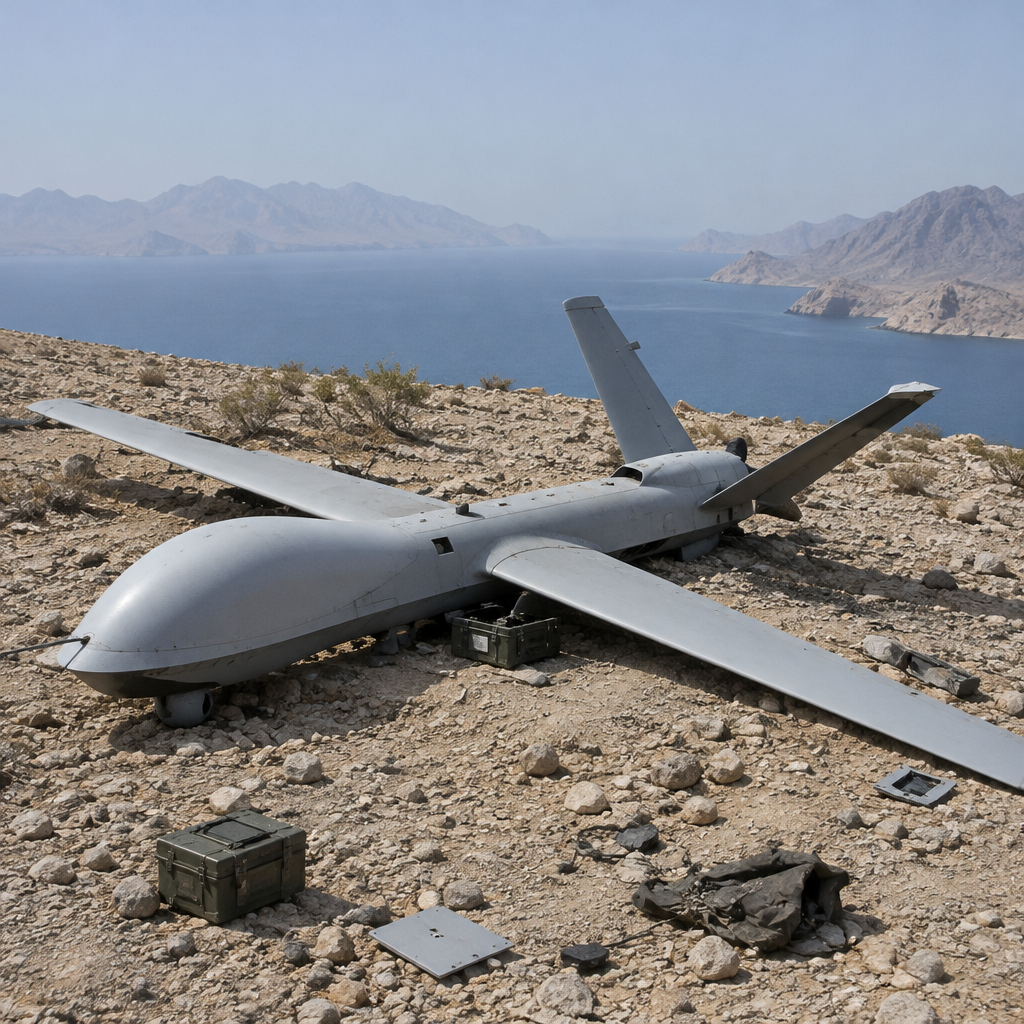
The Islamic Revolutionary Guard Corps (IRGC) released video and statements saying it had captured a largely intact uncrewed aircraft it identified as a U.S.-made MQM-170C Outlaw G2 following an "offensive electronic warfare operation" somewhere to the "west of the Strait of Hormuz." The IRGC further claimed the aircraft was conducting reconnaissance on Iranian air defenses along the Persian Gulf coast. At the time of writing, no firm evidence has been provided to support those assertions.
U.S. Central Command’s public response was blunt but limited: Capt. Tim Hawkins called the IRGC "repeatedly lied out of desperation," and said U.S. forces "remain vigilant and laser-focused on our assigned missions." CENTCOM did not explicitly deny losing an MQM-170-series drone in the region when asked.
What the recovered airframe appears to be
The footage Iran released shows an uncrewed airframe with a notable single forward-looking aperture on top of its nose — a feature commonly associated with staring-type optics used for navigation. TWZ’s examination concluded the airframe in the video "does look to be an MQM-170C, or at least a closely-related variant thereof." The aperture could plausibly be a navigation optic; the source notes that while such an aperture might indicate a seeker if the platform were configured as a one-way attack munition, that usage "seems unlikely."
The IRGC video does not show landing gear; Griffon Aerospace’s Outlaw G2E variant does have fixed tricycle landing gear, and the IRGC footage could reflect gear that "could have broken away when the drone came down." The drone in the video also lacks the high-visibility orange markings typically seen on aerial targets, though the article notes those markings "could easily have been painted over."

Audit-ready is a season. It shouldn't be.
Evidence in spreadsheets, controls drifting between audits, frameworks multiplying on flat headcount. Nubivance runs continuous compliance on Rapid7 Cyber GRC - SOC 2, HIPAA, ISO 27001, PCI, CMMC.
End the scrambleGriffon Aerospace’s Outlaw family and recent Army contracts
Griffon Aerospace, which identifies the design internally as the Outlaw Gen 2 (G2), lists the MQM-170C as a configurable platform. On its website the company says the target configuration has a gross weight of 150 pounds and that payload configurations can grow to 225 pounds. The G2 is described as nearly 11 feet long with a 16-foot wingspan, a maximum endurance of eight hours, a top speed of 126 knots, and a service ceiling exceeding 16,000 feet, propelled by a two-cylinder, two-stroke engine driving a single pusher propeller. The G2 can be launched by catapult and recovered by glide-in landing or parachute.
The broader Outlaw family includes earlier Gen 1 MQM-170A and MQM-170B derivatives and even twin-engine, twin-boom variants that the U.S. military has tested. Notably, the U.S. Army awarded Griffon Aerospace a June 3 contract valued at nearly $68 million for procurement of a Gen 3 Outlaw; the Pentagon’s initial announcement included the phrase "in support of Operation Epic Fury" against Iran, a reference that was later deleted. On August 25 the Army awarded an additional contract to Griffon "valued at just under $133 million, to procure Griffon Outlaw systems, support equipment and field service representatives for system use and employment," an announcement that made no mention of operations against Iran. Griffon’s public site does not list a Gen 3 as of the time reported, and TWZ reported it had reached out for more information.
Operations context: decoys, stimulation, and precedent
TWZ places the claim amid "growing signs that the United States, as well as Israel, are preparing to launch a new major campaign against Iran." The outlet quoted Tyler Rogoway: "Stimulating Iran’s air defenses is critical," arguing that operating as if a full-scale attack could be coming helps detect and geolocate air defenses. The article also noted prior unconfirmed claims, including a September report that Iran shot down a U.S.-made ADM-160 Miniature Air-Launched Decoy (MALD), and unconfirmed reports of unusual UAP-like objects.
TWZ further notes that target drones have operational precedents outside training: BQM-34 Firebee target drones were used to spread chaff over Baghdad in 2003. The piece also observes that the conflict with Iran this year "has seen the first U.S. combat use of longer-range one-way attack drones, as well as explosive-laden kamikaze uncrewed surface vessels (USV)." There is, however, "no evidence at present that drones in the Outlaw family have been configured in this way in any context."
What this means for Griffon Aerospace, the U.S. Army, and the IRGC Navy
- Griffon Aerospace — Watch for clarifications: Griffon’s absence of public Gen 3 details and the company’s role on two Army contracts mean questions about configuration and intended employment remain open.
- U.S. Army — Procurement visibility: The June and August contract announcements link the Outlaw family to U.S. military use outside pure training, suggesting program decisions will draw scrutiny if airframes appear in contested environments.
- IRGC Navy — Messaging and capabilities: The IRGC’s claim of an "offensive electronic warfare operation" that yielded an intact airframe, if accurate, would demonstrate a capability to capture foreign unmanned systems; if inaccurate, it becomes a messaging action with strategic effect.
The footage Iran released appears credible at first glance and shows a platform consistent with an MQM-170C or close variant, but the core operational claims — where the capture occurred, what the drone was doing, and whether the U.S. lost such an asset in the area — remain unsupported by independent evidence in the public record. CENTCOM’s refusal to confirm or deny loss, Griffon’s contractual ties to recent Army procurements, and the broader operational context of air-defense stimulation make this more than a single hardware story: it is a snapshot of contested messaging, procurement transparency, and the operational use of inexpensive, flexible unmanned platforms in a tense region.
Original story: https://www.twz.com/news-features/lets-talk-about-the-u-s-target-drone-iran-claims-to-have-recovered-intact