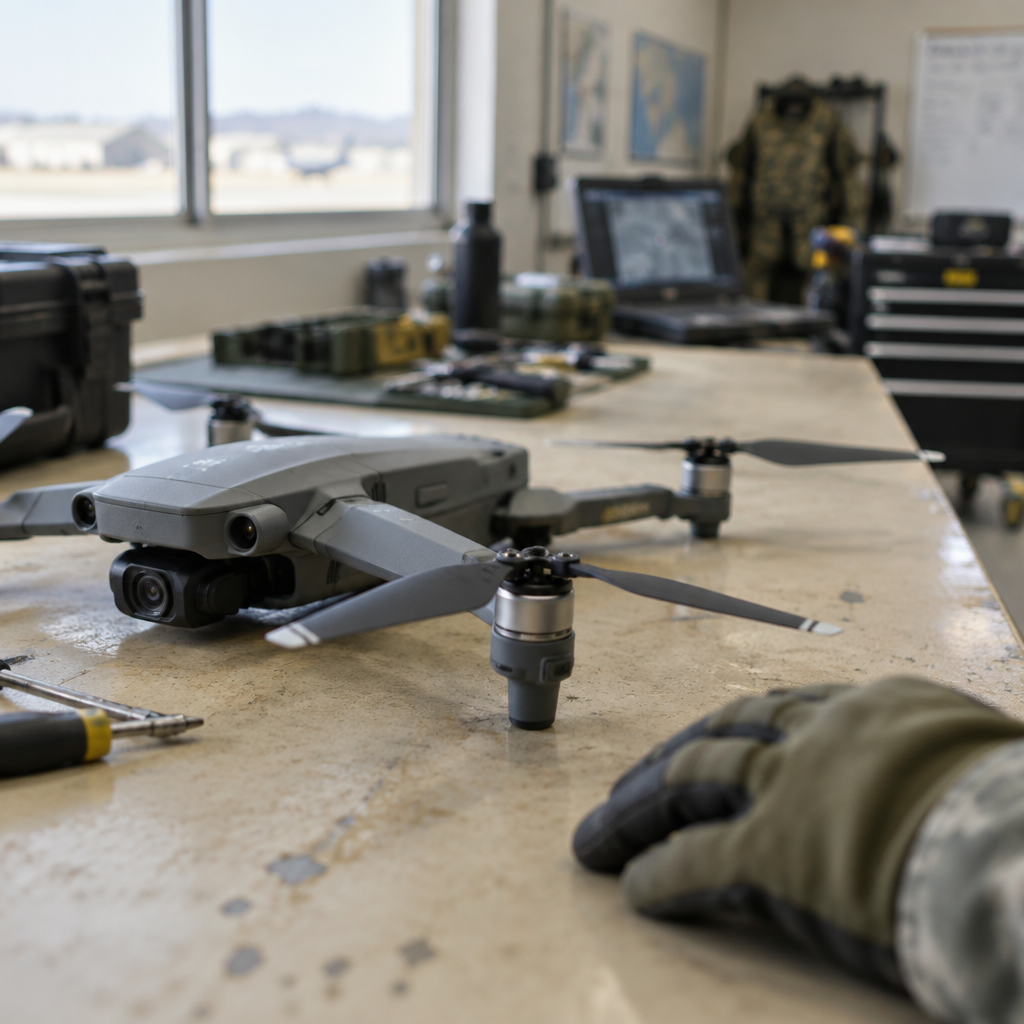
"The ability to reduce the cognitive load on operators and to deliver a true force-multiplier capability requires real autonomy, not simply unmanned capabilities," writes the Breaking Defense Game Changer in its new examination of battlefield drones.
The five levels of battlefield drone autonomy
Breaking Defense frames its analysis around five discrete levels of autonomy for battlefield drones. The Game Changer characterizes those levels as the organizing principle for understanding how unmanned systems evolve from remotely piloted platforms to machines that can act with greater independence. Rather than offering a single technological fix, the piece treats the levels as a framework for comparing capabilities, operator responsibilities, and potential operational effects.
Decentralized intelligence as a central theme
Central to the Game Changer's treatment is the role of decentralized intelligence. Breaking Defense highlights decentralized intelligence alongside the five-level framework, positioning it as a distinct and decisive factor in how autonomy scales on the battlefield. The report situates decentralized intelligence as part of the pathway from basic unmanned capability toward systems that relieve human operators of more routine or time-critical decision tasks.

Audit-ready is a season. It shouldn't be.
Evidence in spreadsheets, controls drifting between audits, frameworks multiplying on flat headcount. Nubivance runs continuous compliance on Rapid7 Cyber GRC - SOC 2, HIPAA, ISO 27001, PCI, CMMC.
End the scrambleReducing cognitive load and delivering a force multiplier
The Game Changer makes a direct connection between autonomy and operational effect: reducing cognitive load on operators is inseparable from delivering a force-multiplier capability, the report states. Breaking Defense stresses that achieving those outcomes depends on "real autonomy," a standard the piece contrasts with merely having unmanned platforms. In the framing used by the Game Changer, autonomy is not synonymous with remote operation; it is a distinct quality that changes what operators must monitor and control.
Implications for future drone operations
Breaking Defense uses the five-level framework and the decentralized-intelligence theme to explore what the future of drone operations might look like. The Game Changer treats real autonomy as the threshold for shifting cognitive burdens away from human operators and for scaling effects in contested environments. That suggests the report views the shape of future operations as dependent less on platform counts and more on how autonomy is designed, distributed, and trusted across systems.
What this means for technologists, policymakers, and procurement leaders
- Technologists and security teams: The Game Changer points attention to architectures that support decentralized intelligence and to where true autonomy must be demonstrated before systems are fielded.
- Policymakers and regulators: Breaking Defense frames the debate as one about defining and distinguishing "real autonomy" from traditional unmanned operations — a distinction with regulatory and oversight implications.
- Procurement leaders and end users: The report implies procurement choices should focus on autonomy that measurably reduces operator cognitive load and achieves force-multiplier effects rather than on platforms that are merely unmanned.
Breaking Defense packages these arguments as a Game Changer report and makes it available without barriers: the download is free, and no registration is required. For readers seeking the report itself, Breaking Defense offers the Game Changer as the place where the five levels, decentralized intelligence, and the operational stakes are laid out in one place.
For commanders, engineers, and policymakers alike, the Game Changer raises a pointed question: if force multiplication depends on "real autonomy" rather than on the unmanned label alone, how will programs define, demonstrate, and adopt that autonomy in practice? The report offers a conceptual road map — and the download is publicly available for those who want to examine it in detail.