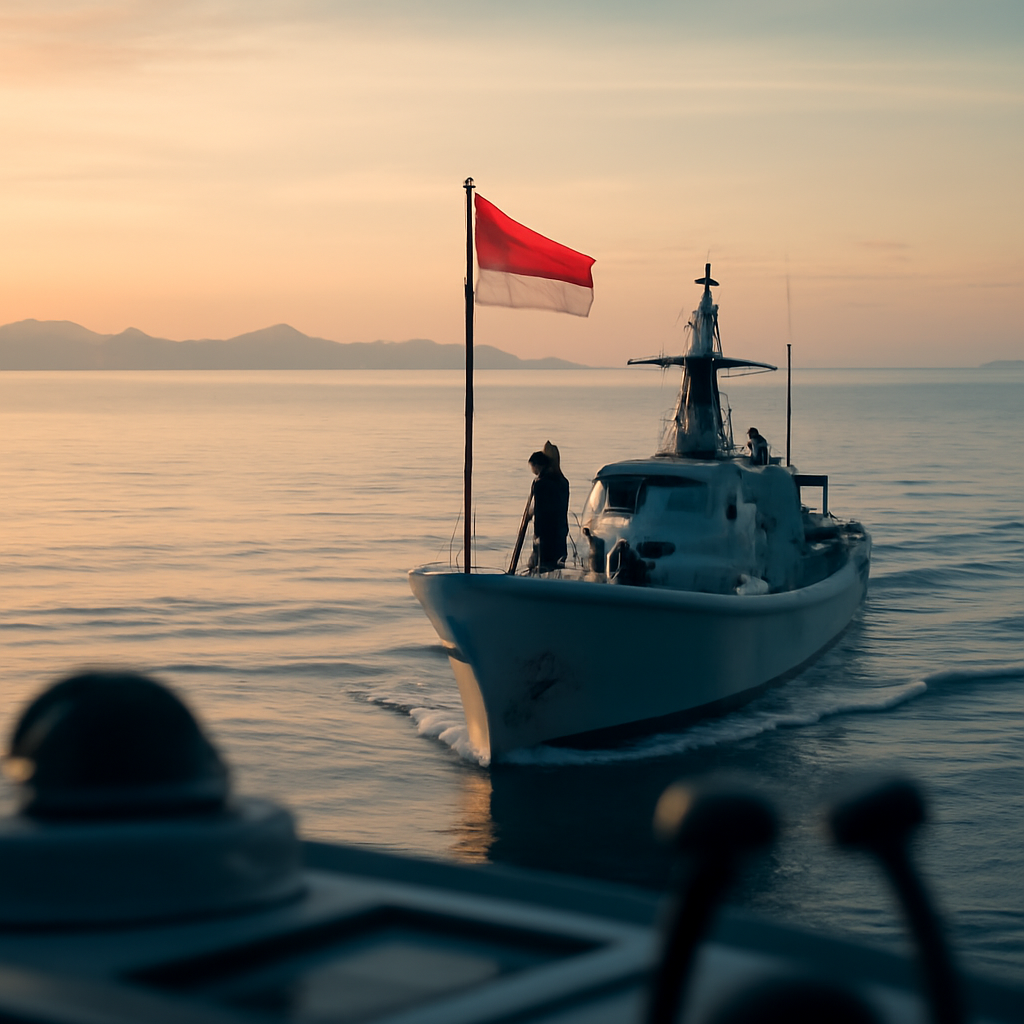
“With China posing a threat to Indonesia’s interests in the South China Sea,” the source begins — a sober line that frames a policy dilemma Jakarta has not settled. Recent moves — a controversial 2024 joint statement recognising overlapping claims in the North Natuna Sea and a 2026 joint naval passage exercise near Taiwan — show Indonesia negotiating at sea without, the source argues, a clear maritime cooperation strategy of its own.
The strategic problem under President Prabowo Subianto
Under President Prabowo Subianto, China has become “even more important as an international partner than before,” the source says, with economic opportunity dominating policy. At the same time, China’s actions in the South China Sea — notably its “illegal nine-dash line claim” that overlaps Indonesia’s exclusive economic zone — are described as one of Indonesia’s largest foreign security concerns. The source contends that previous maritime engagement with China suggests Jakarta “lacks such a strategy,” leaving it vulnerable to Beijing’s agenda.
Sugiono and Wang Yi: marine scientific research (August meeting)
In August, Indonesian Foreign Minister Sugiono met his Chinese counterpart Wang Yi in Jakarta and both agreed to “strengthen collaboration in marine scientific research.” The source recommends that Indonesia must not accept open-ended offers: Jakarta should “determine the specific research subject and the exact location” and ensure any agenda is of shared interest. The point is procedural and legal — maritime science in Indonesia’s exclusive economic zone must be conducted on the basis of mutual consent, not unilateral decision-making.

This site is the portfolio.
OSINTSights runs on Cloudflare Workers, D1, R2, and Vectorize, with an AI pipeline on Hetzner ARM. Nubivance designed, built, and operates it. We do the same for clients.
See what we buildHaiyang Dizhi 10, uncrewed craft and the Tuna Block
The source cites concrete incidents to underline the risk. The Chinese research vessel Haiyang Dizhi 10 “has operated in Indonesia’s exclusive economic zone near the Natuna Islands without Indonesian consent.” Unauthorised Chinese uncrewed underwater craft, bearing markings that label them as research vessels, are “increasingly found in Indonesian archipelagic waters.” Separately, China “often protests against Indonesia’s oil and gas exploration in the Tuna Block” and reportedly intrudes into that development area. These occurrences are used to argue that without clear boundaries for cooperation, routine activity can become contestation of sovereign rights.
Legal bounds: the United Nations Convention on the Law of the Sea and Indonesian law
The source is explicit about legal guardrails. Under the United Nations Convention on the Law of the Sea, coastal states “must consent to marine scientific research in their exclusive economic zone.” The recommendation follows: Indonesia should set limits such that all cooperation “is based on the convention and domestic law,” and it should refuse any proposal that contradicts either. The source insists that joint development proposals — for fisheries or oil and gas in the North Natuna Sea — “should be conducted under Indonesian investment law” and should not be treated as recognition of overlapping claims, because “China has no legitimate claim under the UN convention in the North Natuna Sea.”
Diversifying partners: Japan, India, Australia and ASEAN
To reduce dependence on China, the source urges Jakarta to “not cooperate with China only.” It recommends strengthening ties with middle-power partners — naming Japan, India, Australia and “some other ASEAN states.” Examples already in place include working with Australia on maritime technology and conducting joint naval exercises with India. The rationale is practical: if tensions with China escalate, a diversified set of partners will leave Indonesia with outside support for oil and gas exploration, marine scientific research, fisheries cooperation or joint military exercises.
What this means for the president, maritime agencies, and local fishermen
- The president and national government: must balance economic opportunity with legal and security constraints by setting a national agenda and clear limits before negotiating maritime commitments with China.
- Maritime and research agencies: should insist on written agreements that specify location, subject and legal framework for any marine scientific research and ensure consent under the United Nations Convention on the Law of the Sea and Indonesian domestic law.
- Fishermen around the Natuna Islands: remain at risk, the source warns, as China “threatens local Indonesian fishermen,” making clear the human and livelihood stakes tied to how Jakarta manages cooperation and contestation at sea.
The prescription is straightforward and repetitive by design: Jakarta must set the agenda, bind cooperation to domestic and international law, and diversify partners. Those three steps, the source concludes, “should always bound any commitment to maritime cooperation between Indonesia and China.” The practical question that follows from the facts presented is narrow and immediate: will Indonesia translate those steps into an operational strategy before the next Chinese vessel or proposal tests its limits?