“Polish armed forces and American armed forces have never been so close and so good and so deep as today,” Paweł Ksawery Zalewski told a U.S. audience last week — a declaration of alliance strength that sits beside a Pentagon report that, by omission as much as assertion, sketches a different set of priorities.
The Pentagon’s Sept. 22 report to Congress
The Defense Department’s update, dated Sept. 22 and released on Defense Department social media, tells Congress the administration has made “significant progress implementing the 2026 National Defense Strategy’s guidance.” It highlights efforts to accelerate weapons production, cut red tape, and persuade European governments to increase defense spending and contributions to continental defense plans. The report arrives one day before Defense Secretary Pete Hegseth’s scheduled “State of the Force” address at Marine Corps Base Quantico in Virginia; one person familiar with the matter said Hegseth is likely to discuss some of the update’s key themes.
Golden Dome for America (GDA) and counter‑drone integration
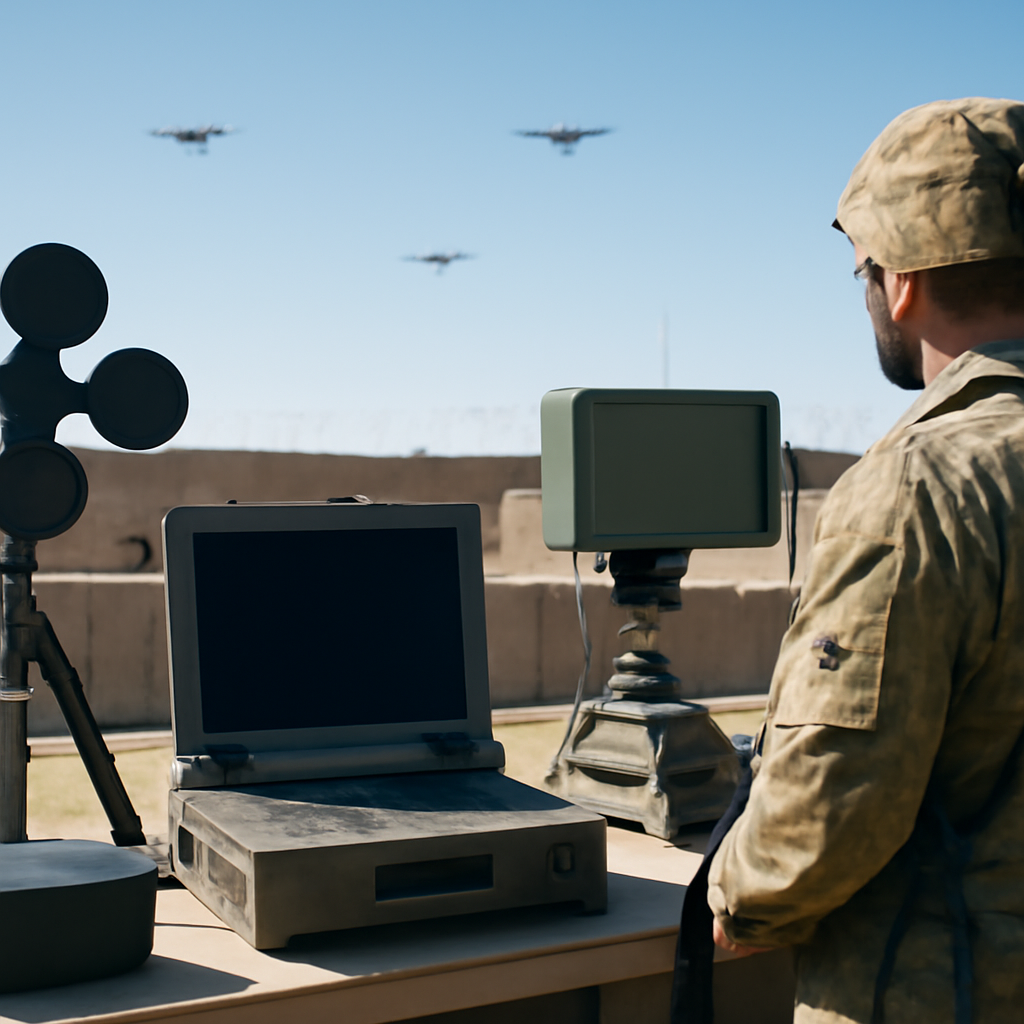
The update highlights work on the Golden Dome for America, or GDA, a continental-layer effort against drones and missiles. The report says the Department of the Air Force “has already conducted our first live-fire event, during which we successfully demonstrated key aspects of GDA command-and-control (C2) as well as integration of other key capabilities.” It also says the Pentagon has coordinated with the Federal Aviation Administration and the Federal Communications Commission to “ease the development and testing of counter-drone defenses” and created “a first-of-its-kind process for the rapid coordination and safe incorporation of next generation C-UAS technology” into the National Airspace System.

Audit-ready is a season. It shouldn't be.
Evidence in spreadsheets, controls drifting between audits, frameworks multiplying on flat headcount. Nubivance runs continuous compliance on Rapid7 Cyber GRC - SOC 2, HIPAA, ISO 27001, PCI, CMMC.
End the scrambleBudget request and munitions acceleration
The report points to a historically large budget request that, according to the document, includes funding for undersea forces, long-range air forces, long-range ground fires, and satellites for communication and intelligence. It singles out a $53 billion initiative “to accelerate the development of munitions,” framing procurement and production speed as central to the administration’s implementation of the 2026 National Defense Strategy.
Middle East operations, Iran, and the NDS’s stated aims
While the NDS sets replenishment of U.S. arsenals as a goal, the update does not mention assessments that Middle East operations have set back that goal. A May report from the Center for Strategic and International Studies warned that Operation Epic Fury and other Middle Eastern operations have delayed replenishment by “months and years.” The update also does not reiterate the NDS’s warning against “endless wars, regime change, and nation building,” phrasing the department instead to say it “anticipated that such a need [for strikes against Iran’s nuclear program] might be forthcoming.”
The NDS, the source notes, had said regional allies should deter Iran and had stated that further military action to prevent an Iranian nuclear weapon would be unnecessary after June 2025’s “Midnight Hammer” bombing. The new report’s language — that the department “anticipated” the possibility of strikes — signals a posture that accepts kinetic options as plausible even where the earlier NDS had suggested limits.
U.S. force posture in Europe and Russian actions
The update reports a reduction in manned brigade combat teams in Europe “from five to three, returning us to the level of BCTs in Europe in 2021.” That numerical change is presented without the broader context of escalating Russian activity that the report and, the source says, the NDS itself do not emphasize. The source frames that omission as significant: it points to Russian “hybrid and kinetic action against NATO members, military assistance to Iran, and intensifying the war on Ukraine” as areas the update does not foreground.
Commentators Max Bergmann and Otto Svendsen wrote on Sept. 24 for the Heinrich Böll Foundation that “a potential U.S. force posture reduction in Europe will leave the continent vulnerable to further Russian aggression.” The juxtaposition — enthusiastic alliance rhetoric, a reported drawdown to 2021 BCT levels, and outside warnings about vulnerability — is left unresolved in the update.
What this means for Polish defense leaders, U.S. military planners, and NATO defense leaders
- Polish defense leaders: Zalewski’s public praise of U.S.-Polish military ties underscores a continued commitment to bilateral cooperation even as the Pentagon documents a reduction in U.S. brigade combat teams in Europe.
- U.S. military planners: The report emphasizes accelerated munitions funding and production, and investment in continental C-UAS capabilities, signaling priorities for procurement and industrial mobilization while facing acknowledged setbacks to replenishment.
- NATO defense leaders: The update’s account of allied persuasion on defense spending and contributions is paired with an operational posture shift — from five to three manned BCTs — that outside analysts warn could alter deterrence calculations on the continent.
The Pentagon’s report paints a picture of progress: big budgets, new defensive technology pathways, and allied buy-in on spending. It also — by what it names and what it leaves in the background — reframes risk priorities, accepts kinetic options as plausible against Iran, and documents a return to a 2021 level of brigades in Europe while outside analysts warn of heightened vulnerability. Secretary Hegseth’s “State of the Force” address the day after the report’s release will be the next publicly scheduled forum in which the department lays out how those threads fit together.