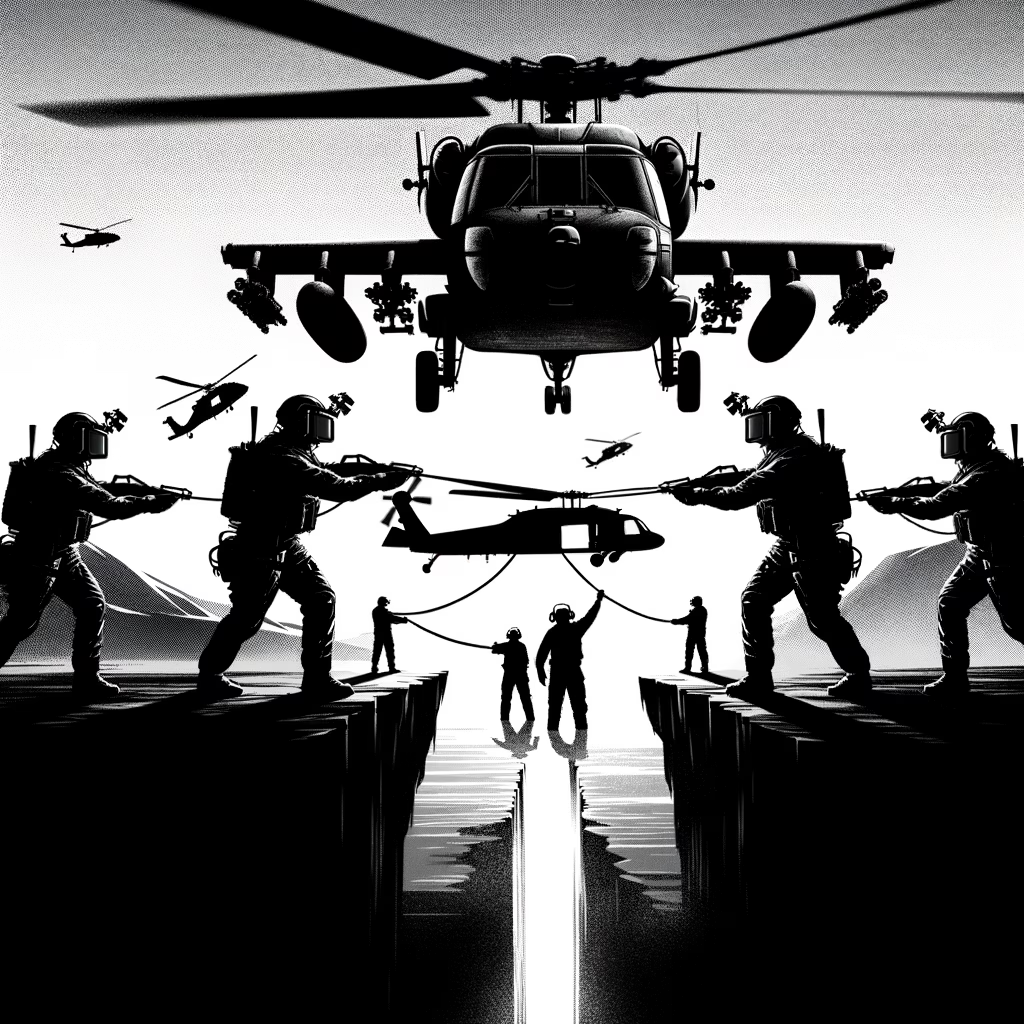
What happens when the pilot sees the threat but the crew doesn’t? In the cramped, noisy world of rotary‑wing operations — low, fast, and often under fire — that split second of unshared perception can be the difference between a coordinated response and catastrophe.
For decades, helicopters and tilt‑rotors have relied on radios, hand signals and a patchwork of displays to keep crews aligned. Today, a new answer is moving from concept to cockpit: helmet‑mounted displays (HMDs) that deliver a common, eyes‑out, real‑time operational picture to pilots, sensor operators and gunners. By fusing sensors, stabilizing imagery and presenting shared symbology, HMDs promise to collapse the communication delays that have long plagued rotary‑wing missions in contested low‑altitude environments .
Background: an old problem in a new battlespace
Rotary‑wing aircraft operate in the most unforgiving slice of the air domain. Terrain, wires, small arms and crowded landing zones combine with night operations and degraded visual environments to compress decision time. Historically, these platforms were designed for different threat environments; their information flows were voice‑centric and often asymmetric — what the pilot sees on the HUD or out the window may not be what the door gunner or crew chief sees on their sensor screens. That persistent “who sees what, and when” gap reduces speed of action and increases risk to aircrews and supported forces .
What HMDs bring to the crew
At their core, HMDs attempt to put the same tactical picture into every crewmember’s line of sight. Key capabilities include:
/ Synthetic or fused sensor overlays (EO/IR, SAR, mapped data) that present aligned maps and target cues.
/ Low‑latency, stabilized imagery so virtual symbology remains slaved to aircraft motion.
/ Shared symbology and cueing that reduce the need for repetitive radio calls and verbal confirmation.
/ Night‑vision integration and visuals tailored for degraded‑visual‑environment operations.
Fielding HMDs to rotary‑wing crews borrows from fighter helmet experience but faces unique engineering and operational hurdles: vibration and helmet stabilization, weight and neck strain over long sorties, expanding usable field of view without distortion, and ensuring latency is low enough that cues remain trustworthy during rapid maneuvers .
The current situation: technology, industry and DoD priorities
Recent advances have made HMDs far more practical for helicopters and tilt‑rotors. Microdisplay improvements, wider optics, lighter materials and better inertial tracking reduce historical constraints. Sensor fusion techniques now allow coherent contextual displays rather than raw, confusing data streams. Major suppliers — including Elbit Systems, Collins Aerospace, BAE Systems and Leonardo — are actively developing and integrating these subsystems for rotary platforms, indicating a maturing industrial base around the capability set .
From a policy and procurement angle, HMD adoption intersects with broader Department of Defense priorities: joint all‑domain operations, resilient and interoperable networks, and the ability to operate in GPS‑ or comms‑denied environments. Modular open architectures (MOSA) and common data‑link standards such as Link‑16 (and evolving waveforms) are critical if HMDs are to display timely, trusted feeds across services and allied partners; without standards, helmets risk becoming bespoke islands that cannot share a single tactical picture .
Operational benefits and real‑world effects
Users and program advocates point to several concrete gains:
/ Faster target acquisition and reduced target handoff time between crew members.
/ Lower verbal workload and fewer distracting radio exchanges, enabling pilots to maintain “eyes‑out” focus during demanding flight regimes.
/ Improved coordination for casualty evacuation, close air support and special operations where seconds matter.
These improvements tighten the OODA (observe‑orient‑decide‑act) loop and can materially improve survivability and mission success in contested lower‑tier airspace .
Challenges and tradeoffs
Despite the promise, HMD adoption carries significant challenges. Engineers and human‑factors specialists worry about helmet weight and long‑sortie fatigue, potential spatial disorientation if overlays are misaligned, and the difficulty of creating intuitive symbology that reduces — rather than increases — cognitive load. Integration into legacy cockpit ergonomics and mission systems is nontrivial: sensor feeds must be trusted, latency must be imperceptible, and data provenance must be clear to prevent miscueing in high‑stress situations .
There are also operational and security concerns. Networks that feed HMDs become high‑value targets for jamming, spoofing or cyber‑attack; adversaries with capable electronic‑warfare toolsets will try to exploit any dependency on external feeds. Policymakers must weigh the operational advantage of shared, eyes‑out displays against the risk of overreliance on potentially degraded data paths, and they must prioritize resilient local sensing, anti‑spoofing measures, and graceful degradation modes.
Perspectives
Technologists: Engineers see HMDs as an inevitable extension of sensor‑fusion trends. The technical path is clear — smaller, brighter microdisplays; better inertial stabilization; and open interfaces — but execution demands rigorous test and evaluation to prove reliability in rotorcraft‑specific environments .
Operational users: Pilots and crewmembers welcome any tool that reduces radio clutter and keeps more attention outside the aircraft, but they ask for simple, predictable interfaces and extensive training. Early operational trials will determine whether HMD symbology truly reduces workload or simply relocates complexity to the helmet.
Policymakers and acquisition leaders: They must balance the urgency of fielding improved situational awareness against the risk of stovepiped programs. Emphasizing MOSA, common data standards and coalition interoperability will reduce long‑term costs and mission friction; conversely, rushed or proprietary acquisitions risk creating fragmented capability pockets that don’t talk to one another .
Adversaries: From a strategic viewpoint, the same technologies that improve allied coordination can become targets. Electronic‑warfare measures that degrade data‑links or spoof sensor inputs could blunt HMD effectiveness; thus, defensive aids, sensor redundancy and doctrine for degraded operations are as important as the helmet hardware itself.
Why this matters
The lower tier of the air domain is becoming increasingly contested and demanding. In that environment, information superiority and the speed of shared understanding are decisive. HMDs are not a panacea, but they offer a practical, near‑term way to collapse the situational‑awareness gaps that have long hampered rotary‑wing crews. When every second counts, giving the pilot, sensor operator and gunner the same eyes‑out picture can convert disjointed actions into coordinated ones — and that can save lives and accomplish missions.
Conclusion
Helmet‑mounted displays for rotary‑wing aircraft stand at the intersection of technology, doctrine and procurement. They promise a simple idea with profound implications: put the same tactical picture into every crewmember’s line of sight and shorten the cycle from perception to action. But achieving that promise requires careful engineering, interoperable standards, robust training and planning for contested communications. As the DoD prepares for more demanding lower‑tier air operations, the question is not whether to pursue HMDs, but how to field them in a way that is resilient, interoperable and trusted — because the next conflict will judge systems not only by their capabilities, but by how well crews can rely on them under fire. Who will be ready when the lights go out?
Source: https://modernbattlespace.com/2025/01/28/hmd-for-rotary-wing-bridging-the-situational-awareness-gap-between-pilots-and-their-crew/



