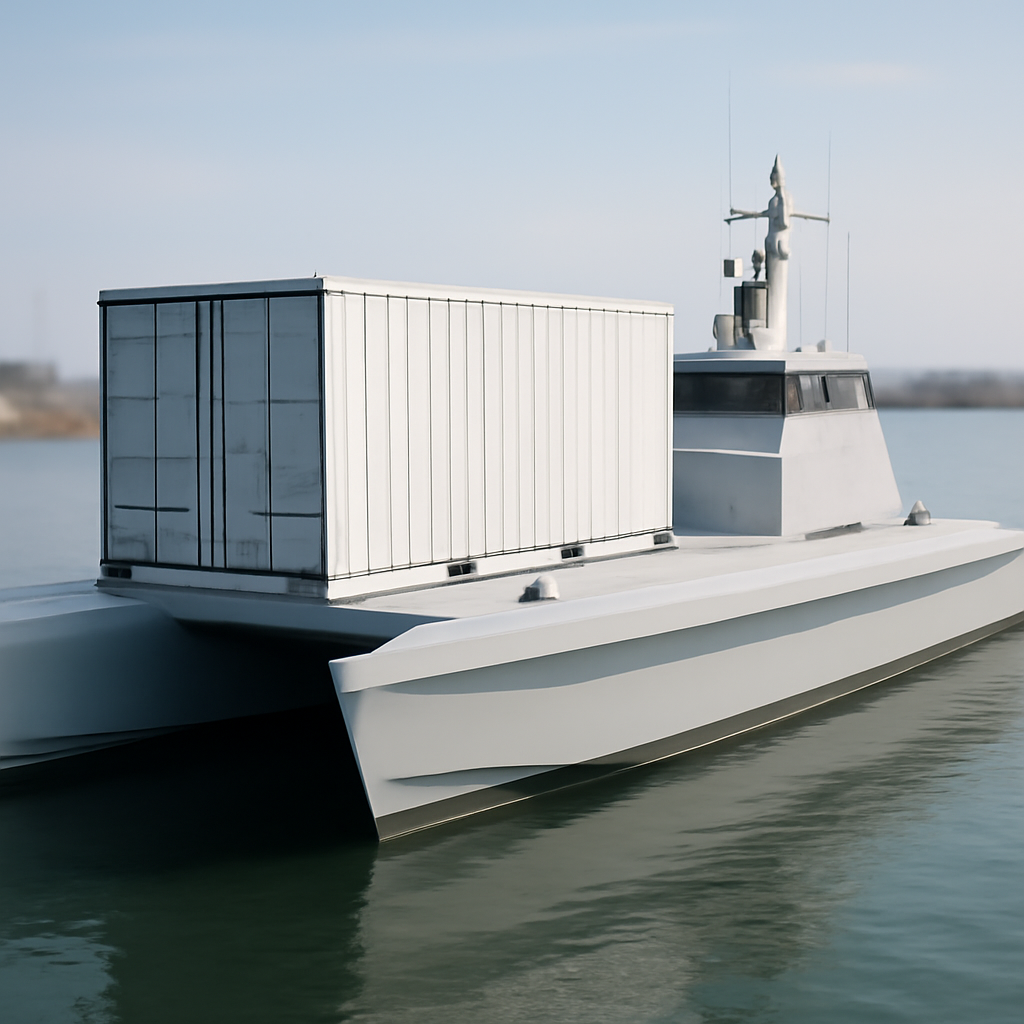
22.5 metres in length and built to carry a single 40 ft shipping container, ARES Shipyard’s newly filed catamaran unmanned surface vessel (USV) design would be a notable step up from the company’s existing 11‑metre ULAQ family.
Design and key specifications revealed in the Türk Patent filing
The registered design describes a catamaran hull with a flatbed section large enough to accommodate a standard 40 ft container. At 22.5 metres overall, the boat is substantially larger than ARES’s monohull ULAQ series, leaving “a generous amount of free space on the vessel’s flatbed section” relative to its length. The filing remains a patent submission; no production timeline or customer is disclosed.
Containerisation as a tactical and logistical multiplier
The explicit ability to carry a 40 ft container was highlighted in the filing as enabling modular mission fits. That containerised approach makes the design viable for routine logistics support missions, and — by the same token — allows for the possibility of embarking containerised weaponry so an operator could “swap mission payloads by container rather than rebuilding the boat.” The extra deck area could also accommodate larger unmanned underwater vehicles (UUVs) or more capable electronic warfare (EW) systems than smaller ARES vessels can host, opening roles such as anti‑submarine warfare (ASW) or enhanced EW deployment.

Audit-ready is a season. It shouldn't be.
Evidence in spreadsheets, controls drifting between audits, frameworks multiplying on flat headcount. Nubivance runs continuous compliance on Rapid7 Cyber GRC - SOC 2, HIPAA, ISO 27001, PCI, CMMC.
End the scrambleARES Shipyard’s existing USV record and industrial capacity
ARES is not new to catamarans or to unmanned vessels. The shipyard previously produced the ARES 17 CF catamaran and developed the ULAQ family jointly with Meteksan Defence — Turkey’s first armed USV — which carries Roketsan’s Cirit and L‑UMTAS guided munitions and completed its first live‑fire test in May 2021. ARES’s recent unmanned work includes the Tufan kamikaze vessel, co‑developed with ASELSAN, which supplies software, sensors, and electronics for that design.
ARES’s production facility occupies roughly 40,000 square metres and can accommodate vessels up to 90 metres in length, underscoring industrial capacity to build larger platforms if the design moves beyond patent stage. The catamaran filing, however, remains at the design stage for now.
Tufan selection and the wider procurement context in Türkiye
In February 2026, Türkiye selected Tufan as one of three designs for the Turkish Navy’s 100‑unit expendable USV programme, a decision taken by Türkiye’s Defence Industry Executive Committee. The order splits production across three teams to maintain parallel supply chains, and the ASELSAN–ARES team was allocated 40 of the 100 vessels. Unveiled at SAHA 2026, the roughly 8‑metre Tufan carries about 227 kg of explosive — a warhead mass the filing notes is comparable to a Mk 82 bomb — and is intended for autonomous swarm‑strike operations against maritime and coastal targets.
Export footprint and regional partnerships
ARES has been active in export markets and regional ventures. Two European navies previously showed interest in the ULAQ system; ARES has promoted the family at exhibitions including DIMDEX in Doha. The shipyard has delivered patrol craft to Oman’s coast guard and, in 2022, three fast interceptor craft to Qatar. Earlier this year ARES established a joint shipbuilding venture in Saudi Arabia — ARES Naval — with Satel Al‑Arabiya, and signed a memorandum with the Saudi Ministry of Industry covering yards at Dammam and Jeddah. These existing relationships frame potential buyers and industrial partners should the container‑rated catamaran proceed to production.
How the Turkish Navy, European navies, and Gulf partners might view the filing
- Turkish Navy: With the Navy already fielding a range of ARES‑linked designs in the Tufan selection, a container‑capable catamaran would provide flexible logistics and mission modularity that could complement expendable swarming assets and larger manned platforms.
- European navies: Having previously shown interest in ULAQ, two unnamed European navies may find a larger, containerised USV attractive where modular payloads, UUV support or increased EW/ASW capability are operational priorities.
- Gulf partners and Saudi venture: Existing deliveries to Oman and Qatar, plus the ARES Naval joint venture and memoranda in Saudi Arabia, give Gulf governments and shipyards an established commercial and industrial channel to evaluate a larger ARES USV for patrol, logistics or specialised roles.
For now, the 40 ft container‑rated catamaran exists as a patent filing that signals ARES’s interest in scaling up and modularising its uncrewed portfolio. The design connects logically to the shipyard’s recent USV work — particularly the ASELSAN‑backed Tufan and the export‑oriented ULAQ family — but whether the concept advances from design to production, and who might buy it, remains unanswered by the filing itself.