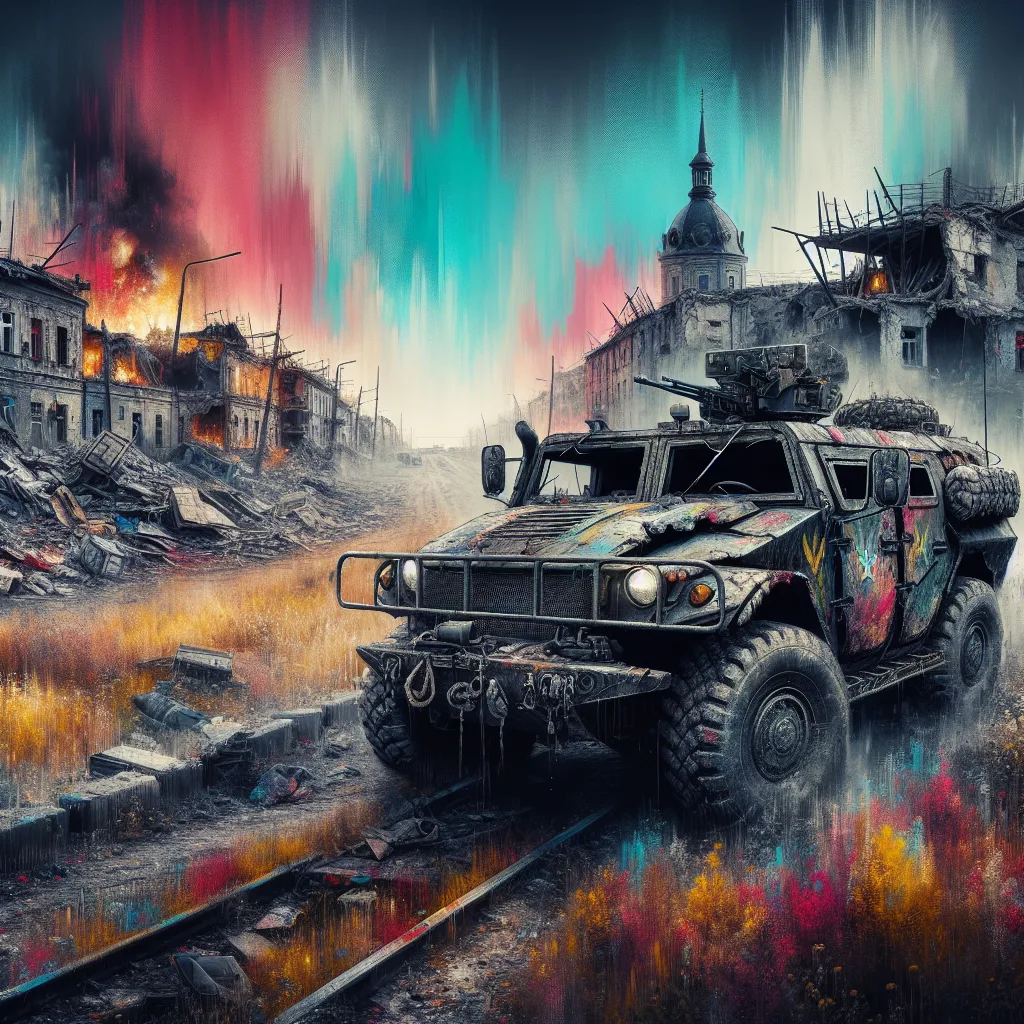
Battle-Tested Resilience: A Damaged MaxxPro Emerges From Ambush in Ukraine
In the convulsive theatre near Kupiansk, Ukraine, a heavily damaged M1224 MaxxPro armored vehicle has emerged from an ambush, its battered form a striking reminder of both modern warfare’s brutal realities and the ingenuity of its operators. Ukraine’s Defense Intelligence Directorate (GUR) recently released rare video footage depicting the dramatic recovery of this disablement—an incident that raises critical questions about the balance between technological fortitude and tactical adaptability on today’s battlefields.
During a high-stakes operation, the MaxxPro was tasked with transporting personnel from Ukraine’s “Timur” special operations unit when it fell victim to Russian fire. Despite the indiscriminate barrage, the vehicle’s robust armored capsule performed as designed, limiting casualties and keeping its crew relatively protected amid the chaos. Ukrainian military authorities have highlighted this recovery as not just a tactical success, but also as evidence of the vehicle’s advanced engineering—a design philosophy that champions survivability under fire.
Developed by Oshkosh Defense, the M1224 MaxxPro has long been recognized for its mine-resistant, ambush-protected features. Its design reflects decades of innovation aimed at mitigating the ever-present threats on modern battlefields, particularly those involving explosive devices and direct anti-armor fire. The recent incident near Kupiansk lends real-world context to these design ideals, demonstrating that even under severe operational conditions, the principles of modularity and survivability can make a profound difference.
The released footage, first detailed by Defence Blog, captures a moment of intense vulnerability sparking into strategic recalibration. When the MaxxPro was severely incapacitated by enemy fire, rapid on-ground tactics allowed its extraction from an active combat zone. This recovery not only salvaged a critical asset but also provided a visual lesson in the critical balance between high-technology solutions and the on-the-ground improvisational capacities of soldiers.
Why does this matter? Beyond the immediate tactical significance, the incident underscores a broader strategic narrative. Each recovery operation in the heat of combat serves as a microcosm of the evolving doctrines governing modern warfare. It demonstrates that even state-of-the-art technology is subject to the unpredictable whims of battle—where every hit, every maneuver, carries the weight of national security and the lives of those on the front lines.
Defense analysts note that while the recovery operation highlights commendable resilience and tactical flexibility, it also raises important questions about the vulnerabilities inherent in current armored vehicle designs. The incident reinforces a dual insight: first, that advanced armored technology can afford critical protection when it matters most; and second, that combat environments demand a continual re-evaluation of equipment and tactics in response to an adversary’s evolving strategies. This ebb and flow of technological innovation and battlefield adaptation is well-documented in military studies, where experts stress the importance of real-time lessons learned.
Looking ahead, the recovery of this MaxxPro could influence strategic discussions among defense planners both in Ukraine and among its international partners. The incident serves as a timely case study on the practical challenges of modern combat, potentially informing future modifications in vehicle design, operational protocols, and recovery tactics. As policymakers and military engineers review current practices, the resilience demonstrated here might lead to enhanced training programs and investments in vehicle survivability systems, ensuring that the lessons from Kupiansk are not lost amid the din of ongoing conflict.
At its core, the story of the damaged and recovered MaxxPro is deeply human. It is a narrative about soldiers and strategists who, even when faced with unexpected adversity, cling to the fundamental imperative of preserving life while sustaining operational momentum. In war, as much as in peace, every decision is fraught with risk, and every recovered asset speaks to the valor and resourcefulness of those who risk everything on the frontline.
As observers and analysts continue to track the unfolding events in Ukraine, this incident serves as an enduring symbol of how modern conflict compels continuous evolution—both in the technology that protects and in the minds that command it. It is a reminder that, in every flashpoint of adversity, innovation and human resolve converge, asking us all: When every element of modern warfare is tested to its limits, what ultimately determines whether one prevails?



