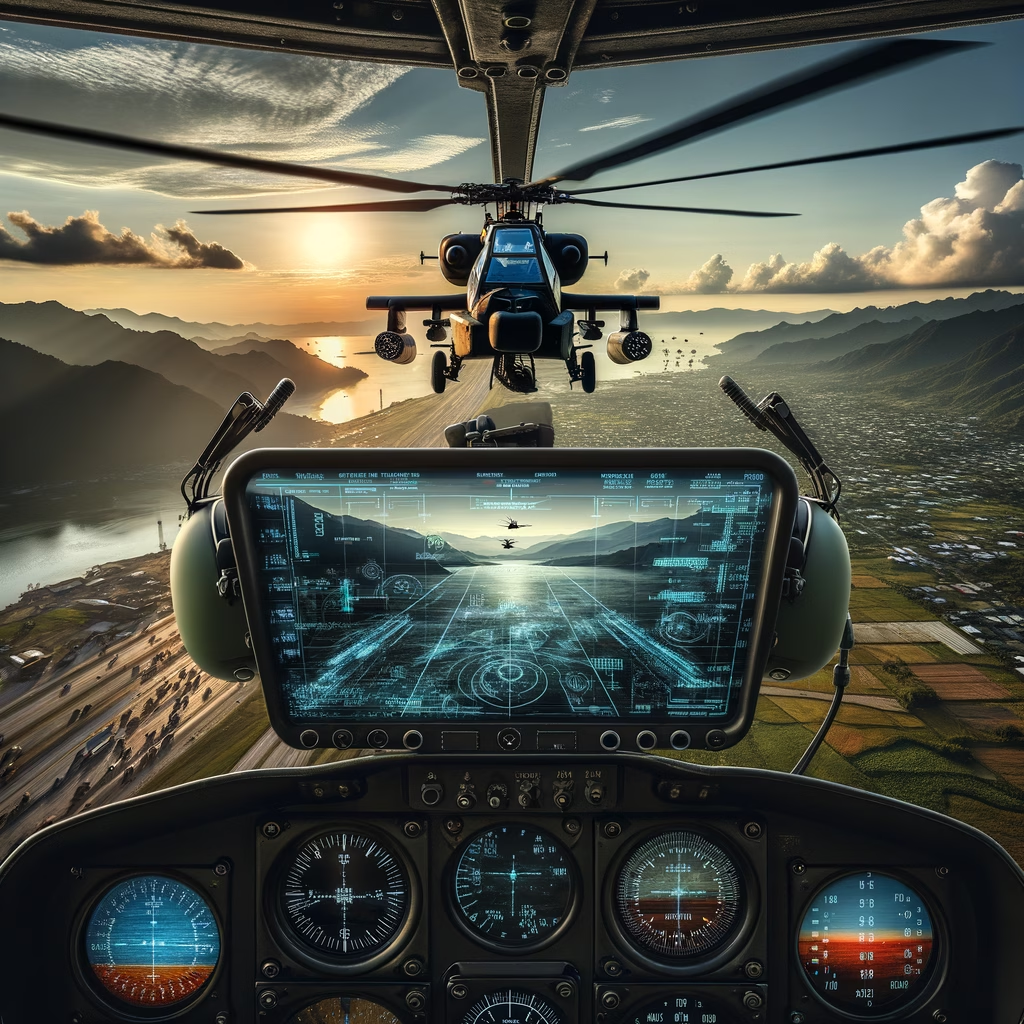
What happens when the pilot sees the threat but the crew does not? For rotary-wing aviators operating at low altitudes against peer and near-peer adversaries, that gap between perception and shared understanding can be the difference between mission success and catastrophe.
The Department of Defense is gearing up for a futurescape where the lower tier of the air domain—where helicopters and tilt-rotors operate—is increasingly contested. Anti-access/area-denial systems, pervasive sensors, electronic warfare, and layered ground threats force aircraft to operate faster, lower, and with far less margin for error. In that environment, head-mounted displays (HMDs) are fast emerging as a practical countermeasure to the rotary-wing situational-awareness gap between pilots and their crews.
HMDs are not new to aviation. Fighter programs such as the F-35 have long relied on immersive helmet systems to put sensor data and targeting cues directly into the pilot’s line of sight. Translating that capability to rotary-wing platforms, however, presents unique technical and operational challenges. Vibration, helmet weight, night-vision compatibility, cockpit ergonomics, and the need to fuse disparate sensor feeds into an intuitive, low-latency display complicate implementation for helicopters and tilt-rotors.
Why does this matter? Rotary-wing crews increasingly rely on collaboration: pilots fly, sensor operators hunt, and scouts communicate. When those roles inhabit different physical positions in a noisy, cramped cockpit, the cadence of radio calls and hand signals can introduce critical delays. HMDs promise to collapse those delays by delivering a common operating picture directly to each crewmember’s eyes—shared symbology, cueing for threats and targets, and aligned maps and overlays that reduce the need for verbal confirmation.
Technologists point to several enabling trends. Advances in microdisplays, wider field-of-view optics, helmet stabilization and inertial tracking, and lighter materials have reduced many historical barriers. Improvements in sensor fusion—where electro-optical/infrared (EO/IR), synthetic aperture radar (SAR), and data-link feeds are combined—allow HMDs to present coherent, contextual information rather than a confusing stream of raw sensor data. Industry participants such as Elbit Systems, Collins Aerospace, BAE Systems, and Leonardo are actively developing and integrating these subsystems for rotary platforms.
From a policy and procurement standpoint, HMD adoption intersects with larger DoD priorities: joint all-domain operations, resilient networks, and fight-through capabilities in GPS- or comms-denied environments. Modular, open architectures (MOSA) and common standards for data links—including Link-16 and emerging waveforms—are crucial if HMDs are to receive timely, trusted feeds across services and allied partners. The DoD’s push toward interoperable systems aims to avoid a patchwork of bespoke helmets that can’t exchange the same tactical picture.
Operational users—pilots, sensor operators, and crew chiefs—see both promise and peril. Benefits include faster target acquisition, reduced verbal workload, improved night and degraded-visual-condition operations, and enhanced casualty evacuation coordination. Yet human factors experts caution that poorly designed displays can overload crews, induce spatial disorientation, or distract from outside visual scanning. Certification and flight-qual testing remain essential to ensure that added symbology does not create new hazards.
There are also hard technical constraints unique to rotary-wing missions. Helicopters operate at lower speeds and altitudes, with more airframe vibration and frequent head movement among crew members. Tilt-rotors such as the V-22 Osprey present their own aerodynamic and cockpit challenges. Ensuring image stability, minimizing latency between sensor capture and helmet display, and maintaining reliable alignment between what is seen in the helmet and external reality are nontrivial engineering tasks.
Security is another front-line concern. Any system that consolidates sensor data and navigation cues becomes a lucrative target for cyber and electronic attack. Jamming, spoofing, and data falsification could not only blind a crew but mislead them. Hardened data links, anti-spoofing navigation, and resilient sensor fusion that can continue to provide credible cues when one input is compromised are necessary design features.
Adversaries are not blind to the implications. Near-peer competitors have invested heavily in sensor grids, ground-based air defenses, and EW capabilities that specifically target rotary-wing vulnerabilities. As a result, the tactical advantage conferred by an HMD depends on the survivability of the underlying network and sensors. In contested environments, crews will need adaptive modes that degrade gracefully—prioritizing the most reliable cues and minimizing false positives.
Cost and logistics raise practical questions for policymakers. Helmet systems that integrate cutting-edge optics, inertial measurement units, and secure processing are expensive, and retrofitting older airframes can be complex. Training pipelines must incorporate helmet usage from the outset; simulations and live-fly training must teach crews how to prioritize helmet symbology and maintain visual scan discipline. Acquisition programs must balance fielding new kits with sustainment budgets and lifecycle upgrades.
Despite the complications, field exercises and experimentation point to measurable operational gains. When sensor operators and pilots share a common visual reference, target handoffs accelerate, miscommunication declines, and mission tempo increases—advantages that translate directly to survivability in dense threat environments. Integration of HMDs with digital mapping, blue-force tracking, and battlefield management systems enhances coordination with ground forces and unmanned assets.
Looking ahead, several priorities will determine whether HMDs truly bridge the rotary-wing situational-awareness gap or remain a niche augmentation. First, human-centered design and rigorous flight testing must establish safe, intuitive displays that reduce cognitive load. Second, resilient architectures and hardened communications are essential so helmets can be trusted in contested space. Third, doctrinal and training changes must embed helmet-centric workflows into how crews are taught to sense and act.
For strategists and commanders, the question is how to align investment with doctrine. An HMD is not merely a piece of hardware; it is a force-multiplying interface that can change tactics, techniques, and procedures. That requires integrated procurement, cross-domain training, and acceptance that information advantage is now as critical as kinetic firepower.
In an era where the margin between seeing and understanding can be measured in seconds, head-mounted displays offer a pragmatic route to narrowing the rotary-wing awareness gap. But the technology is only part of the solution—engineering, doctrine, training, and cyber resilience must converge if crews are to realize the full benefit. Otherwise, the very systems meant to clarify the battlespace could add new layers of risk.
Is it enough to put the tactical picture into every crewmember’s eyes, or will the next flight instead reveal that human judgment and disciplined communication remain the most reliable instruments of survival?
Source: https://modernbattlespace.com/2025/01/28/hmd-for-rotary-wing-bridging-the-situational-awareness-gap-between-pilots-and-their-crew/