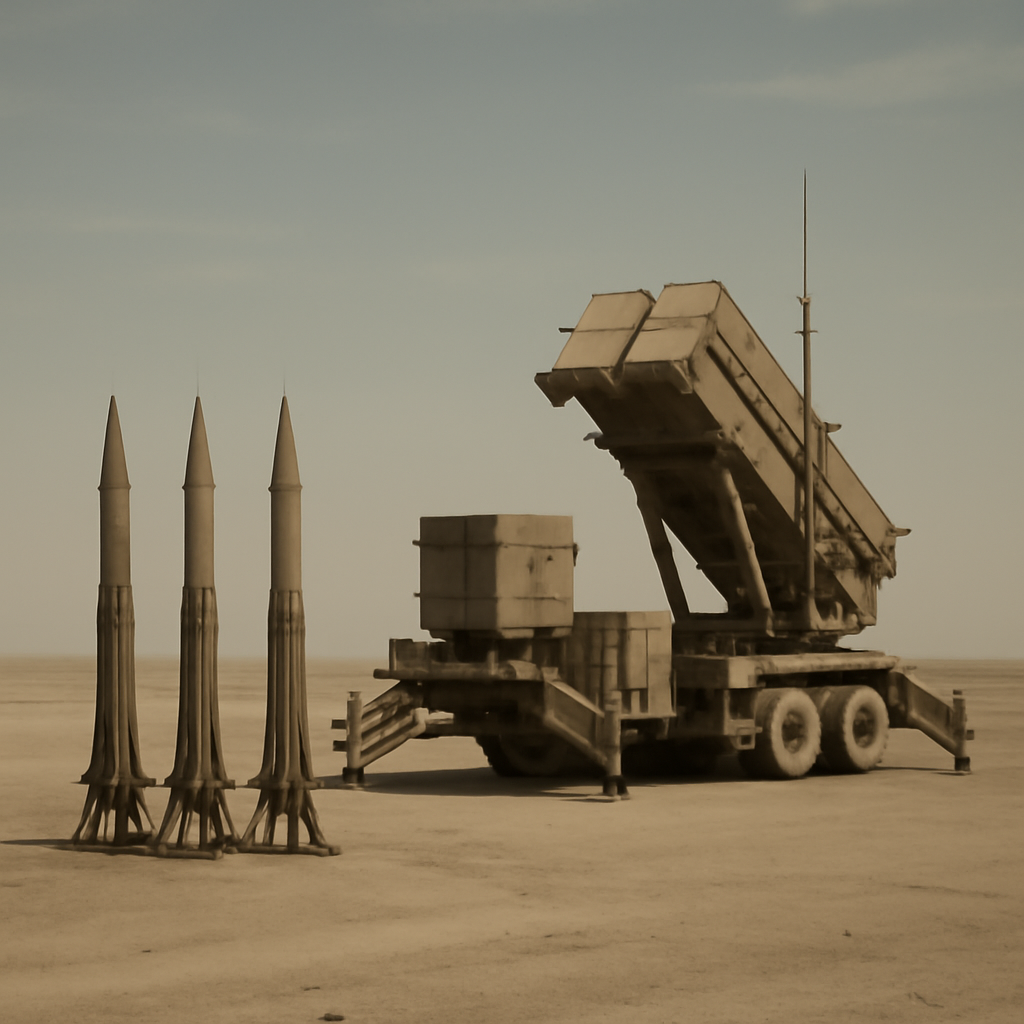
"We don’t have enough munitions to sustain a long-term fight," warned Tom Cole, an Oklahoma Republican who chairs the US House of Representatives’ Appropriations Committee.
US Patriot and Thaad inventories: numbers, usage, and remaining stocks
Before the first US and Israeli strikes on Iran in February, the Pentagon's inventory included roughly 360 missiles for THAAD batteries and about 2,300 missiles for Patriot batteries, according to the Center for Strategic and International Studies in Washington. In the six months of intermittent fighting that followed, US forces fired as many as 290 THAAD interceptors and as many as 1,430 Patriot interceptors. By that arithmetic the United States could be left with roughly 70 THAAD rounds and about 870 Patriot rounds—levels the source describes as far too low to protect US and allied bases in a major conflict.
Patriot, Thaad and Aster: performance envelopes and per-round cost
The source stresses that heavy interceptors are the only munitions with the ability to engage ballistic missiles effectively. The Patriot’s latest PAC-3 interceptor is a radar-guided round that can intercept ballistic targets at altitudes around 50 km; a PAC-3 costs about US$4 million per round. THAAD’s infrared-guided interceptor reaches significantly higher—around 150 km—and costs roughly US$12 million per round. Europe’s SAMP/T system uses Aster missiles that can engage ballistic targets up to about 25 km and cost near US$3 million per round.

Audit-ready is a season. It shouldn't be.
Evidence in spreadsheets, controls drifting between audits, frameworks multiplying on flat headcount. Nubivance runs continuous compliance on Rapid7 Cyber GRC - SOC 2, HIPAA, ISO 27001, PCI, CMMC.
End the scrambleIndustrial constraints: ramp-up timelines and supplier commitments
To restore depleted stocks the Pentagon is contracting Lockheed Martin and Raytheon to increase THAAD and Patriot production, respectively, and is paying tens of billions of dollars to do so. But the ramp-up is not quick: a Patriot missile takes about 42 months to produce and a THAAD missile about 53 months. The result is a long period during which US allies that rely on American-made interceptors will face constrained access to fresh rounds.
Ukraine’s Freya initiative and the FP-7.x interceptor
Faced with depleted Western stocks and frequent ballistic attacks, Ukraine has moved to develop a mostly domestic anti-ballistic capability under the Freya initiative. Kyiv munitions maker Fire Point announced an FP-7.x interceptor in July 2026. The program adds an infrared seeker supplied by German firm Diehl to Fire Point’s FP-7 surface-to-surface rocket, converting it into an interceptor. Fire Point said it aims to test the FP-7.x against a ballistic target by July 2027 and acknowledged the timetable is compressed—"trying to squeeze a program that usually takes 20 to 30 years into a framework of a few years," Fire Point chief executive Iryna Terekh said.
The source is candid about the technical challenge: "Hitting a missile with a missile is one of the more demanding missions in modern warfare." Fire Point can draw on Ukrainian industry experience with Soviet-era rockets; the FP-7.x appears to derive from missiles associated with the old Soviet S-300 system. The program’s success will hinge in part on the quality, price and supply of the German seekers. Fire Point has claimed a per-round price of about US$700,000—far below Patriot or THAAD costs—and the source notes this price point could enable large buys if the interceptor proves effective.
Allied exposure and the need for multinational alternatives
The shortage is framed as global because the United States supplied most of the West’s heavy interceptors. The piece warns that, while the United States replenishes stocks over years, allied users of Patriot and THAAD could go without fresh rounds. The immediate implications are visible in Ukraine: its roughly half-dozen donated Patriot batteries and two Franco–Italian SAMP/T batteries are running low, leaving cities and critical infrastructure vulnerable to bombardment.
The source names regions that would be affected if no alternatives appear: Taiwan, Japan, the Philippines and Australia facing Chinese missiles; Gulf States facing Iranian missiles; and Europe facing Russian missiles. Eurosam, the Franco–Italian venture behind Aster, is not rapidly expanding output; France has licensed Ukraine to produce Aster missiles, but "Kyiv’s priorities seem to lie elsewhere," the source says. The author argues that, given these constraints, the solution must be multinational: additional joint programs—an Asian missile-defence initiative, a Gulf initiative, and another European initiative alongside Freya—are urged so partners need not rely solely on US inventory replenishment.
The arithmetic is stark: expensive interceptors, long production lead times, and heavy firing in current conflict have combined to break the American missile shield for a period measured in years. The practical question the source leaves on the table is simple and urgent—who will defend allied skies in the meantime, and how quickly can multinational alternatives be brought online?