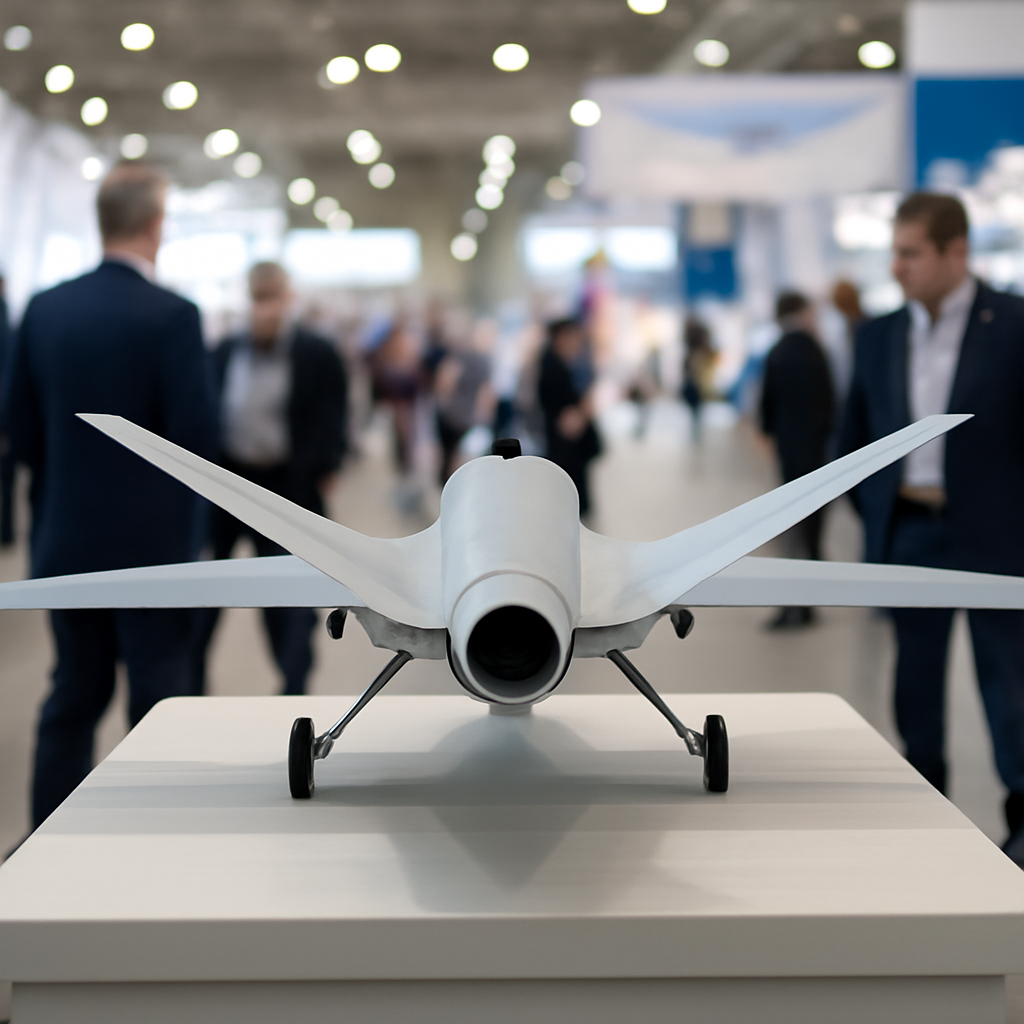
"We're really excited to kind of really up our stats on range and speed," Craig Anders, an AEVEX representative, told TWZ at AUSA, describing the Specter’s turbine engine.
AEVEX unveils Specter at AUSA in Washington, D.C.
AEVEX Corp. publicly displayed its Specter jet-powered drone for the first time at the Association of the U.S. Army’s annual meeting in Washington, D.C. The company, which built the Phoenix Ghost family that was rushed to Ukraine in 2022, announced Specter in September as a high-speed, low-cost, jet-powered autonomous platform designed for high-risk operational environments.
Airframe, observability and modular payload architecture
The Specter’s external configuration includes a V-shaped lower fuselage, high-mounted unswept trapezoidal wings, a v-tail and rear-mounted conformal engine intakes — features the company says reflect design choices that balance survivability with production economy. AEVEX has described the aircraft around a modular architecture: an interchangeable nose section is intended to accommodate different payloads, including kinetic warheads, electronic warfare equipment, intelligence, surveillance and reconnaissance (ISR) systems and other future capabilities. The company has said the platform is designed to be adaptable rather than optimized for one fixed mission, and has called it a "multi-mission, multi-domain fighter."

This site is the portfolio.
OSINTSights runs on Cloudflare Workers, D1, R2, and Vectorize, with an AI pipeline on Hetzner ARM. Nubivance designed, built, and operates it. We do the same for clients.
See what we buildAttritable concept: between cruise missile and high-end unmanned combat aircraft
AEVEX positions Specter in a middle ground. The company frames the aircraft as attritable — intended to have a relatively low price tag so commanders can send it into dangerous areas without risking higher-cost platforms — while also offering mission flexibility beyond a single-use munition. Anders said the aircraft will be able to carry cameras and "different types of non-kinetic effect payloads." At the same time, AEVEX has not presented Specter as a high-end, reusable unmanned combat aircraft nor solely as a disposable munition.
Manufacturing approach: Divergent and Digital Manufacturing and Production System (DAPS)
AEVEX is developing Specter with Divergent, an engineering and manufacturing company the source describes as known for digital production processes and metal additive manufacturing. Anders said Divergent works with AEVEX engineers on the aircraft’s digital design and produces its fuselage. AEVEX said Divergent’s Digital Manufacturing and Production System (DAPS) is being used to support scalable production and manufacturability — a central element of the company’s affordability ambitions. Neither company has disclosed a projected unit cost or demonstrated production volumes or price points for the concept.
Planned testing, launch modes and autonomy
Specter remains in development, with its first flight planned for December 2026. Anders said the initial flight will be a basic test using early test aircraft fitted with landing gear so they can be recovered and reused to refine flight characteristics and handling; the company has not said whether a reusable, gear-equipped operational version is intended. The planned initial configuration uses a ground launch assisted by a rocket-assisted takeoff (RATO) system; an air-launched variant is on the roadmap and is expected to follow in the relatively near term. AEVEX is drawing on its CompassX autonomy architecture and says the platform’s open interfaces and software-defined capabilities are intended to let Specter evolve as operational requirements change. The company has not publicly disclosed several key technical details, including range, payload capacity, communications architecture, terminal targeting methods or the extent of its autonomous capabilities.
Family of Affordable Mass Missiles (FAMM), Rapid Dragon and near-term applications
Anders identified the U.S. Army’s Family of Affordable Mass Missiles (FAMM) effort as a primary focus for Specter and mentioned opportunities associated with Rapid Dragon and other programs. The source notes the U.S. Air Force requested funds in FY2027 for FAMM — $55 million in discretionary and $300 million in mandatory reconciliation funds to procure 1,000 All Up Rounds covering both the Palletized (FAMM-P) and Lugged (FAMM-L) variants — figures AEVEX cited when discussing potential markets. Those comments indicate where AEVEX hopes Specter could fit, while the company has not said the aircraft has been selected for any of those programs.
What this means for the U.S. Army, the U.S. Air Force, and defense manufacturers
- The U.S. Army: The Army’s FAMM effort is an explicit focus for AEVEX; the service’s requirements for high-speed, scalable strike options will be a practical test of whether Specter can meet operational thresholds while staying attritable.
- The U.S. Air Force: The FY2027 request cited in the reporting shows funding intent for mass-missile procurement; the Air Force’s procurement choices and how they prioritize palletized or lugged rounds will shape potential opportunities for air-launched or palletized variants of Specter.
- Defense manufacturers and production partners: Divergent’s DAPS and digital-production processes are central to AEVEX’s pitch; manufacturers will be watching whether the partnership can translate digital design and metal additive manufacturing into demonstrable unit costs and sustained production rates.
AEVEX has taken a visible step by showing Specter at AUSA and setting a December 2026 flight milestone. The program’s next test flights and any publication of performance, cost and production data will determine whether the company can deliver the speed, range and modularity it promises without pushing the platform beyond the "attritable" price points it needs to be fielded at scale. The Specter concept — jet propulsion, modular payloads and a production approach tied to digital manufacturing — is explicit; whether it becomes a practical bridge between cruise missiles and higher-end autonomous aircraft depends on those pending demonstrations.