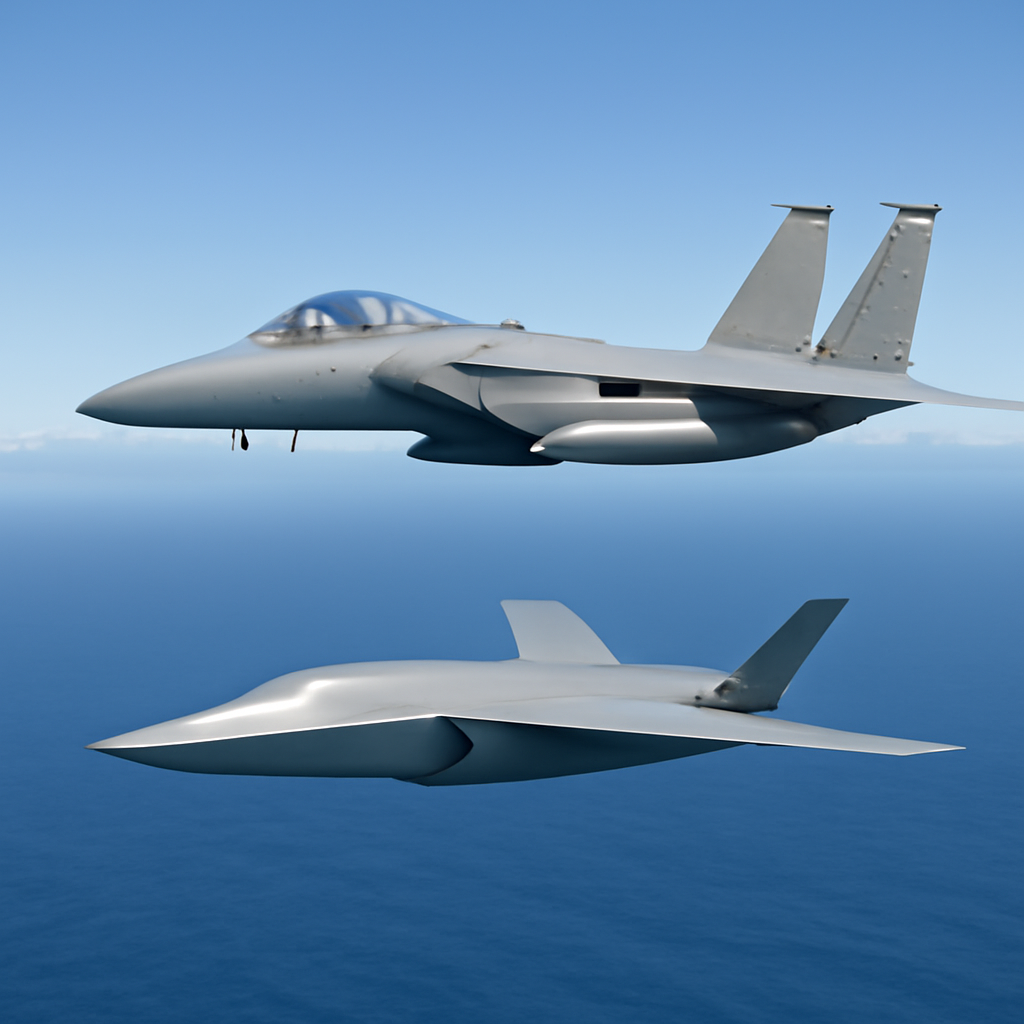
The photographs, published on PACAF’s official Facebook page, are the clearest public glimpse yet of a crewed F-15EX and an MQ-28 operating together in a large, multinational Indo-Pacific exercise. PACAF framed the images as demonstrating “the future of human-machine teaming in the theater,” but the published material does not specify whether the aircraft were linked by live command-and-control, autonomous teaming software, or simply flying in formation for imagery.
PACAF’s images and the Valiant Shield setting
PACAF released photos taken over the Philippine Sea during Valiant Shield 26, the U.S.-led exercise spanning the Indo-Pacific region. Separate Air Force imagery published during the exercise shows the MQ-28 performing a flyover during Valiant Shield 2026 over Rota, Commonwealth of the Northern Mariana Islands, on June 25, 2026, and pictures of a proof-of-concept Forward Arming and Refueling Point (FARP) operation at Rota dated June 28, 2026. That FARP imagery included an MQ-28 alongside Air Force HC-130J Combat King II and HH-60W Jolly Green II aircraft, members of the Royal Australian Air Force (RAAF), and the Nellis-based Experimental Operations Unit.
F-15EX as a potential drone controller
The pairing in imagery follows long-standing concept work that positions the F-15EX Eagle II as a likely platform to command Collaborative Combat Aircraft (CCA). Boeing concept art has regularly pictured the F-15 working with MQ-28s; the company has described the F-15EX’s “two-seat configuration” and advanced cockpit systems as enabling roles such as battle management and joint all-domain command and control.
Aircrew quoted in the source material describe concrete attributes that support that role. Maj. Aaron “Kamikazze” Eshkenazi, an F-15EX pilot assigned to the 85th Test and Evaluation Squadron at Eglin Air Force Base, noted discussion about back-seat roles ranging from traditional weapon system operator (WSO) tasks to cyber or air battle manager duties. Maj. Joshua “Viper” Judy, a WSO with the 40th Flight Test Squadron, emphasized the F-15EX’s large area display (LAD) and customizable screens as improving data synthesis and situational awareness compared with older cockpit displays, and said the aircraft is being optimized to support evolving mission sets including “flying unmanned fighters out there.”

Audit-ready is a season. It shouldn't be.
Evidence in spreadsheets, controls drifting between audits, frameworks multiplying on flat headcount. Nubivance runs continuous compliance on Rapid7 Cyber GRC - SOC 2, HIPAA, ISO 27001, PCI, CMMC.
End the scrambleMQ-28 Ghost Bat operations and weapons testing
The MQ-28’s presence in Valiant Shield is itself notable: the drone was visible with an infrared search and track (IRST) sensor during the exercise and took part in the Rota FARP activity. The source recounts at least one prior end-to-end weapons trial: during Trial Kareela at RAAF Base Woomera “late last year,” an MQ-28 launched an AIM-120 AMRAAM. The article also notes the Air Force’s YFQ-44 Fury ‘fighter drone’ prototype has been tested out of Edwards Air Force Base to explore how CCAs can be deployed and sustained in contested environments.
Platform configurations, production steps, and deployments
On the MQ-28 production path, the RAAF has received eight Ghost Bats in a pre-production Block 1 configuration. Boeing is building the first of a batch of nine Block 2 drones for the RAAF as a bridge to a Block 3 design that will include an internal weapons bay sized to accommodate a single AMRAAM, two GBU-39/B Small Diameter Bombs (SDB), or equivalently sized stores. In U.S. testing, MQ-28 flights have included operations off southern California from the U.S. Navy’s Point Mugu base, and Boeing is actively exploring export opportunities with the Indo-Pacific identified as a key market.
On the F-15EX side, the Air Force’s fiscal 2027 budget outlined a planned buy reportedly standing at 267 jets. The source also published photos of an F-15EX and F-15E Strike Eagles assigned to the 85th Test and Evaluation Squadron landing at Kadena Air Base, Japan, on June 29, 2026—relevant to discussions about co-locating CCAs with F-15EX fleets. Gen. Kenneth Wilsbach, identified as then-head of PACAF, said the Air Force was “absolutely” considering fielding CCA drones at Kadena, where they would be an adjunct to the F-15EX presence.
What this means for the RAAF, the U.S. Air Force, and Boeing
- RAAF: The RAAF’s reception of eight Block 1 Ghost Bats and Boeing’s Block 2 production for Australia signal an incremental, hands-on path toward integrating armed and sensor-capable CCAs into coalition operations.
- U.S. Air Force: Photos of F-15EXs operating alongside MQ-28s in Valiant Shield—and deployments to Kadena—underscore active experimentation with manned-unmanned teaming, cockpit architectures built for back-seat command roles, and concepts for distributed operations such as Agile Combat Employment.
- Boeing: The company’s concept art, active MQ-28 production work, and marketing toward Indo-Pacific exports align with the public pairing of F-15EX imagery and MQ-28s as both a product and operational narrative.
The PACAF images mark a visible step from conceptual artwork toward operational experimentation, but the record published with the photos stops short of confirming live manned-unmanned connectivity or weapons employment during those flights. Valiant Shield’s history as a proving ground for proof-of-concept trials makes it plausible that the activity served broader testing goals; publicly confirmed details on the degree of integration between the F-15EX and MQ-28 in this exercise have not been released.