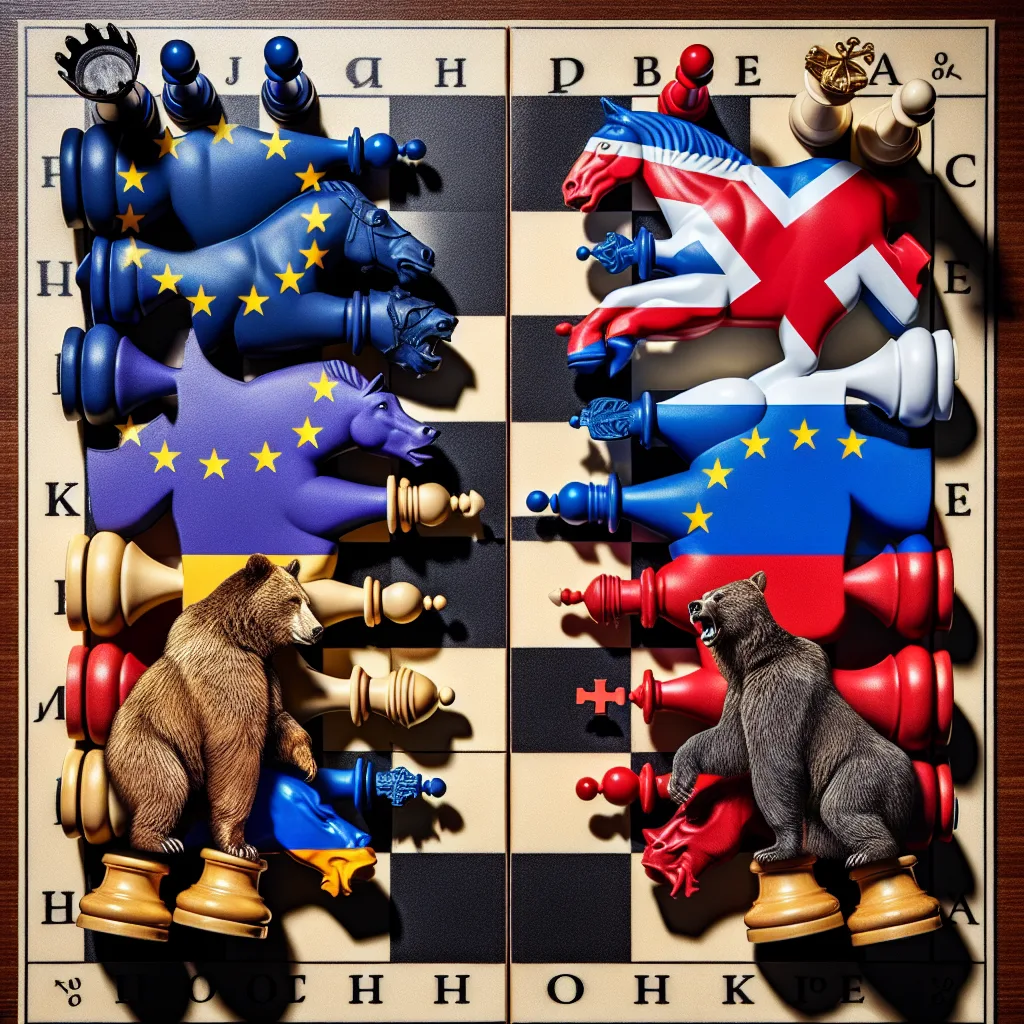
Exiled Voices and Divided Loyalties: The Chechen Separatist Gambit in Europe
In the echoing corridors of European policy debates and on the frontlines of Ukraine’s embattled terrain, a quietly emerging force is reshaping narratives of resistance. Chechen separatists in exile, an unlikely coalition born out of bitter enmity with President Vladimir Putin’s regime and the pro-Putin influence of Chechen leader Ramzan Kadyrov, are mobilizing support for an independent Chechnya. Operating from European safe havens, these groups are engaging influential institutions—from the European Union to the Council of Europe and beyond—leveraging their anti-Putin stance as a potential trump card in a geopolitical contest that continues to reverberate across Eastern Europe.
Amid the backdrop of the ongoing war in Ukraine, these exiled factions are not only rallying public opinion and policy dollars but have also found real-world expression on the battlefield. In a rapidly evolving conflict, several Chechen battalions are fighting alongside Ukrainian forces, united by a resolute determination to confront the Russian military. Their presence complicates the already tangled web of loyalties and strategic interests, challenging both Moscow’s narrative and Europe’s understanding of regional security.
Historically, Chechnya’s turbulent relationship with Moscow has been a saga marked by brutal conflicts and a relentless quest for autonomy. Since the wars of the 1990s and early 2000s, the Chechen struggle has oscillated between bitter separatist fervor and pragmatic accommodation. Under the current leadership of Ramzan Kadyrov, Chechnya has largely found itself aligned with Kremlin interests, with a well-financed security apparatus and a public display of loyalty that belies underlying fractures within the Chechen community.
Yet, the river of dissent has not entirely dried up. Among the diaspora scattered across Europe, voices of an independent Chechnya have reemerged with a vengeance. These groups, representing different factions of the Chechen community, reject the notion that loyalty to the Kremlin is an inevitable destiny. Instead, they propose an alternative vision—one that sees Chechnya as free from the clutches of Russian authoritarianism, a scenario that European policymakers and international observers are watching with careful interest.
At the heart of this complex mosaic lies a multi-dimensional struggle. On one side, these exiled groups are determined to reclaim the autonomy they believe was subverted by Moscow’s heavy-handed policies and Kadyrov’s unwavering allegiance to the Kremlin. On the other side, their efforts at lobbying Europe and supporting Ukrainian military operations represent an attempt to reshape the discourse around Chechen identity and sovereignty in the post-Soviet space.
European institutions, long cautious of further destabilizing an already fractious neighborhood, now find themselves wrestling with the implications of supporting a separatist cause. The European Union, for example, has stepped up its dialogue around human rights and rule of law in the region, while the Council of Europe debates issues of self-determination and minority rights. As these organizations weigh the potential benefits of backing a nascent movement against the inherent risks of fueling further division, Chechen separatists are well aware that their success depends as much on diplomatic maneuvering as on the harsh realities of military conflict.
Over the plains and urban centers where Ukraine’s resilience is on full display, the sight of Chechen fighters on the frontlines has introduced both an element of unpredictability and a potent symbol of internal Russian dissent. Their participation is not merely an isolated military contribution but a manifestation of a broader struggle—one that pits a desire for national self-determination against entrenched power structures.
For many Ukrainian military officials and strategists, the inclusion of these battalions is a welcome, albeit complicated, development. As documented in reports by the Atlantic Council, the presence of Chechen fighters brings with it tactical insights drawn from decades of guerrilla warfare and urban combat. However, there remains a palpable concern that the symbolism of foreign intervention, even by those opposing Moscow, could complicate Ukraine’s own narrative of national unity and external resistance.
The significance of this Chechen separatist movement extends far beyond the theatre of war. For policymakers in Europe, the involvement of these exiled factions raises critical questions regarding security, stability, and the influence of diaspora politics. In a series of candid discussions, experts at the European Council on Foreign Relations have emphasized that the resurgence of Chechen nationalism in exile acts as both a lever and a litmus test—its ripple effects could recalibrate European priorities regarding Russia and the broader Eastern European security architecture.
Several factors underscore why this development matters deeply for European and global security:
- Geopolitical Realignment: The mobilization by Chechen separatists represents a tactical exploitation of Europe’s historical antipathy toward Russian expansionism, offering a symbolic alternative for countries wary of Kremlin’s ambitions.
- Security Implications: With armed groups actively engaged in conflict zones, the risk of illegal arms flows and transnational extremism emerges as a concern that necessitates careful oversight by European security agencies.
- Diplomatic Disruptions: The lobbying efforts targeting institutions such as the European Union could shift the focus from human rights abuses and democratic norms toward questions of self-determination and internal identity politics in Russia’s periphery.
- Military Dynamics: The presence of seasoned Chechen fighters in Ukraine adds a layer of tactical complexity that might influence future military engagements and the strategic calculus of regional alliances.
One perspective drawn from this evolving story comes from Dmitry Gorenburg, a senior fellow at the Atlantic Council, who noted in a recent interview that “The rise of Chechen separatism in exile is emblematic of a broader struggle against centralized, authoritarian power.” While Gorenburg’s comments underline the historical resonance of Chechnya’s bid for independence, they also serve as a reminder that such movements invariably carry both promise and peril. Gorenburg’s analysis, rooted in extensive research and firsthand accounts, reinforces the idea that Europe’s handling of the Chechen diaspora must balance principled support for self-determination with pragmatic concerns of regional stability.
Further complicating matters is the duality faced by many in the Chechen community. Years of repression, coupled with experiences of both cultural pride and brutal conflict, have left deep scars. For some exiles, the quest for independence is interwoven with a painful history—a narrative marked by sacrifice, loss, and the persistent hope for a dignified future. Their contributions in Ukraine have not only been a fight against Russian military might but also an act of reclaiming identity amidst the chaos of global politics.
European governments, while still deliberating their position, are beginning to acknowledge that supporting the Chechen separatist cause may, in some respects, serve as a counterweight to Russian influence. However, such support is being cautiously measured. Officials from the European External Action Service have reiterated that any engagement with separatist entities must respect the rule of law and international norms on state sovereignty—a stance that underscores Europe’s reluctance to fully endorse a movement that might trigger widespread destabilization.
Looking ahead, observers note that the trajectory of Chechen separatism in exile will likely remain a dynamic and shifting battleground. With Ukraine continuing its protracted defense against Russian aggression, the Chechen appeal—as both a symbolic gesture and a military asset—may gain further traction. Yet the path to an independent Chechnya remains fraught with legal, political, and practical obstacles.
European policy analysts are keeping a close watch on several fronts:
- Policy Shifts: Monitoring any adjustments in European Union policy that might signal implicit support for self-determination in contested regions could offer early signals of a broader geopolitical transformation.
- Security Realignments: The integration of foreign fighters into Ukrainian operations will likely prompt reassessments of funding, intelligence coordination, and border security measures by European states.
- Diplomatic Engagement: As lobbying intensifies, the interplay between Russia’s strategic responses and Europe’s diplomatic maneuvers will be a key area to watch, especially in the context of ongoing sanctions and diplomatic isolation.
As the Chechen separatist movement continues to gain visibility, a perennial question looms: How should Europe navigate the delicate balance between supporting a marginalized voice of opposition and inadvertently contributing to further fragmentation within and beyond Russia’s borders?
This interrogation is not merely academic. It touches on broader themes of national identity, sovereignty, and the future framework of international relations in a world increasingly defined by hybrid warfare and diasporic activism. In many ways, the Chechen cause encapsulates a microcosm of the post-Cold War order—a world where historical grievances and modern political imperatives intersect in unpredictable ways.
In the end, the Chechen separatist effort in Europe is more than a flashpoint in the ongoing conflict between Russia and Ukraine. It is a testament to the enduring power of identity, the complexity of liberation struggles, and the intricate interplay between exiled communities and the corridors of power. As Europe and its allies shape their strategies in response to an increasingly multipolar world, the Chechen movement serves as both a cautionary tale and an emblem of persistent hope.
When viewed through the lens of history and current geopolitical realities, one cannot help but ask: In a world where power is continually redefined, what will be the lasting impact of those who dare to challenge an entrenched regime in the search for autonomy and dignity?



