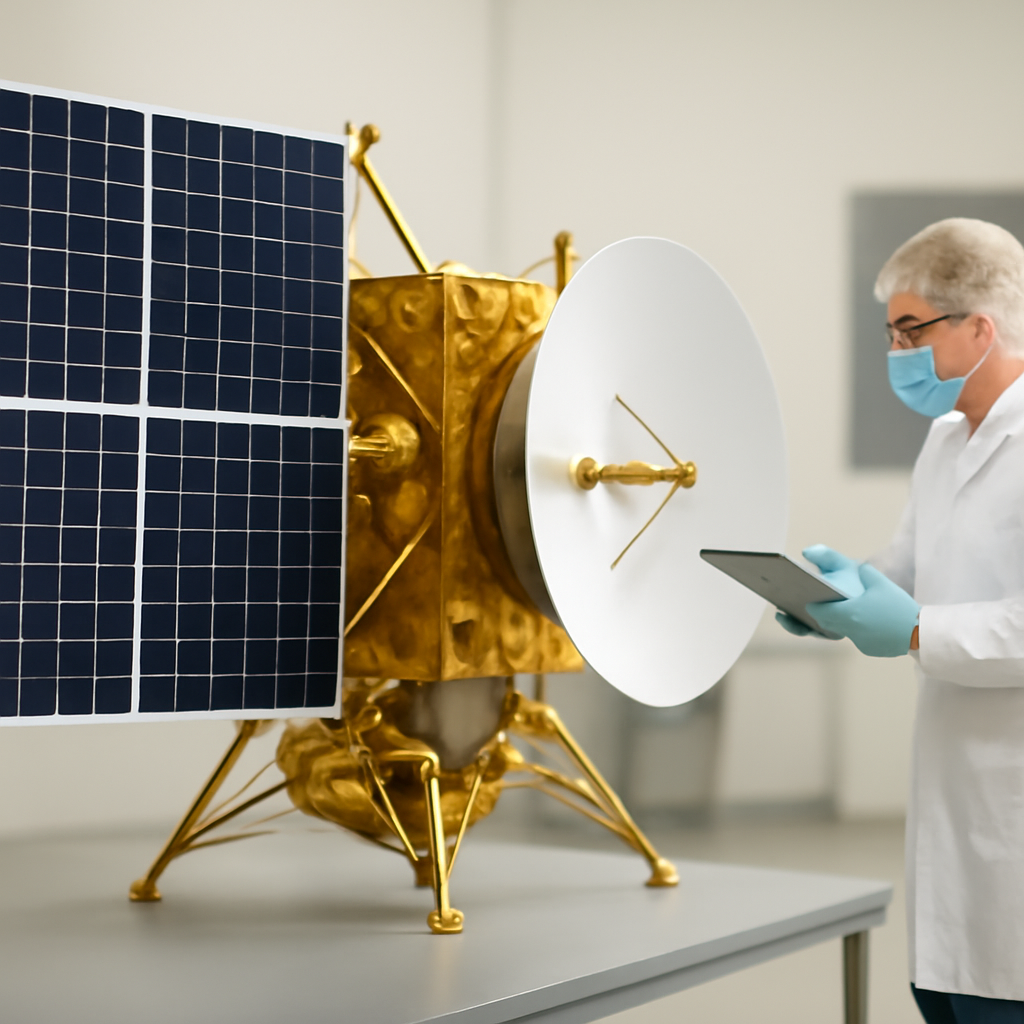
"As “dirty” RF and contested environments proliferate, autonomy increasingly depends on resilient positioning," the sponsored article on Breaking Defense states.
3D vision as a claimed game-changer
The Breaking Defense sponsored piece opens with a blunt claim: 3D vision is redefining how drones navigate without GPS. That formulation appears as the article's central framing, asserting that 3D vision is not an incremental improvement but a redefinition of navigation approaches in GPS-denied circumstances. The article positions 3D vision squarely as the technology doing the heavy lifting when satellite signals are unavailable or unreliable.
How the article frames "dirty" RF
The sponsored report uses the phrase "dirty RF" to describe one class of challenge for unmanned systems. It does not elaborate technical specifics in the quoted line, but puts "dirty" RF in proximity to "contested environments," implying that radio-frequency conditions degraded by interference, jamming, or congestion are part of the problem set that 3D vision is meant to address. The article's single-sentence content ties dirty RF directly to the urgency of alternative navigation methods.

This site is the portfolio.
OSINTSights runs on Cloudflare Workers, D1, R2, and Vectorize, with an AI pipeline on Hetzner ARM. Nubivance designed, built, and operates it. We do the same for clients.
See what we buildContested environments and the navigation problem
Breaking Defense's sponsored piece groups contested environments with dirty RF. The juxtaposition signals that the article considers operational settings where standard positioning sources are degraded, denied, or contested to be increasingly common. By connecting those environments to the claim about 3D vision, the sponsored item frames contested spaces as the practical context prompting a shift in navigational strategy for drones and other autonomous systems.
Resilient positioning as the required capability
The article states that "autonomy increasingly depends on resilient positioning." That phrase assigns resilient positioning the function of sustaining autonomy when conventional positioning — such as GPS — cannot be trusted. The sponsored story draws a straight line: degraded RF and contested environments lead to a dependence on positioning approaches designed to be resistant to interference, denial, or corruption.
Drones navigating without GPS
The title and the quoted sentence together convey a clear narrative: when GPS is unavailable, drones must navigate by other means, and 3D vision is the alternative being foregrounded. The article treats GPS-denied navigation as not merely possible but as being redefined by the capabilities that 3D vision provides. While the piece does not itemize the sensors, algorithms, or architectures behind that vision-based navigation within the quoted material, it frames the technology as a response to the operational problem described.
Autonomy's dependence — operational and strategic implications
By asserting that autonomy "increasingly depends on resilient positioning," the Breaking Defense sponsored article elevates the subject from a technical curiosity to a strategic consideration. The phrasing suggests a trend rather than a single event: as the conditions described proliferate, resilience becomes a core requirement for autonomous systems. The piece positions resilient positioning as an enabler of autonomy rather than an optional enhancement.
Sponsored context and messaging
The article carries a clear sponsorship label at the outset. The presence of "[Sponsored]" contextualizes the claims as part of sponsored content. Readers are therefore told both what the narrative is — that 3D vision redefines GPS-free navigation amid dirty RF and contested environments — and that the narrative is presented within a paid or partner context. That framing matters because it signals the piece's intent to advocate for a particular perspective or technology solution.
Questions the piece leaves open
Constrained intentionally to a short statement, the sponsored item raises more questions than it answers. If 3D vision is indeed redefining how drones navigate without GPS, how will resilient positioning be delivered at scale? What trade-offs between sensor suites, processing, and endurance arise when systems must rely on vision instead of satellite navigation? How do operators and planners adapt tactics and doctrine to account for environments the article calls "contested"? The Breaking Defense sponsored content does not provide those specifics in the quoted material, but its framing invites them.
The article makes a compact argument: confronted by dirty RF and contested environments, autonomy cannot long remain dependent on traditional positioning; resilient positioning — and, in particular, 3D vision — is presented as the pivot. The sponsored label alerts readers that the piece advances a particular viewpoint about technological trajectories, and the single declarative sentence serves as both diagnosis and prescription.
That combination — a diagnosis of proliferating interference and contested spaces, and a prescription favoring resilient, vision-based navigation — is the story the Breaking Defense sponsored piece delivers. It is concise, pointed, and deliberately framed to highlight a technological response to a described operational problem.
Read the original Breaking Defense article here: https://breakingdefense.com/2026/04/3d-vision-is-redefining-how-drones-navigate-without-gps/