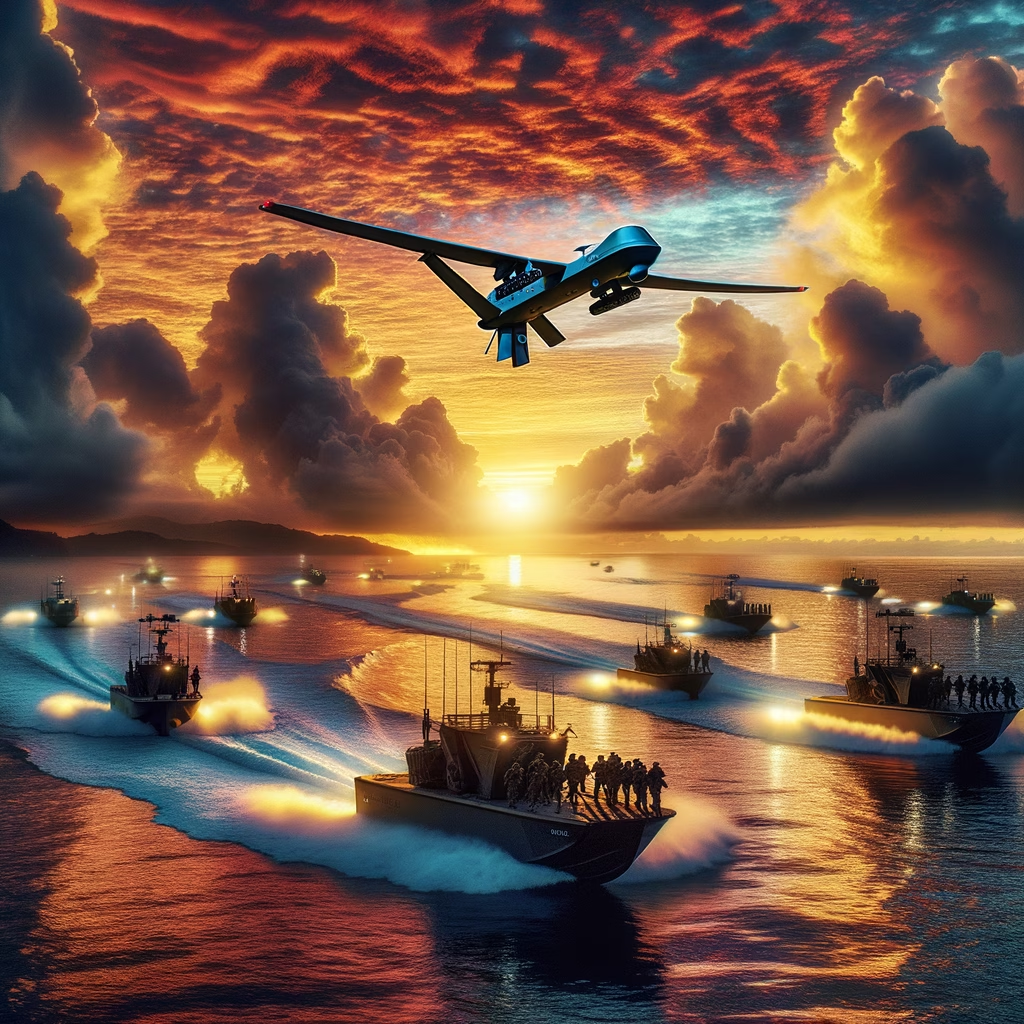
How do you protect a force that is meant to move across water when the water itself is the battlefield? That is the dilemma playing out now in the Pacific, where the U.S. Army is testing unmanned surface vessels — commonly called drone boats — alongside newly designed landing craft in exercises meant to keep afloat the movement and protection of sailors and soldiers alike.
The trials, reported by Defense One, reflect a pragmatic shift in Army thinking: recognizing that water is no longer merely a medium for Navy and Marine Corps operations but a contested domain requiring Army solutions as well. The service is looking for better ways to protect its waterborne forces, testing platforms intended to scout, screen, resupply and, when necessary, defend littoral convoys against growing threats.
For decades, doctrine drew clear lines between services: the Navy dominated the sea, the Army the land. Those lines have blurred as technology, geography and adversary capabilities have converged. Anti-access/area-denial (A2/AD) systems, long-range sensors and precision fires projected from shore complicate coastal movement. Adversaries can detect, target and interdict traditional amphibious and logistics routes, making even short sea transits dangerous. In this environment, small, networked vessels — some unmanned, some redesigned for survivability and modularity — offer new ways to maintain mobility while reducing risk to personnel.
The current trials in the Indo-Pacific are exploratory but purposeful. They involve unmanned surface vessels (USVs) that can perform reconnaissance, electronic warfare or even act as decoys; and improved landing craft designed to reduce detection signatures, speed offloads or better integrate with distributed maritime operations. The Army’s interest is not theoretical: sustaining formations across thousands of miles of ocean, across islands and archipelagos, will require more resilient, adaptable logistics and force-protection measures.
Why this matters goes beyond platform novelty. The tests address three interlocking problems:
/ Detectability — littoral operations are vulnerable to sensors ashore and in the air. Smaller, quieter, or expendable vessels change the calculus of risk.
/ Survivability — unmanned units can be used in higher-risk roles, preserving sailors and soldiers for critical tasks.
/ Logistics — distributed operations demand flexible, modular landing craft and unmanned systems that can shuttle supplies where larger ships cannot.
Technologists see the trials as a laboratory for autonomy, sensing and networking at sea. Advances in autonomous navigation, sensor fusion and remote command-and-control can let USVs operate in coordination with manned ships and shore units. For industry, the Pacific experiments are an opportunity to refine autonomy stacks, hardened communications and maritime versions of plug-and-play payloads — from mine countermeasures to persistent electronic reconnaissance.
For policymakers and budgeteers, the trials raise familiar trade-offs. Investing in autonomous maritime systems may offer cost-effective force multipliers, but it also requires sustained funding for integration, testing, and training. The Army must balance investments between traditional capabilities and emerging systems while ensuring interoperability with Navy and Marine Corps platforms. Policy choices will shape whether the services pursue joint doctrines and procurement or parallel, potentially duplicative, programs.
Users — the soldiers and boat crews who will depend on these systems — emphasize practicality. A landing craft that offloads faster, a drone boat that scouts ahead of a convoy, or an unmanned asset that draws enemy fire can materially affect survivability and mission tempo. But users also stress that new tech must be rugged, maintainable, and operable in austere conditions. Field maintenance, parts, and the habit of working with unmanned systems in mixed manned-unmanned formations will determine operational success.
Adversaries will adapt. An unmanned surface vessel that acts as a reconnaissance node can be jammed, spoofed or captured; a landing craft with reduced signature can still be challenged by sophisticated shore-based radars and missiles. Moreover, the proliferation of similar unmanned systems is a double-edged sword: the same capabilities that aid U.S. forces may also empower hostile actors. That amplifies the importance of secure communications, resilient autonomy, and robust rules of engagement to prevent escalation or unintended incidents at sea.
There are legal and ethical angles, too. Unmanned vessels operating in international waters raise questions about navigation rules, identification and the threshold for the use of force. The operational concept must fit within maritime law and allied expectations, especially in crowded littorals where civilian traffic mixes with military operations.
The trials also test the Army’s institutional willingness to operate beyond traditional boundaries. The service historically has been cautious about committing to blue-water capabilities, deferring to the Navy. Yet modern multi-domain operations—where land, sea, air, space and cyber are tightly coupled—argue for cross-domain competence. The Army’s experimentation with boatborne autonomy and new landing craft signals a broader doctrine: if the theater demands littoral mobility under contested conditions, the Army will prepare to meet that demand.
Challenges remain. Autonomy must be dependable in GPS-denied or electronically contested environments. Command-and-control architectures must scale to coordinate dozens of small units. Supply chains must deliver spares and software updates across great distances. And above all, training must instill confidence in commanders who will choose when to commit human crews and when to send machines forward.
Still, the research is emblematic of a practical mindset: rather than wait for idealized solutions, the force is testing what is available, learning, and iterating. That approach has a familiar logic to technologists and soldiers alike — deploy, observe, adapt — but it must be matched by strategic clarity from policymakers and responsible integration with allies operating in the same maritime spaces.
If the trials succeed, the battlefield advantage would be operational: safer transits, more resilient logistics, and the ability to project power across complex archipelagos with fewer vulnerable chokepoints. If they fail, the lessons will still be valuable: which sensors worked, which autonomy modes degraded under jamming, what maintenance patterns emerged.
Ultimately, the Army’s Pacific experiments underscore a simple truth of modern warfare: geography and technology together compel services to rethink old roles. The water between islands is not just a line on a map; it is a contested theater requiring layered, networked solutions. As the Army pushes small boats and unmanned systems into that space, the question becomes less about whether the service should operate at sea and more about how all services will learn to operate together in a world where shorelines are front lines.
Source: https://www.defenseone.com/technology/2025/09/drone-boats-new-landing-craft-get-army-pacific-tryouts/408100/