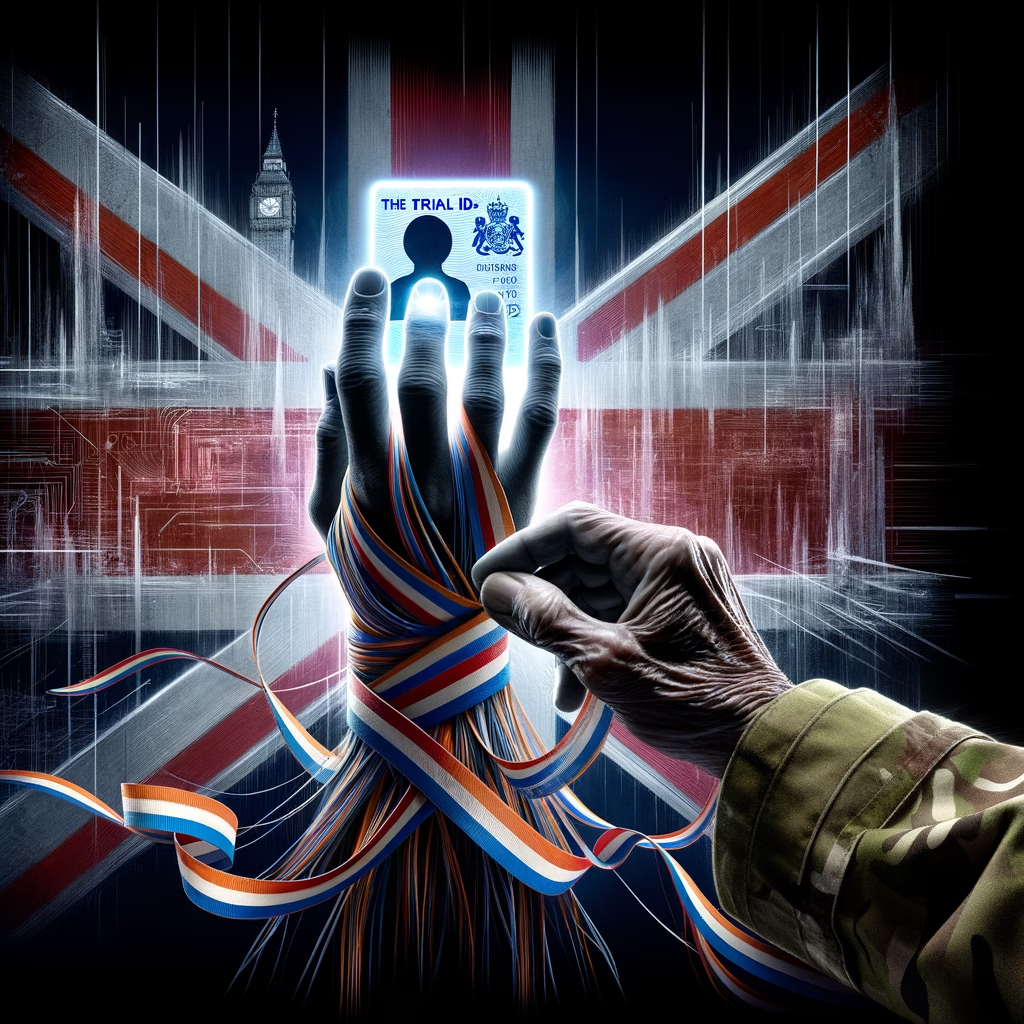
UK Calls Up Armed Forces Veterans for Digital ID Trial
Can a cohort of former soldiers restore public confidence in a national digital identity programme where earlier pilots have faltered? The UK government appears to be testing that hypothesis by recruiting Armed Forces veterans as early users in a controlled trial of a government-backed digital identity scheme. The experiment is both practical and symbolic: it will stress-test technical systems and probe whether trust can be cultivated by credible, civic-minded participants.
Digital identity trial with veterans
The Ministry of Defence and the Cabinet Office are reported to be enlisting veterans to act as early adopters who will use digital credentials to verify identity for services historically requiring physical ID checks. The pilot is intended to demonstrate that a government-endorsed digital identity can be rolled out securely and at scale. Behind the headline, however, lies a complicated knot of engineering challenges, policy trade-offs and social concerns that have dogged identity projects in the UK and elsewhere.
Advocates argue digital identity can streamline access to public and private services, reduce fraud and cut administrative costs. Critics counter with warnings about mission creep, surveillance risks and the exclusion of vulnerable groups. Technically, a successful system must be secure against sophisticated attacks, usable across a spectrum of devices and digital literacy levels, and interoperable with banks, healthcare providers and other services.
Why recruit veterans? There are pragmatic and symbolic reasons. Practically, many veterans hold diverse identity credentials, are familiar with structured testing and can be reached through existing service networks. Symbolically, veterans are often viewed as disciplined and civic-minded, which could help sway public opinion. But the choice raises representativeness concerns: veterans are not demographically or digitally identical to the broader population. Their experiences may not reflect older people, those with limited internet access, or individuals distrustful of government programmes, so lessons learned will need careful contextualisation.
Key technical pain points
– Secure credential storage and cryptographic proof of identity without creating centralised, queryable databases. The architecture must avoid single points of failure while still enabling reliable verification.
– Usability across devices and for people with different levels of digital literacy. Accessibility, recovery flows and clear user journeys will determine uptake.
– Interoperability so third-party services can accept verified claims consistently. Standards and trust frameworks are essential to prevent fragmentation.
– Robust fraud detection to counter identity theft, synthetic identities and organised abuse. Detection and remediation must be integrated across the ecosystem.
Security researchers emphasise that the hardest problems are often integration and human factors rather than headline cryptography. Even strong cryptographic schemes crumble under poor implementation, insecure recovery processes or social-engineering attacks. Privacy advocates press for data minimisation and selective disclosure — giving relying parties only the attributes they need, not an entire identity dossier.
Policy trade-offs and governance
Policymakers confront a balancing act. A centralised model simplifies oversight but concentrates risk; a federated approach reduces single-point risk but complicates governance and accountability. The government’s current path favours standards, trust frameworks and enabling multiple certified identity providers rather than creating a single centralised database — a design intended to balance competition and public oversight.
Regulatory clarity will be crucial. Rules on liability, accreditation of identity providers, auditability, dispute resolution and independent oversight will shape the system’s resilience. Civil liberties organisations call for legal safeguards and transparency, technologists want open standards and third-party audits, and service providers need clear liability frameworks to accept verified attributes without undue exposure.
User experience and social impact
For users, the promise is tangible: fewer repeated face-to-face checks and faster access to services like banking, benefits, renting and healthcare. For people who struggle with mobility or paperwork, a well-designed digital identity could be liberating. But for others, it raises legitimate concerns about surveillance, data exploitation and the consequences of lost or revoked credentials.
Adversaries know digital identity systems are high-value targets. A single compromise can open doors to financial accounts, medical records and benefits. The system must therefore assume attackers will probe every layer and design incident response, restoration pathways for harmed individuals, and transparent disclosure practices.
International context
The UK’s experiment sits beside varied international models. Estonia’s e-Residency and national digital ID is often cited for integration and uptake; other states have opted for private-sector-led, mobile-first or tightly regulated centralised systems. The UK’s emphasis on interoperability and multiple accredited providers aims to encourage innovation while preserving oversight — but success depends on implementation details and trust-building.
What success and failure look like
Measurable benefits of a successful rollout include faster service access, reduced fraud and cost savings across public and private sectors. Failure could erode public trust, lead to a patchwork of low-quality private solutions, and embed new privacy harms into everyday transactions. The veteran cohort trial can yield operational insights — authentication flows, user acceptance, edge cases — but it will not, by itself, answer all societal questions about equity and long-term governance.
Who should set the rules? Civil society demands independent oversight and strong safeguards; technologists call for open standards and rigorous testing; service providers need predictable liabilities. Legislators must mediate these demands while maintaining democratic accountability.
Conclusion: Can digital identity win public trust?
The veterans’ mission is civic rather than martial: to help prove whether the state can deploy a digital identity infrastructure that is secure, usable and deserving of public trust. The outcome will hinge on technical detail, institutional design and political willingness to accept constraints on power in exchange for convenience. If the experiment succeeds, it could reshape how Britons prove who they are; if it fails, it will be a cautionary tale about digitising identity without sufficient safeguards. Transparency, independent evaluation and inclusive testing will determine whether this pilot bridges scepticism and acceptance or simply masks deeper shortcomings.



