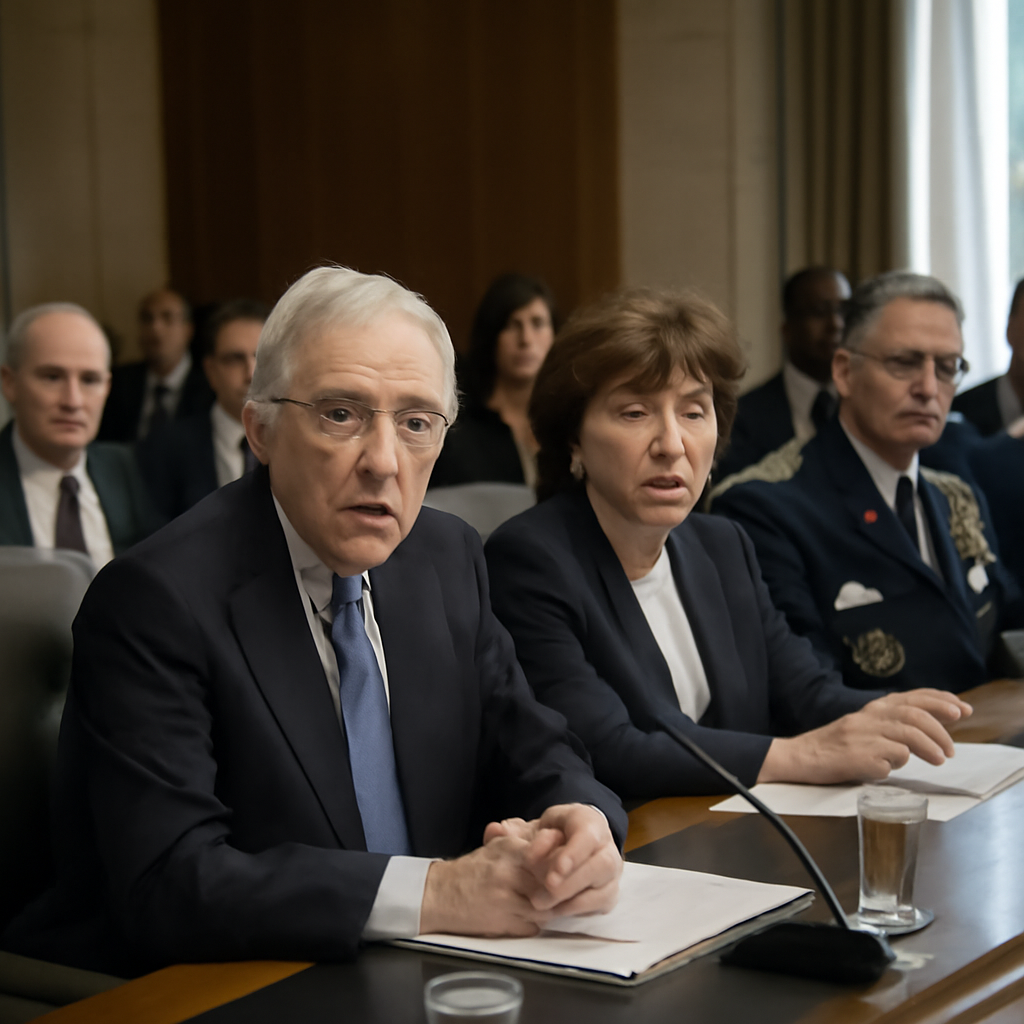
"I think it's safe to conclude there will not be another reconciliation bill," Sen. Mitch McConnell, R-Ky., said during a hearing on Capitol Hill, bluntly undercutting Pentagon plans that relied on reconciliation dollars to fill out next year's defense budget.
Senate appropriators McConnell and Collins reject a third reconciliation vehicle
McConnell — identified in the hearing as the head of the Senate Appropriations defense subcommittee — told colleagues that a further reconciliation bill that would include defense funding is "really not an option." Senate Appropriations Chairman Susan Collins, R-Maine, responded in agreement: "I agree with that assessment." The remarks came as appropriators pressed Air Force leaders about the consequences if reconciliation-directed defense money does not materialize.
Air Force testimony: F-35, munitions and readiness at risk
Air Force Secretary Troy Meink testified at the hearing about consequences tied to the service's FY27 request, answering a direct question from Collins on what would happen if F-35 funding included in the reconciliation request never arrives. Meink warned that a continuing resolution would have "significant" impacts on readiness and would leave the Air Force unable to make key investments in drone defense, F-35 sustainment and munitions procurement.

Your town's IT department is one person. Maybe.
Ransomware crews target small municipalities because nobody's watching. Nubivance gives Maine and New Hampshire towns a security program sized to a town budget.
Protect the town officeRepublican leadership, the budget committees, and the decision to prioritize immigration
The source material makes clear appropriators do not control the reconciliation process; Republican leadership and the budget committees do. Republican leaders chose to focus the second reconciliation bill, following last year's One Big Beautiful Bill, on immigration enforcement and left out defense and other priorities. That second package is a roughly $70 billion agreement that the Senate passed last week and that the House was set to vote on today.
The choice to prioritize immigration has prompted internal Republican discussion about a possible third reconciliation measure. The Republican Study Committee convened a meeting Monday, according to Politico reporting cited in the hearing, to discuss a third bill that could include defense funding — but senators and appropriators at the hearing framed that path as increasingly unlikely as midterm elections approach.
Supplemental funding remains a potential — but unspecified — alternative
Senators and witnesses raised supplemental appropriations as the alternate route to replenish equipment expended or destroyed in Iran or to fund new systems. Acting Pentagon Comptroller Jules Hurst outlined such possibilities in March, but defense officials did not provide a timetable for when a supplemental request would be delivered to Capitol Hill, drawing "consternation" from lawmakers.
Sen. John Hoeven, R-N.D., asked whether a supplemental would become more important if reconciliation fails. Meink said obtaining the full FY27 request was "vital" and added that any supplemental will come from the Office of Management and Budget, noting "The DoW [Department of War] is working with OMB on options." When Sen. John Kennedy, R-La., warned Congress is unlikely to pass a budget before Oct. 1 and urged preparation for a continuing resolution, he received Meink's assessment that a CR would have "significant" impacts; Kennedy replied, "Well, I think you should prepare for it."
What this means for the Air Force, Senate appropriators, and OMB
- Air Force leaders: Expect constrained flexibility — Meink signaled that without reconciliation or timely appropriations the service will face difficult tradeoffs in sustainment, munitions procurement and advanced defensive systems.
- Senate appropriators: McConnell and Collins positioned themselves to dampen expectations for a reconciliation fallback, signaling they do not see passage of a third bill as a feasible route to fill defense gaps.
- Office of Management and Budget: OMB was identified by Meink as the locus for any supplemental options; the timing and scope of such a supplemental remain under OMB and Defense coordination.
The debate in the hearing mapped a narrowing range of options: Republican leaders have prioritized an immigration-focused reconciliation bill now before the House, senators charged with appropriations have declared further reconciliation "not an option," and defense officials have held open the possibility of a supplemental while warning of significant readiness impacts from a continuing resolution. The immediate policy question left on the table is straightforward and time-sensitive — will Republican leadership pursue a third reconciliation effort, or will the administration and OMB move a supplemental request to Capitol Hill before the fiscal year turns on Oct. 1?