“Fewer than three out of five (58%) respondents in both the military/defense and government sectors say their employees always use appropriate tools for sensitive/confidential information,” SENTRIQS’ research found.
United States Marine Corps missions reveal the practical gap
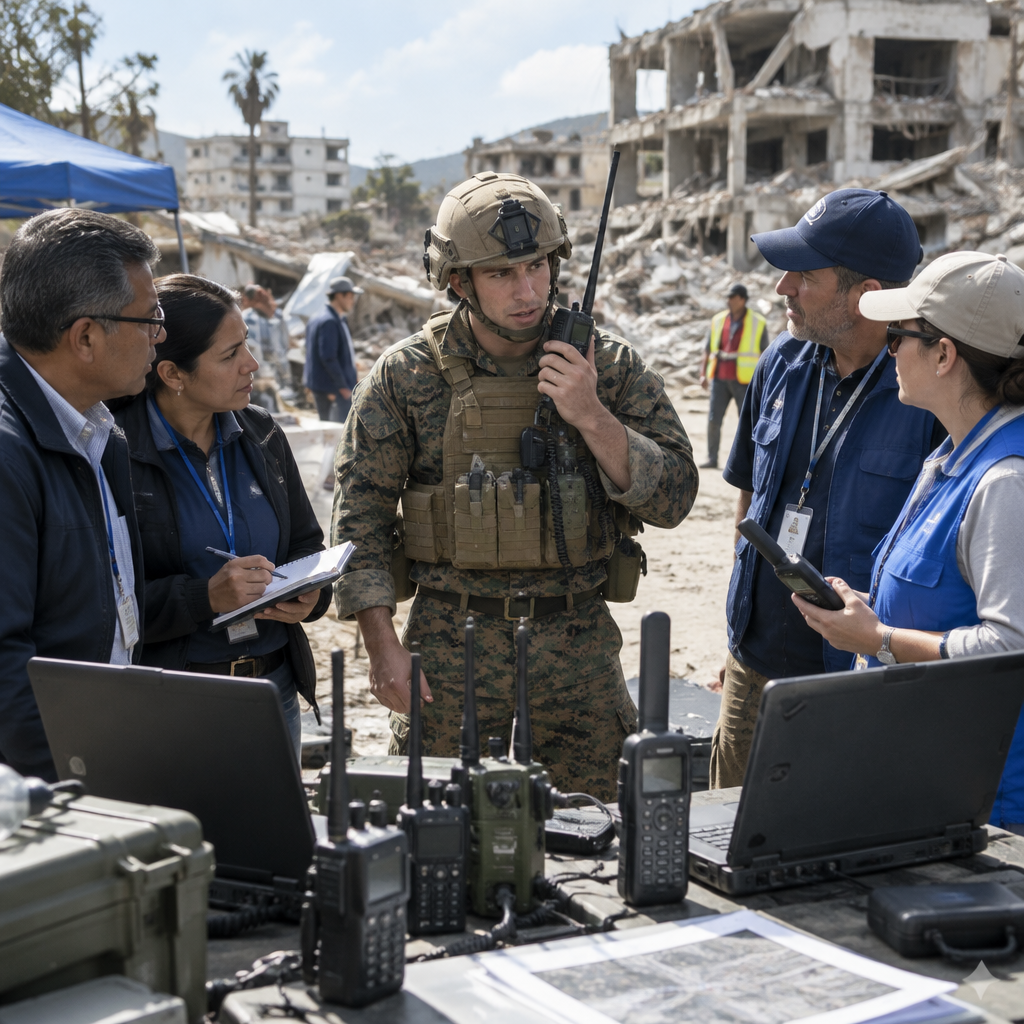
Modern defense operations increasingly require coordination across services, allied forces, government agencies and non-governmental mission partners. The piece describes how the United States Marine Corps, frequently dispatched for humanitarian assistance and disaster relief, confronts a recurring communications problem on the ground: local governments, aid organizations such as the Red Cross and local law enforcement all “use their own systems and tools.” That diversity creates literal and figurative language barriers—different protocols, devices and user expectations—that complicate timely information sharing without replacing existing, operational equipment.
DHS-Office of the Inspector General post‑mortem: the cost of fragmented information
The report points to the July 2024 shooting at a Donald Trump campaign rally as an example of how fractured communications can produce fatal outcomes. According to a Department of Homeland Security-Office of the Inspector General post‑mortem analysis cited in the article, critical information was shared only in fragments and “didn’t reach all security personnel at the site.” The shooting resulted in a first responder losing his life while shielding his wife and daughters. The article cautions that the event is not a direct analogy to military command and control, but uses the incident to underline the broader operational lesson: when information does not reach the right people in full and on time, coordination — and lives — can be at stake.

Audit-ready is a season. It shouldn't be.
Evidence in spreadsheets, controls drifting between audits, frameworks multiplying on flat headcount. Nubivance runs continuous compliance on Rapid7 Cyber GRC - SOC 2, HIPAA, ISO 27001, PCI, CMMC.
End the scrambleTechnical and organizational barriers: legacy systems, proprietary hardware, and human practice
Proprietary hardware, incompatible networks and legacy infrastructure are framed as major contributors to the “interoperability gap.” The article argues that wholesale replacement of equipment is frequently impractical—expensive, disruptive and incompatible with ongoing operations. Beyond technical incompatibility, the piece emphasizes human and governance failures: some organizations believe their tools are secure without fully understanding what constitutes a secure platform, and “governance and compliance with internal policies aren’t consistently enforced.” The SENTRIQS finding that only 58% report consistent appropriate-tool usage underscores the difference between security in theory and security in practice.
Software‑defined, hardware‑agnostic approaches and GLYPH’s proposed solution
To bridge disconnected communications without ripping out fielded systems, the article promotes software‑defined, hardware‑agnostic communications as a way to connect disparate environments. Such solutions aim to reduce dependence on specific devices or proprietary stacks so personnel can communicate across platforms. Complementing that approach, secure collaboration platforms are presented as a way to prevent mission actors from resorting to tools outside organizational security constraints.
The article details a specific offering: GLYPH. Framed as a secure collaboration product from SENTRIQS, GLYPH is described as providing messaging, file sharing, calls and meetings in a protected environment designed for mission actors. Technically, GLYPH is said to enable post‑quantum encryption plus messaging layer security (MLS) and to be built so that even GLYPH “can’t access information shared within the platform.” The piece stresses that secure options must also be easy to use—“the secure choice must also be the easy‑to‑use choice”—to drive consistent behavior among personnel.
What this means for technologists, policymakers, and mission partners
- Technologists and security teams: Expect emphasis on software‑defined, hardware‑agnostic connectors and cryptographic protections such as post‑quantum encryption and MLS to bridge legacy and proprietary systems while preserving confidentiality against internal and external inspection.
- Policymakers and procurement leaders: The article implies a need to balance investment in new systems with integration strategies that minimize disruption—prioritizing solutions that can interoperate with existing infrastructure rather than forcing wholesale replacement.
- Mission partners and end users (services, NGOs, local agencies): Usability becomes a security imperative; the report argues that without tools that are both secure and easy to use, personnel will default to ad hoc channels that erode operational security and shared situational awareness.
The central argument is straightforward: as operations grow more distributed and joint, the ability to share information securely and reliably across organizational boundaries becomes as operationally critical as the platforms themselves. Closing the interoperability gap will require technical bridges that respect legacy systems, governance that makes secure behavior the norm, and procurement choices that favor interoperability and usability. The unstated test remains whether leaders can make the secure choice the easy choice in time to prevent the next fragmentary failure.