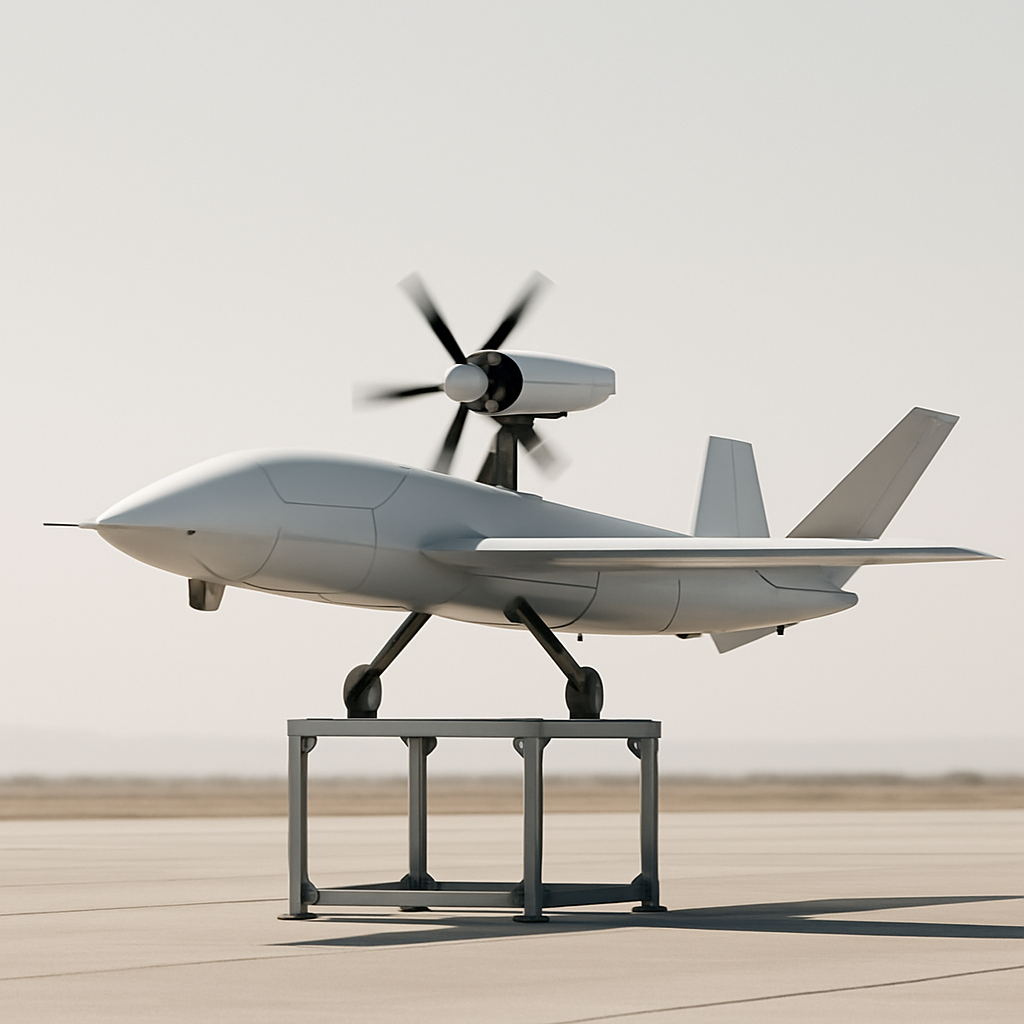
“This milestone is not just about a single flight,” Air Force Lt. Col. Clark McGehee, the SHEPARD program manager at DARPA, said in a statement, summing up the program’s intent after Northrop Grumman’s XRQ-73 took to the air in April from Edwards Air Force Base.
DARPA confirms April flight and ongoing short flight test campaign
DARPA announced the XRQ-73 test flight in a press release and later confirmed to The War Zone that flight testing began in April. The agency said the program will continue “maturing the hybrid electric propulsion system through a short flight test campaign currently underway,” Lt. Col. McGehee told TWZ, adding that the X-plane-style effort “involved resolving complex, unforeseen technical challenges during ground testing and integration.” The Air Force Research Laboratory (AFRL) was also involved in the milestone event.
Design evolution: visible changes since 2024
Newly released images accompanying the announcement show clear changes from the earlier XRQ-73 appearance that first surfaced in 2024. Most immediately eye-catching is the addition of two vertical stabilizers—one mounted on top of each wing near but not at the very tips. The drone’s predecessor, the XRQ-72A, also had vertical wingtip stabilizers, according to earlier reporting.
Other alterations visible in the photos include a much smaller auxiliary dorsal intake between two larger dorsal intakes, at least two black-colored blade antennas on top of the fuselage, and a forward-facing fairing at the nose that “appears to be a forward-facing camera system.” That fairing sits between two rectangular “nostril” intakes. A large, faceted fairing below the center fuselage—likely a sensor enclosure—remains present; program materials note space in that area could house test instrumentation and other systems to support development.

This site is the portfolio.
OSINTSights runs on Cloudflare Workers, D1, R2, and Vectorize, with an AI pipeline on Hetzner ARM. Nubivance designed, built, and operates it. We do the same for clients.
See what we buildScale, classification, and the XRQ lineage
DARPA has previously described the XRQ-73 as a Group 3 uncrewed aerial system (UAS) weighing approximately 1,250 pounds and intended to include “operationally representative … mission systems.” The War Zone summarized U.S. military definitions for Group 3 UAS in reporting that accompanies DARPA’s material: a Group 3 UAS weighs between 55 and 1,320 pounds, can fly at altitudes between 3,500 and 18,000 feet, and has a top speed between 100 and 250 knots. At about 1,250 pounds, the XRQ-73 is substantially larger than the XRQ-72A, whose prior requirements called for a drone weighing between 300 and 400 pounds; schematics obtained via the Freedom of Information Act previously showed the XRQ-72A had a 30-foot wingspan, 11.2-foot length from nose to wingtips, and a four-foot height including its wingtip stabilizers.
What DARPA and Northrop Grumman say the propulsion work could deliver
DARPA framed the SHEPARD program’s core goal as proving “high-efficiency and very quiet propulsion technology that could pave the way for new operational capabilities.” The agency’s press release said: “Hybrid electric propulsion architectures will drive the development of revolutionary new aircraft designs by offering a combination of fuel efficiency, reduced emissions, and enhanced operational flexibility.” Northrop Grumman described the XRQ-73 as advancing “next-generation propulsion for lightweight autonomous aircraft,” adding the hybrid-electric system “combines fuel efficiency, reduced emissions and enhanced operational flexibility – enabling new mission possibilities and supporting the evolution of new aircraft designs.”
What this means for DARPA, the Air Force Research Laboratory, and General Atomics
- DARPA: The agency is continuing a short flight test campaign to mature hybrid-electric propulsion and has characterized the XRQ-73 as an X-plane-style effort that required resolving “complex, unforeseen technical challenges” before flight. A review of DARPA’s proposed Fiscal Year 2027 budget “does not appear to show a request for new funding for this effort,” the reporting notes, suggesting the program’s near-term resourcing or organizational posture could evolve.
- Air Force Research Laboratory (AFRL): AFRL participated in the milestone flight and last year awarded a separate contract for a similar-sounding hybrid-electric effort to General Atomics. That prior AFRL contract—described as for the “GHOST” program, a hybrid-electric propulsion ducted fan next-generation ISR/strike UAS—was valued at just over $99 million.
- General Atomics: The company was quoted last year via spokesperson C. Mark Brinkley, who declined to discuss details of the AFRL contract, saying, “We’ve been promising something impressive related to hybrid-electric propulsion, and now I can’t talk about it anymore.” The existence of AFRL’s GHOST award indicates parallel activity in hybrid-electric propulsion within the U.S. research ecosystem.
The XRQ-73’s first public flight closes one chapter in a technology push and opens several practical questions: how the hybrid-electric architecture will perform across the flight test campaign, whether the altered airframe elements—dorsal intake, twin vertical stabilizers, nose fairing and antennas—will persist or change, and how the program will be resourced or reorganized given the absence of an obvious FY2027 funding line. For now, DARPA and its partners have demonstrated that the evolved XRQ-73 has reached flight test, and they will be watching performance data closely as the short campaign proceeds.