“Tunnels present a very distinct problem, they are filled with mud, debris, and floodwater. Clearing them requires specialized skills that none of the countries, including Nepal, have had,” Nepali Prime Minister Balendra Shah told parliament on September 2.
August 26 avalanche and the wiped-out border corridor
On August 26 an avalanche triggered floods along the Bhotekoshi and Trishuli rivers near the China–Nepal border. Video and on-the-ground accounts show the road, bridges, the customs and immigration office with China, and “the entire settlement and traditional bazaar along the riverbank” were wiped out in a single moment. The collapse of this corridor left communities cut off and critical infrastructure gone, creating immediate search-and-rescue and humanitarian needs.
More than 20,000 security personnel deployed; 85 still unaccounted for
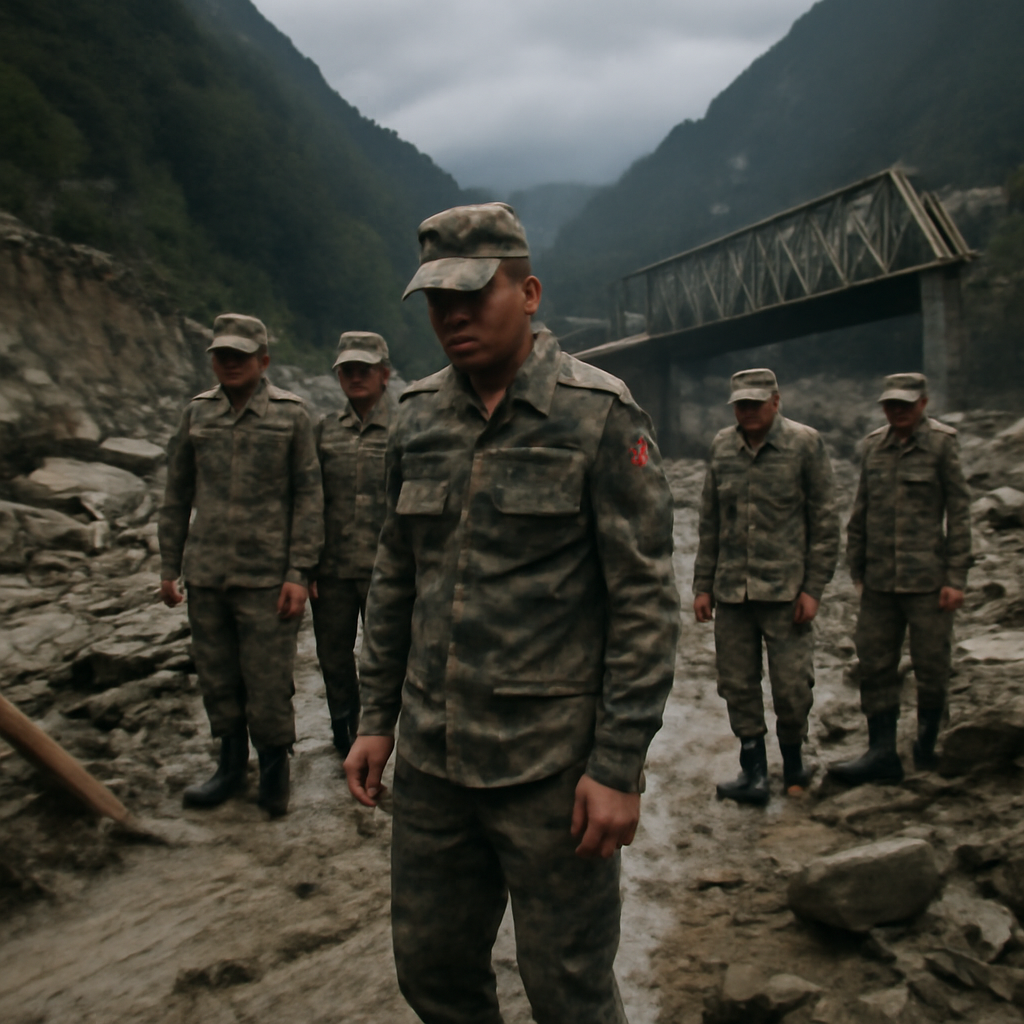
The Nepali government deployed security forces — the Nepal Army, Nepal Police, and Armed Police Force — as first responders, putting “more than 20,000 security personal into responding to the disaster,” a mobilization described as possibly the largest since the 2015 earthquake. The central government leaned on these forces after the collapse of local and provincial governments and because many affected areas were inaccessible.
A week after the incident, 85 security force members remained unaccounted for: 45 from the Nepal Army, 28 from the Nepal Police, and 13 from the Armed Police Force. Police personnel went missing while on duty near the border, customs area, and river corridor; some were swept away while circulating notices to downstream communities. Army personnel were stationed at Langtang National Park and at multiple hydropower projects when they went missing. Armed Police Force members were reported missing from a border post. Three police posts — in Timure, Rasuwagadhi, and Syafrubesi — were damaged or swept away.

Audit-ready is a season. It shouldn't be.
Evidence in spreadsheets, controls drifting between audits, frameworks multiplying on flat headcount. Nubivance runs continuous compliance on Rapid7 Cyber GRC - SOC 2, HIPAA, ISO 27001, PCI, CMMC.
End the scrambleHydropower tunnels and stalled rescue efforts
Rescue operations have focused on hydropower tunnels and related sites: Upper Trishuli-1, Rasuwagadhi Hydropower, Chilime Hydropower, Langtang Khola, and Upper Trishuli-3A are all named locations where “hundreds of workers are believed to be trapped in these tunnels.” As days passed, families of those trapped and security personnel expressed growing frustration. Some tunnel rescue operations have been halted “due to a lack of progress and the rescue team’s inability to advance.” Teams are considering options such as a controlled blast to clear debris blocking tunnels, and footage of Nepal Army personnel laboring in tunnel operations shows soldiers risking their lives in attempts to reach trapped workers.
Prime Minister Balendra Shah warned that progress depends on weather and drier conditions, and he commended the security forces for mobilizing “at short notice” under severe constraints. At the same time, the government acknowledged it lacks the advanced expertise, technology, and equipment required for effective tunnel rescues and has sought international assistance — specifically for tunnel rescues and forensic work — reaching out to India, China, and South Korea for critical equipment and technology.
Legal framework and the military’s expanding role
The security forces’ deep involvement in disaster response is not new. The Nepali Constitution (2015 / 2072 BS) contains a provision for deploying the military in national crises arising from disasters and development projects. Nepal’s National Security Policy (2016) explicitly includes climate change and the environment as matters of national interest. Still, the article emphasizes that “ad hoc stretching of the security forces into disaster response” risks exposing those forces to new vulnerabilities and capacity constraints as environmental disasters increase in frequency and intensity across the Himalayan region.
What this means for the Nepal Army, the Nepali government, and hydropower workers
- Nepal Army and security forces: Their central role as first responders is deepening operational demands — from mountain rescue to tunnel operations — even as the forces face equipment, training, and expertise shortfalls for specialized technical rescues.
- The Nepali government and policymakers: The collapse of local authorities and the lack of cross-border disaster communication underlined gaps in preparedness; the government has already sought external technical help for tunnel rescues and forensics, signaling recognition that domestic capacity is inadequate for some recovery tasks.
- Hydropower workers, families, and local communities: Hundreds are believed trapped in tunnels, and families report frustration as some rescue efforts stall; the physical damages to customs, roads, and marketplaces have also severed livelihoods and access to services.
The event is being read inside Nepal as more than an isolated disaster. The International Center for Integrated Mountain Development (ICIMOD) has identified dozens of potentially dangerous glacier lakes in the Hindu Kush Himalayan region, and officials and observers now see the August 26 flood less as an outlier and more as a warning. The core question the incident leaves is not whether the military should respond to disasters — the constitution and policy already allow and expect it — but how the military and the state will build the training, equipment, cross-border communication, and specialized capabilities needed to operate safely and effectively as climate-driven emergencies become more complex.