PLA Amphibious Maneuvers Signal Strategic Posturing Across the Taiwan Strait
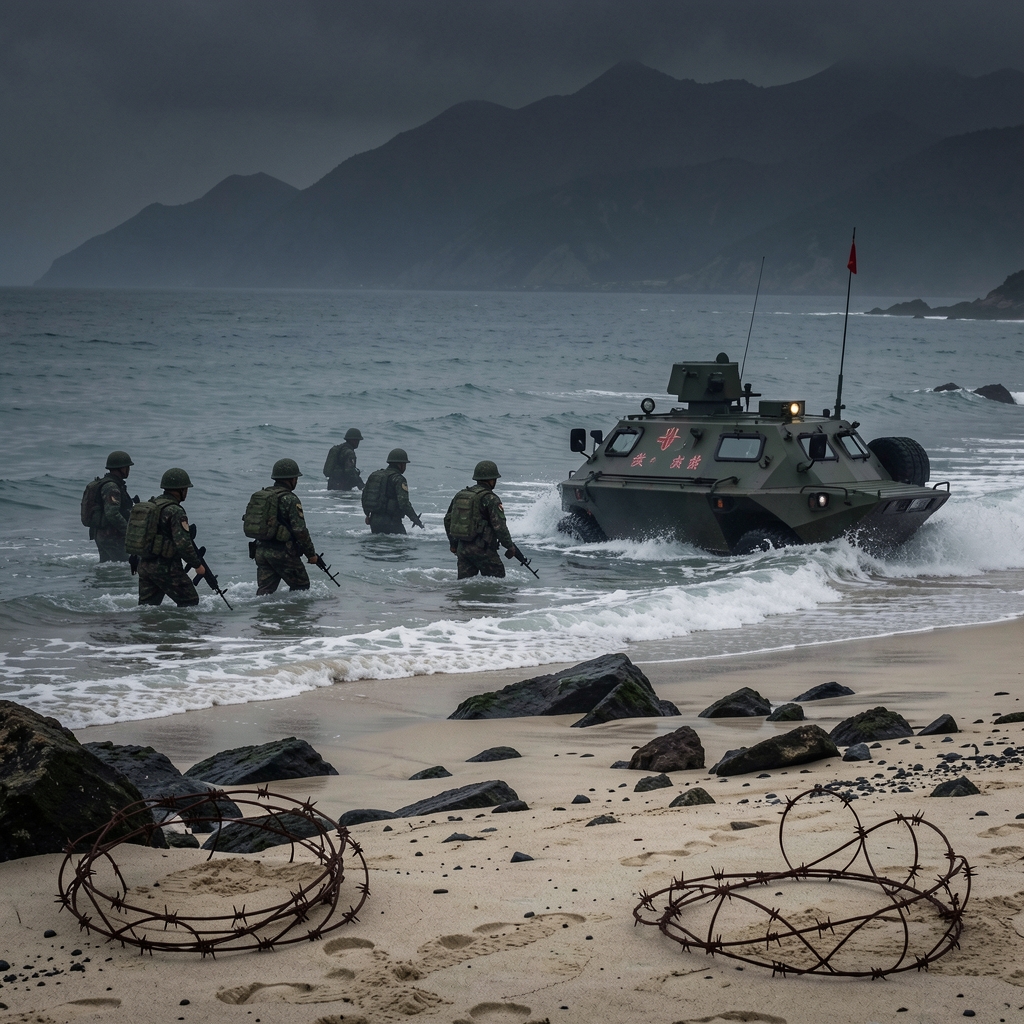
On the first anniversary of Taiwanese President Lai Ching-te’s inauguration, China’s military staged a high-profile amphibious landing drill in a move that has drawn international attention and underscored the escalating tensions in the Taiwan Strait. State broadcaster CCTV reported that elements from the People’s Liberation Army’s (PLA) 73rd Group Army executed a coordinated beach landing exercise along a strategic coastline, employing the Type 05 series amphibious vehicles. The drill, viewed from multiple vantage points by defense analysts, arrives at a time when cross-strait relations continue to oscillate between strategic ambiguity and overt demonstrations of force.
The exercise, vividly captured in images of landing vehicles approaching a shoreline, symbolizes not only China’s enhanced operational capabilities but also its readiness to project power in a region that has long been a flashpoint. Observers note that the timing of the exercise—coinciding with the anniversary of President Lai’s inauguration—carries an unmistakable political message, one designed to reaffirm China’s claims over Taiwan amidst an increasingly assertive military posture.
Historically, cross-strait relations have been fraught with tension. Since the retreat of the Nationalist government to Taiwan following the Chinese Civil War, Beijing’s commitment to the “One China” principle has remained unwavering. Over the past decades, occasional military drills, diplomatic maneuvers, and economic engagements have alternated in a complex and often uneasy dance. Against this backdrop, the recent amphibious landing exercise emerges as another calculated display of military might intended both as a deterrent and as an instrument of geopolitical signaling.
According to the CCTV report, the PLA’s 73rd Group Army leveraged the capabilities of the Type 05 amphibious vehicles—platforms designed for rapid deployment from sea to shore—to simulate operational conditions of a full-scale landing assault. The exercise appears designed to test logistical coordination, command and control mechanisms, and the integration of landing forces in an environment that replicates potential operational theaters in the Taiwan Strait. With these maneuvers, Chinese military planners are likely scrutinizing every aspect of amphibious warfare beyond routine readiness drills.
In addition to the operational mechanics of the drill, experts note several strategic reasons why this exercise matters. Its timing and location are no accident, and they speak volumes about China’s broader regional ambitions. The amphibious drill functions as a tangible reminder to both domestic and international audiences of the PLA’s evolving doctrine—a doctrine that increasingly emphasizes power projection, rapid response, and strategic deterrence.
The implications for regional stability are significant. As China continues to push its military modernization agenda, neighboring countries, particularly Taiwan, are compelled to reassess their defensive postures. The drill is likely to intensify calls from some quarters for strengthened alliances and increased military support, including arms sales and joint exercises, which further complicates the balance of power in the region.
Defense experts have weighed in on the potential ramifications. Dr. Bonnie Glaser, Director of the China Maritime Studies Program at the Center for Strategic and International Studies (CSIS), has observed that “such maneuvers serve as both a message and a rehearsal,” referring to China’s dual aims of deterring adversaries and preparing for potential contingencies. Dr. Glaser’s insights emphasize that while the exercise is demonstrative of enhanced amphibious capabilities, it also poses a critical challenge to regional security frameworks reliant on a delicate balance of power.
To understand the breadth of the situation, it is instructive to consider several key factors:
- Operational Readiness: The ability to conduct amphibious assaults is a cornerstone of modern military powerprojection, and the use of the Type 05 series vehicles indicates a level of sophistication and doctrinal evolution within the PLA.
- Political Timing: Scheduling the exercise on a politically significant anniversary amplifies its symbolic resonance, serving as a response to Taiwanese democratic milestones while reinforcing Beijing’s narrative on national unity.
- Regional Deterrence: The exercise reinforces a broader deterrent message aimed at dissuading foreign involvement in Taiwan’s defense, reflecting China’s growing impatience with what it perceives as external interference in a matter it considers an internal affair.
- Strategic Ambiguity: For observers beyond the immediate region, these maneuvers underscore the inherent unpredictability in cross-strait relations, where military readiness and political signaling intermingle in complex and sometimes contradictory ways.
This military action also warrants a closer look at its implications for international policy and military strategy. The PLA’s conduct of such a high-profile exercise invites comparisons to similar maneuvers throughout history, where readiness drills have often preceded shifts in geopolitical alliances and defense postures. As analysts consider the potential repercussions, there emerges a consensus that these events are not isolated military displays but part of a continuum of strategic recalibration in East Asia.
Indeed, the current state of affairs presents a multifaceted dilemma for policymakers. For the Taiwanese government, the exercise is a stark reminder of the looming military threat and necessitates a reevaluation of defense contingencies. Meanwhile, neighboring states and global powers with interests in regional stability face the challenge of balancing a commitment to peace with the practicalities of deterrence. The United States, for instance, has long maintained a policy of strategic ambiguity with regard to Taiwan—a stance that might be tested further if PLA amphibious capabilities continue to expand.
Looking ahead, observers expect that China’s military exercises will help refine amphibious landing protocols and contribute to an overall enhancement of PLA operational readiness. These developments could precipitate a recalibration of defense strategies not only across East Asia but also within the broader context of global maritime security. The potential for increased military spending, more frequent tactical drills, and strengthened defense partnerships is high as countries weigh the importance of credible deterrence in a volatile region.
As the PLA continues to modernize its forces and adopt advanced amphibious warfare strategies, the strategic landscape in the Taiwan Strait is poised for heightened vigilance. For Taiwan, this development means further pressure to boost its own defensive capacity and to seek reassurance from established allies. For analysts and policymakers, China’s latest exercise serves as both a warning and a test—one that highlights how military capability and political intent are increasingly inextricable.
In the final analysis, China’s amphibious drill is emblematic of a broader narrative: the inexorable push towards a new era in cross-strait relations and the complex interplay of military ambition and political symbolism. As global observers monitor these maneuvers, the fundamental question remains—how will this display of force shape the future of Taiwan Strait stability, and what measures will be taken to preserve the delicate balance in a region where history, politics, and military strategy converge?