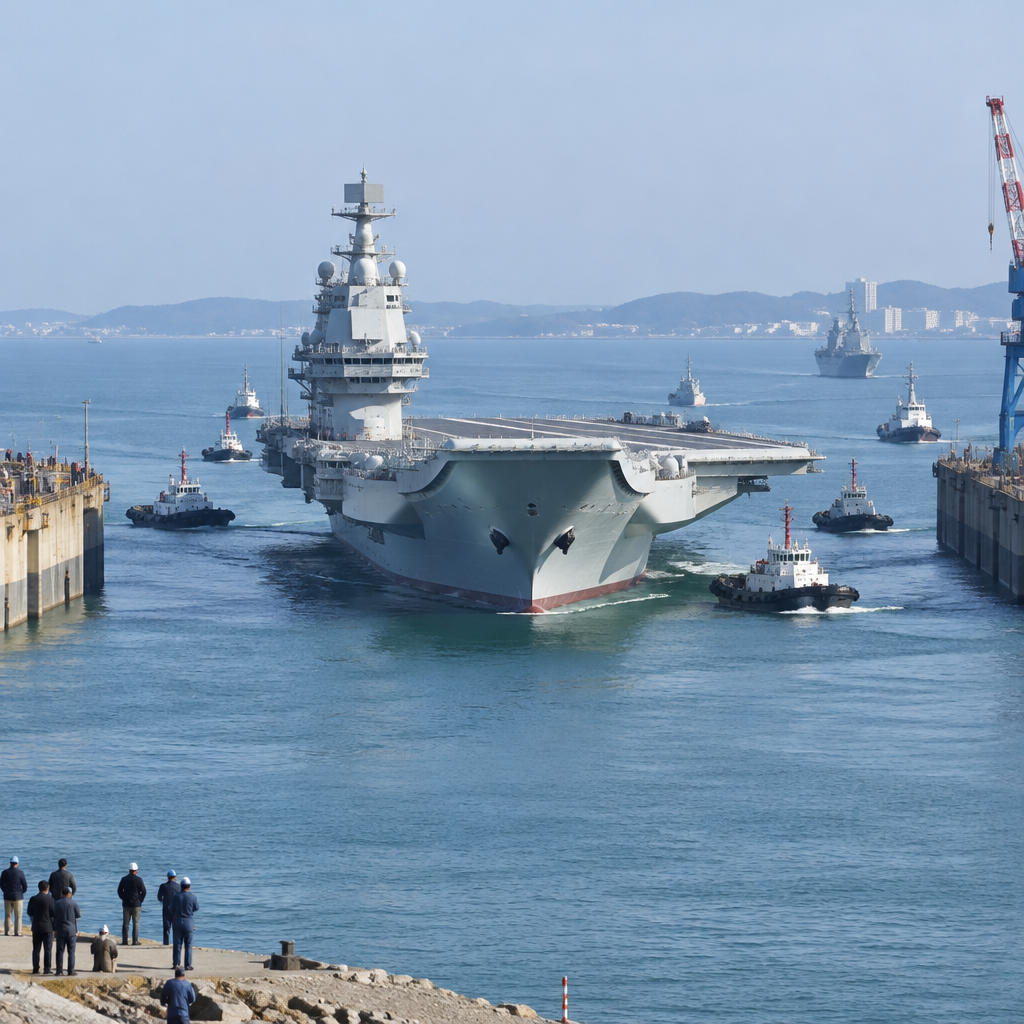
Roughly five months in dry dock: recent online images appear to show the aircraft carrier CV-17 Shandong departing the Yulin naval complex on Hainan Island, marking the end of a maintenance period that satellite imagery had placed as beginning in January 2026.
CV-17 Shandong departs Yulin naval complex
Images circulating on social media, reportedly taken by a tourist with a camera phone, appear to show CV-17 Shandong leaving Yulin on Hainan. The images are being discussed by PLAN watchers because they would provide a visible confirmation that the carrier has returned to sea after what the reporting describes as "roughly five months in dry dock."
The account does not offer an exact departure date in its text, but it explicitly links the visible movement to the dry-dock period that began earlier in 2026.
Satellite imagery and the January 2026 dry-dock entry
Satellite imagery had previously confirmed that Shandong entered Yulin's carrier-capable dry dock in January 2026. The report highlights a departure from prior maintenance practice: this was the first time a Chinese aircraft carrier reportedly underwent major maintenance at Yulin rather than returning to Dalian.
That change — moving major carrier work to a southern facility on Hainan Island — is a discrete, documented shift in where heavy maintenance was performed, according to the same account that noted the photographer’s images.

Audit-ready is a season. It shouldn't be.
Evidence in spreadsheets, controls drifting between audits, frameworks multiplying on flat headcount. Nubivance runs continuous compliance on Rapid7 Cyber GRC - SOC 2, HIPAA, ISO 27001, PCI, CMMC.
End the scrambleSanya Naval Base construction and carrier support on Hainan
The wider Hainan complex is also featured in the record: a prior photo essay described "bustling construction" at China's South China Sea Aircraft Carrier Support Base at Sanya, with work underway to make the facility capable of accommodating all three of China’s aircraft carriers simultaneously. The same series captured CV-17 and CV-18 together at Sanya Naval Base on October 1, 2025.
That construction narrative adds context to the Shandong maintenance story: the island’s bases are not only hosting carriers for shorter visits but are being prepared to handle larger, more sustained carrier operations and services.
Carrier rotations and Hainan ports: past movements noted
The material records a pattern of carriers spending time on Hainan in prior years. A post from October 8, 2024 described the PLAN's winter "snowbird" deployment to Hainan, noting that Hainan Jin Jiaomu Port was where CV-16 and CV-17 were "vacationing." Earlier posts also noted other southern deployments and exercises, including maritime safety notices tied to military exercises around Hainan in late December 2020 and early January 2021 (notices HN0127, HN0128, HN0129).
Together these items create a short documentary trail: seasonal carrier visits, construction of expanded support infrastructure, and now a documented in-place, multi-month maintenance episode at Yulin.
What this means for naval analysts, regional policymakers, and satellite imagery analysts
- Naval analysts: Will treat the Yulin dry-dock episode as evidence that heavy carrier maintenance can be performed on Hainan rather than at Dalian. The combination of satellite confirmation in January 2026 and recent visual images of departure strengthens that assessment.
- Regional policymakers: Should note the operational implication that Hainan’s support facilities are being scaled — and used — in ways that reduce the need for carriers to transit back to northern shipyards for major work. Those logistics shifts change basing and sustainment calculations in the region.
- Satellite imagery analysts and open-source investigators: Will see a working example of how low-resolution social-media imagery and higher-altitude satellite confirmations can be combined: satellite data flagged the dry-dock entry in January 2026, while a tourist photo appears to show the ship leaving months later.
Shandong’s departure from Yulin, as reported, is a discrete item of operational information: it documents both a physical movement and a procedural change — major carrier maintenance conducted on Hainan rather than in Dalian. For observers, the concrete next question embedded in those facts is simple and specific: will future carriers follow the same maintenance pattern at Yulin, and will the Sanya complex reach the capacity to host all three carriers as the construction work described intends? The recent images and the January satellite confirmation provide the evidentiary baseline that analysts will use to answer it.