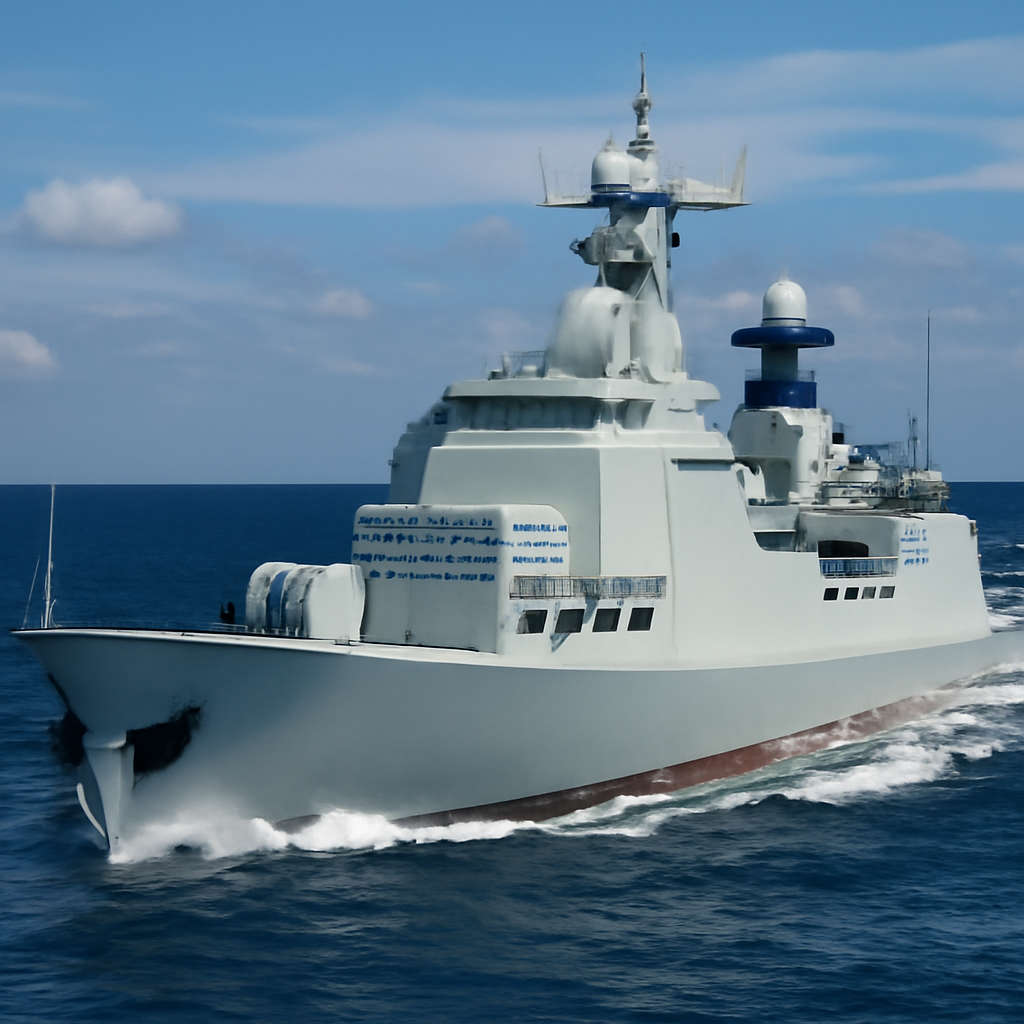
"The S-300 was a stopgap solution from day one," wrote China Defense Blog — and a new photo of the Type 051C destroyer Shenyang (DDG 115) at sea appears to prove the point.
Shenyang (DDG 115): visible changes at sea
A recently surfaced image shows the upgraded Type 051C Shenyang underway with clear changes to its forward superstructure. The distinctive revolving launchers and associated fire-control radar of the Russian S-300F "Rif‑M" system have been removed. In their place are four 8‑cell HQ‑10 short‑range air‑defense launchers. The blog notes additional, unspecified modifications are visible in the photo, and that the ship had been largely absent from public view for more than a year — a gap many observers had taken to indicate an ongoing modernization.
S-300F's role: an interim solution inside a Chinese hull
The blog frames the S‑300F as an intentional interim measure. According to the post, the Type 051C was effectively "a Chinese hull wrapped around a Russian S‑300F system" and provided a rapid fleet‑area air‑defense capability while indigenous systems matured. The S‑300F, the blog argues, "served its purpose" but never became the long‑term foundation of PLAN surface‑to‑air capability: outside the two Type 051C destroyers, the S‑300 never spread throughout the navy. The post says the future instead "belonged to the HQ‑9 family and the domestic combat systems that came with it."

This site is the portfolio.
OSINTSights runs on Cloudflare Workers, D1, R2, and Vectorize, with an AI pipeline on Hetzner ARM. Nubivance designed, built, and operates it. We do the same for clients.
See what we buildDomestic ecosystem over individual systems
The author sharply reframes the update on Shenyang as part of a broader shift: modern military power, the post says, is less about discrete platforms than about whether systems belong to a common command‑and‑control, logistics, software, sensor, and weapons architecture. "The PLAN of 2026 is built around a domestic ecosystem, not an imported one," the blog states, arguing that value now flows from how well a ship, submarine, or battery integrates into an overall "kill chain" rather than from the hardware alone.
Kilo retirements and the pattern of "Sino‑ization"
The blog extends the ecosystem thesis to China’s submarine force, detailing a string of Kilo‑class retirements and retrofit practices. It lists three confirmed retirement groups from China’s Kilo acquisitions: 2 Project 877EKM boats (ordered 1993), 2 Project 636 boats (ordered 1997), and 8 Project 636M Improved Kilo boats (ordered 2002). One specific boat, Kilo 877EKM pennant 365, arrived in 1995 and was decommissioned in 2021 after multiple refits that replaced Russian subsystems with Chinese communications and electrical equipment and installed an H/ZQQ‑5 photoelectric mast in place of traditional optical periscopes. The blog emphasizes that imported platforms are often progressively fitted with domestic subsystems where practicable.
The post contrasts the Kilo experience with the handling of older Ming‑class boats: rather than scrapping them, the PLAN transferred two Type 035G Mings to Bangladesh and one Type 035B to Myanmar. By contrast, the blog reports that retired Kilos appear to be heading to museums rather than foreign buyers, and proposes three possible explanations drawn from the record: they may not be attractive to buyers; they may be too complicated to support outside the PLAN; or legal end‑user and third‑party transfer restrictions embedded in original contracts might constrain resale. The author searched for details of the original Sino‑Russian Kilo contracts and found no public record addressing transfer restrictions.
What this means for the PLAN, Bangladesh/Myanmar, and naval analysts
- For the PLAN: The Shenyang refit, the blog argues, illustrates a continuing prioritization of domestic subsystems and architectures — swapping a foreign missile system for HQ‑10 batteries and, implicitly, systems that better fit China’s command and logistics networks.
- For Bangladesh and Myanmar: The post highlights divergent approaches to retired boats — Mings were transferred to those countries, while Kilos appear destined for museums — suggesting recipient nations may prefer platforms that sit squarely inside Chinese logistics and training ecosystems.
- For naval analysts and procurement planners: The case is offered as a reminder that platform capability is increasingly judged by network integration. Chinese practice, per the blog, favors retrofitting or retiring systems based on fit with a domestic combat ecosystem rather than on hull age alone.
Shenyang’s appearance at sea is more than a photographic curiosity. Taken together with the Kilo retirements and the blog’s broader argument, it underlines a deliberate move: from imported point solutions toward systems that conform to a domestic, networked combat architecture. The details the post supplies — S‑300F removal, HQ‑10 installation, the H/ZQQ‑5 mast on refitted Kilos, and the list of decommissioned Kilos — give a clear snapshot of that process, even as questions remain about contractual constraints on re‑exports and the fate of the sister Type 051C.
https://china-defense.blogspot.com/2026/10/first-look-at-upgraded-type-051c.html