"the emphasis on “capability” rather than platforms and numbers," Admiral Naveed Ashraf told Quwa in a recent interview — a concise formulation that frames Pakistan’s current defence calculus.
Admiral Naveed Ashraf and the Navy’s shift toward capability
In Quwa’s interview, the Pakistan Navy Chief of Naval Staff (CNS), Admiral Naveed Ashraf, stressed a modernization roadmap that privileges capability over the sheer acquisition of platforms and force-size metrics. The reporting underlines a concrete fiscal reality: Pakistan is "fiscally constrained" and therefore cannot rely solely on platform procurement to improve its defence posture. That constraint helps explain the Navy’s rhetorical and practical shift to capability-based priorities.
Precision-guided munitions scale and design choices
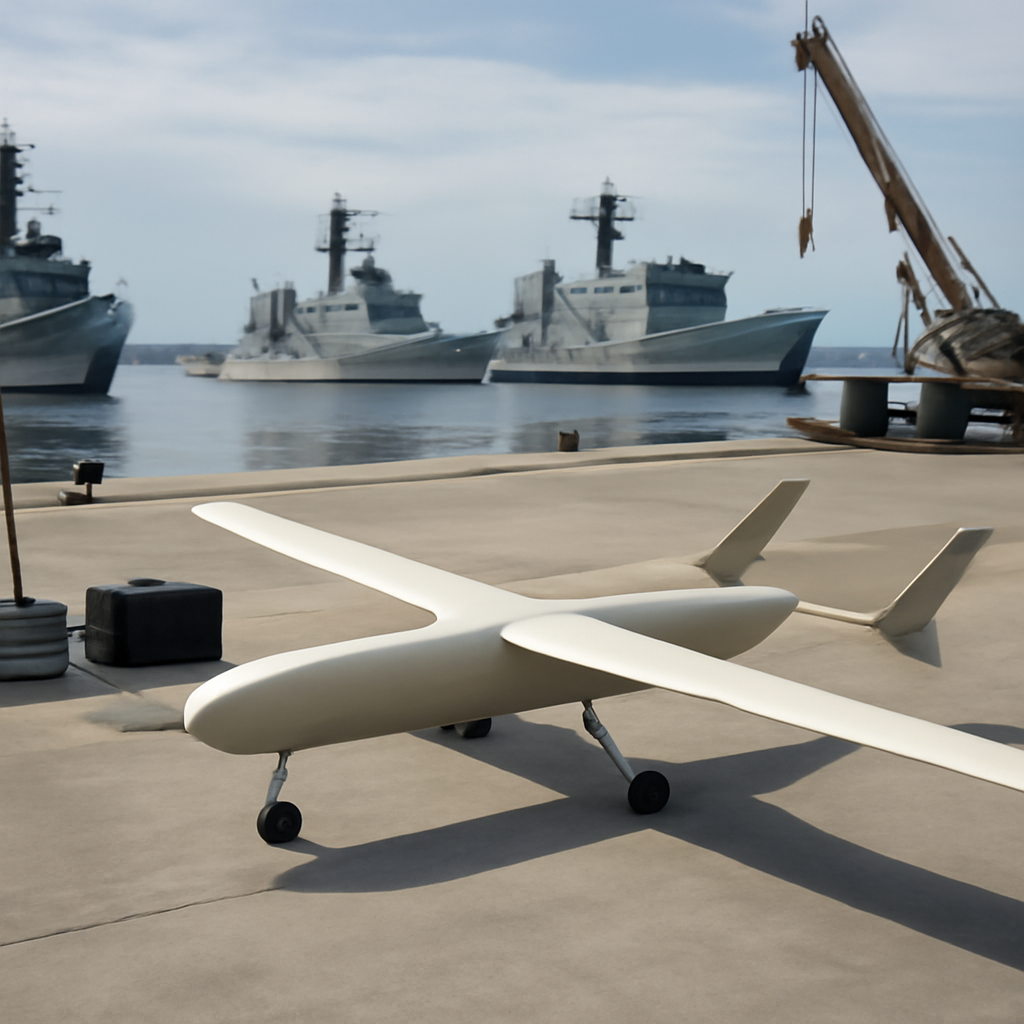
Quwa’s analysis places that capability emphasis alongside Pakistan’s rapidly developing precision-guided munitions (PGM) program. Earlier Quwa reporting, referenced in the same piece, identifies an explicit push to drive PGM scale — visible through "more frequent testing and simpler munitions designs." In other words, Pakistan is pursuing quantity and design simplicity as part of a strategy to field more PGMs while working within budgetary limits.

Audit-ready is a season. It shouldn't be.
Evidence in spreadsheets, controls drifting between audits, frameworks multiplying on flat headcount. Nubivance runs continuous compliance on Rapid7 Cyber GRC - SOC 2, HIPAA, ISO 27001, PCI, CMMC.
End the scrambleSurvivability as an equally crucial procurement axis
The piece argues that scale alone is not enough: survivability of PGMs in contested airspace is an "equally crucial" component. Drawing lessons from the Russia-Ukraine War and the Middle East War, Quwa highlights survivability as a major procurement consideration. For Pakistan, the problem is heightened because India "maintains a relatively dense, high-tech integrated air defence system (IADS)," and will "certainly invest in 'soft' and passive elements like electronic warfare (EW) density." The upshot in Quwa’s framing: delivering ordnance successfully requires designing PGMs that can survive in dense IADS and EW-intensive environments.
NESCOM’s early attention to viability and survivability
Quwa reports that Pakistan's National Engineering & Scientific Commission (NESCOM) began thinking about viability and survivability in IADS/EW-dense spaces "fairly early on — i.e., prior to 2024." That timing matters: it suggests Pakistani technical planners had anticipated contested, electronically degraded operating environments before the recent intensification of lessons learned from active conflicts elsewhere. The Demand Tracker’s headline — invoking mesh networking for Pakistan’s loitering munitions — signals one technological approach under consideration to improve command, control and resilience of loitering PGMs, although Quwa’s text emphasizes the broader survivability imperative rather than detailing particular technical schemes.
How the Pakistan Navy, NESCOM, and India’s IADS are responding
- Pakistan Navy — The Navy is prioritizing capability over additional platforms and numbers, a posture that aligns with fiscal constraints and an operational aim to field effective systems rather than just larger fleets.
- NESCOM — Having considered viability and survivability prior to 2024, NESCOM appears to be directing engineering effort toward PGM resilience in electronically contested environments; the Demand Tracker’s focus on mesh networking suggests technical options are being explored to sustain connectivity and mission success for loitering munitions.
- India and its IADS — India’s relatively dense, high‑tech integrated air defence system and its anticipated investment in EW and passive measures represent the external threat environment that shapes Pakistan’s emphasis on survivability alongside scale.
Pakistan’s PGM strategy, as presented by Quwa, is therefore two-pronged: expand munition numbers and simplify designs to reach scale, while simultaneously hardening those munitions against detection, jamming and interception in an IADS- and EW-intensive battlespace. NESCOM’s pre‑2024 focus on survivability, coupled with the Demand Tracker’s attention to mesh networking for loitering munitions, indicates planners are already working to close the gap between quantity and effectiveness.
The practical question left by this reporting is sharply focused: can the combination of scaled, simpler PGMs and survivability measures — including networked command links for loitering weapons — deliver reliable strike effects against a dense, evolving IADS? Quwa’s coverage shows Pakistan is attempting to answer that question on two fronts at once: procurement scale and survivability engineering.
Source: Quwa — Demand Tracker: Mesh Networking for Pakistan’s Loitering Munitions