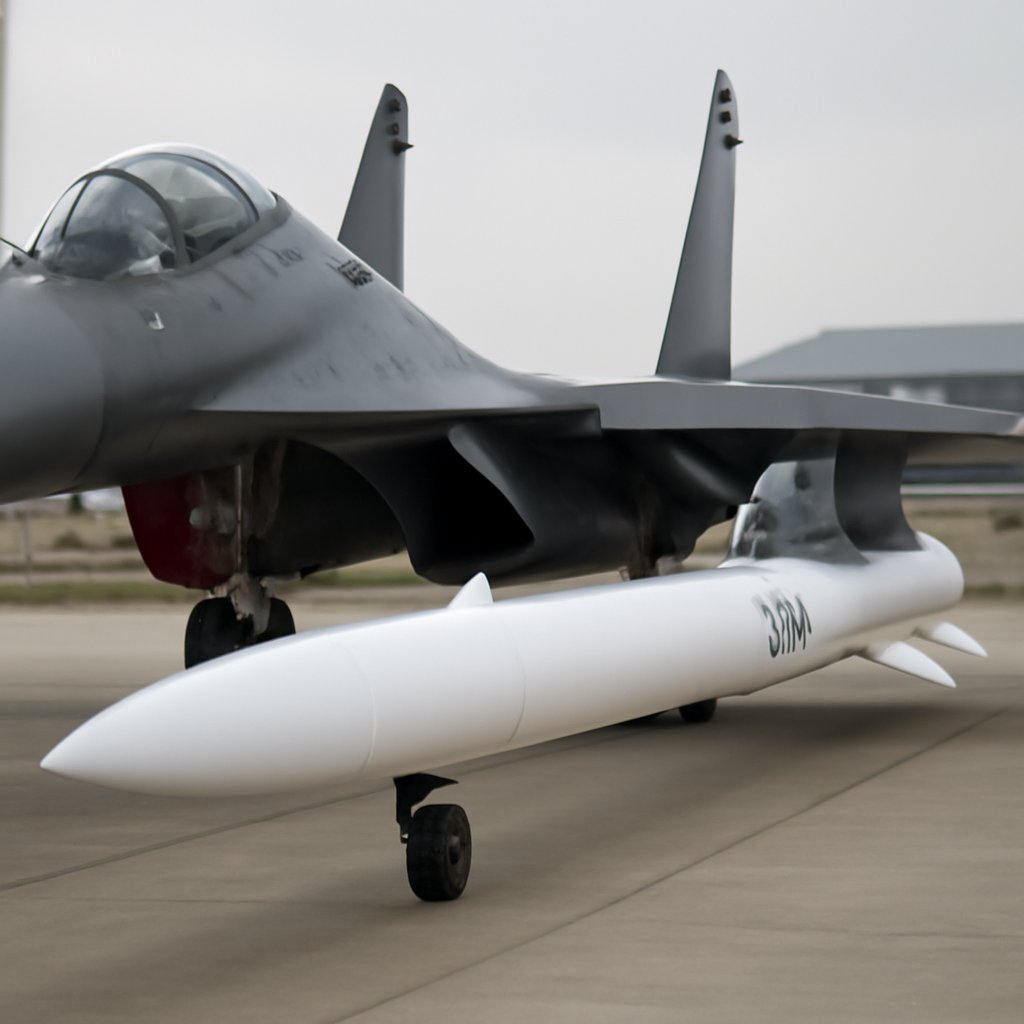
The missile is roughly six meters long.
PL‑17 missile dimensions: a single, verifiable detail
Much has been written, or, more accurately, speculated about the PLAAF’s PL‑17 extreme‑long‑range air‑to‑air missile. Amid debate over range, speed, seeker type, datalink, guidance logic and every other attribute enthusiasts and analysts can imagine, there is one concrete, repeatedly visible fact: the PL‑17 is huge. The source material confirms a length of roughly six meters, and photographic evidence consistently gives the same impression — a weapon whose physical presence dominates the hardpoint on which it sits.
Public speculation catalogued: range, speed, seeker, datalink, guidance
The public conversation around the PL‑17, as recorded in the source, is largely speculative. Commentators and analysts argue about the missile’s range, its speed, what kind of seeker it employs, whether it has a datalink and how its guidance logic might be arranged. Those lines of debate are noted here not to endorse any particular technical claim but to underline that much of the PL‑17 story, beyond size, rests on inference rather than confirmed reporting.

Audit-ready is a season. It shouldn't be.
Evidence in spreadsheets, controls drifting between audits, frameworks multiplying on flat headcount. Nubivance runs continuous compliance on Rapid7 Cyber GRC - SOC 2, HIPAA, ISO 27001, PCI, CMMC.
End the scramblePhotographic record and the J‑16 airframe
The central visual cue repeated in the material is photographic: images exist that show the PL‑17 installed on an airframe identified in the source as the J‑16. Those images are the basis for the one non‑speculative observation available — the missile’s length and the way it occupies its mounting. Beyond the photographs’ consistent visual signal of scale, the source emphasizes that the remaining attributes of the weapon remain the subject of argument and conjecture.
What this means for analysts, open‑source imagery teams, and military planners
- Analysts and military planners: With the PL‑17’s size repeatedly confirmed in imagery, analysts have one reliable input for modeling carriage, aerodynamic effects and platform integration. That single, visible fact narrows certain lines of technical inference even as it leaves performance characteristics open to debate.
- Open‑source imagery teams: Photographs are doing the evidentiary work here. For open‑source teams, the lesson is procedural: collect high‑quality imagery, document mounting and orientation consistently, and make scale the starting point for any further technical reading where other sensor data are absent.
- Observers and commentators: The record in this source suggests caution. Where imagery yields a clear, repeatable fact — the missile’s length — commentary should take that as foundation, and treat other attributes as provisional until verified.
A visual fact reframes the story
The source’s framing is crisp: despite extensive public debate over technical specifications and capabilities, the one verifiable element is simple and concrete — the PL‑17 looks large, and it measures roughly six meters. That single fact has a moderating effect on the louder claims that populate discussion forums, tweets and technical roundtables: when photographic evidence answers one question decisively, analysts should let it guide how they weigh more hazardous inferences.
The takeaway is not that the rest of the debate is irrelevant. It is that the debate must be tethered to the evidence that exists. In this case, what we can confidently say about the PL‑17 is limited and visually grounded: an extreme‑long‑range air‑to‑air missile, field‑identifiable by its size, repeatedly photographed in a way that underscores its physical dominance on the aircraft hardpoint. Everything else remains, for now, an argument built atop that visible fact.
Read the original: Is That a PL‑17 on a J‑16? Yes — and the Real Story Isn’t the Missile.