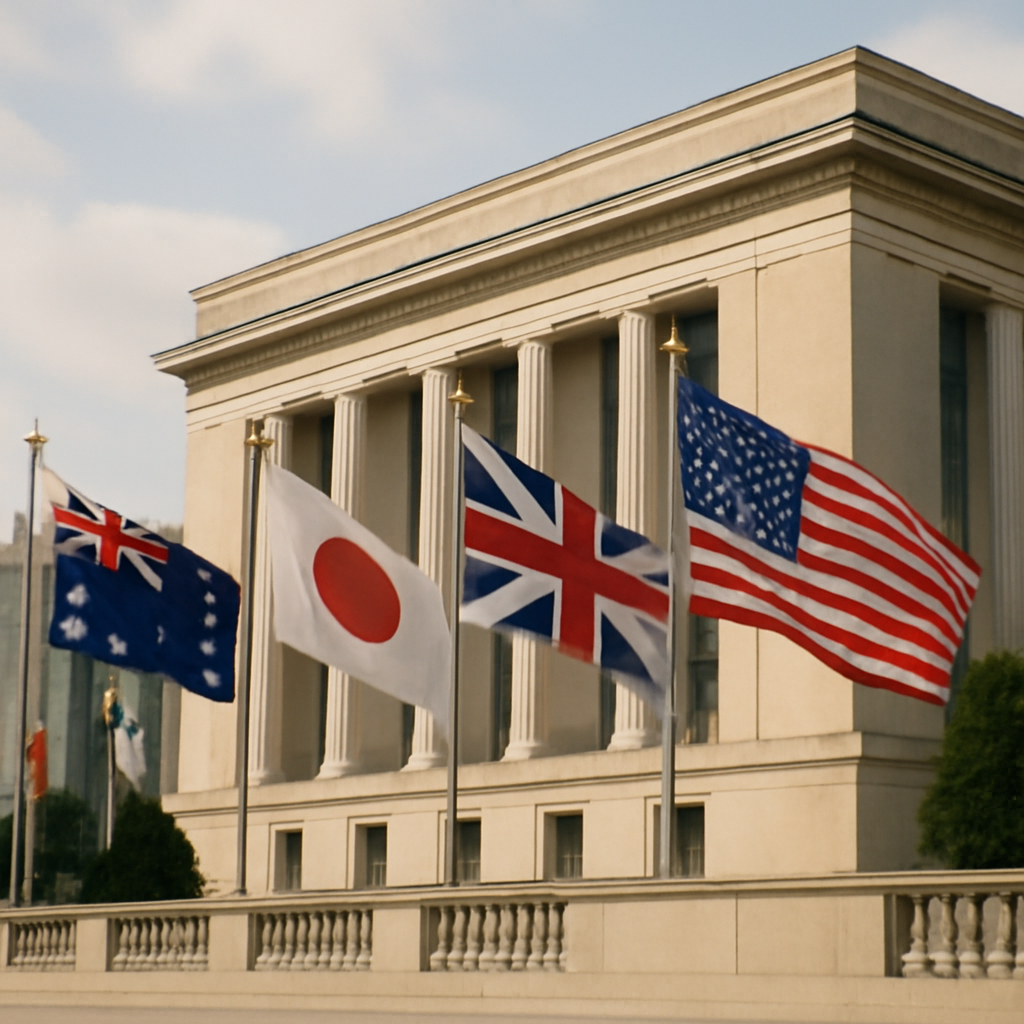
On the award’s 10th anniversary, 14 governments, including Australia, Japan, Britain and the United States, issued a joint statement reaffirming the award, while the European Union released a separate statement saying the same thing.
2016 arbitral award and the anniversary that exposed silence
The 2016 arbitral tribunal under the United Nations Convention on the Law of the Sea found “there was no legal basis for China’s expansive ‘historic rights’ claim.” That decision was final and binding. Yet, a decade later, the public reaffirmation by 14 governments and the European Union’s separate statement stood alongside a notable silence from many others. The source points to multiple possible explanations — domestic politics, alliance management and differing threat perceptions — but asks whether economic pressure is increasingly shaping which lawful positions governments will publicly defend.
Australia’s experience: targeted restrictions on five export sectors
China’s restrictions on Australian wine, barley, lobster, timber and coal are presented in the source as an illustrative case of modern economic coercion. Those measures, the piece argues, targeted sectors where Australia had concentrated asymmetric dependence. The cost to Beijing, the source contends, was low; whether the intent was to compel immediate policy change or to signal the consequences of future decisions matters less than the broader strategic effect: economic interdependence can impose political costs without military confrontation.

The cyber insurance questionnaire just landed. Now what?
SOC 2, HIPAA, insurance renewals - someone has to own security strategy. Nubivance provides fractional CISO leadership without the full-time salary.
Get a security leadWeaponised interdependence: scholars and the shifting toolkit of influence
The essay situates the phenomenon in a line of scholarly work. It cites Albert Hirschman’s analysis of how unbalanced trade creates influence, Robert Keohane and Joseph Nye’s theory of complex interdependence, and recent arguments by Henry Farrell and Abraham Newman that control of critical nodes allows actors to turn interdependence into “weaponised interdependence.” The key change, the source says, is not that coercion exists but that it now operates with greater precision, persistence and reach — economic pressure can be applied more frequently, more precisely and at considerably lower political risk than military force.
How the United States’ instruments are described as different
The piece notes that the United States also uses sanctions, export controls and tariffs to pursue strategic objectives, but stresses a contrast: these instruments “differ from China’s approach, particularly in their legal foundations, transparency and stated purposes.” The source explicitly states they are “not morally equivalent,” framing the issue as one where tools and their justificatory frameworks matter to how coercion is judged.
What this means for Indo‑Pacific governments, Australian exporters, and defence partnerships
- Indo‑Pacific governments: They face choices across artificial intelligence, semiconductors, critical minerals, digital infrastructure, investment screening, Taiwan, the South China Sea and defence partnerships — each carries potential economic consequences that may now shape not only what policies are made but which are even considered.
- Australian exporters: The experience with wine, barley, lobster, timber and coal shows how concentrated dependence on a single market can leave sectors exposed to precise restrictions that impose political pressure without military conflict.
- Defence and alliance planners: The piece highlights a strategic effect beyond immediate trade losses — repeated demonstrations of economic leverage can narrow a country’s “strategic decision space,” encouraging decisions to be ruled out before they are formally debated.
Preserving the practical freedom to govern
The central prescription in the source is not a rejection of globalisation but a focus on preserving sovereignty understood as the freedom to make policy choices. Diversified markets, resilient supply chains, trusted technology partnerships and stronger domestic capability, the source argues, are means to reduce concentrated asymmetric dependence. Their purpose is explicit: to keep future governments free to consider “every policy option that serves Australia’s interests, democratic values and international legal obligations.”
The final, stark test the source offers is a measure of success for modern economic coercion: not tariffs imposed or exports lost, but “the sovereign choices governments quietly conclude are no longer worth making.” In that frame, the strategic task is clear — to protect not only physical borders and alliances, but the practical space in which democracies can govern.
https://www.aspistrategist.org.au/preserving-freedom-to-govern-in-the-face-of-economic-coercion/