Why does a coast guard operation need decades‑old landing ships that can carry "four full‑size tanks" or "200 and so troops"? That blunt question, raised in a recent blog post, frames a practical and political puzzle about capability, posture and intent.
Background: an unexpectedly heavy tool in a maritime service
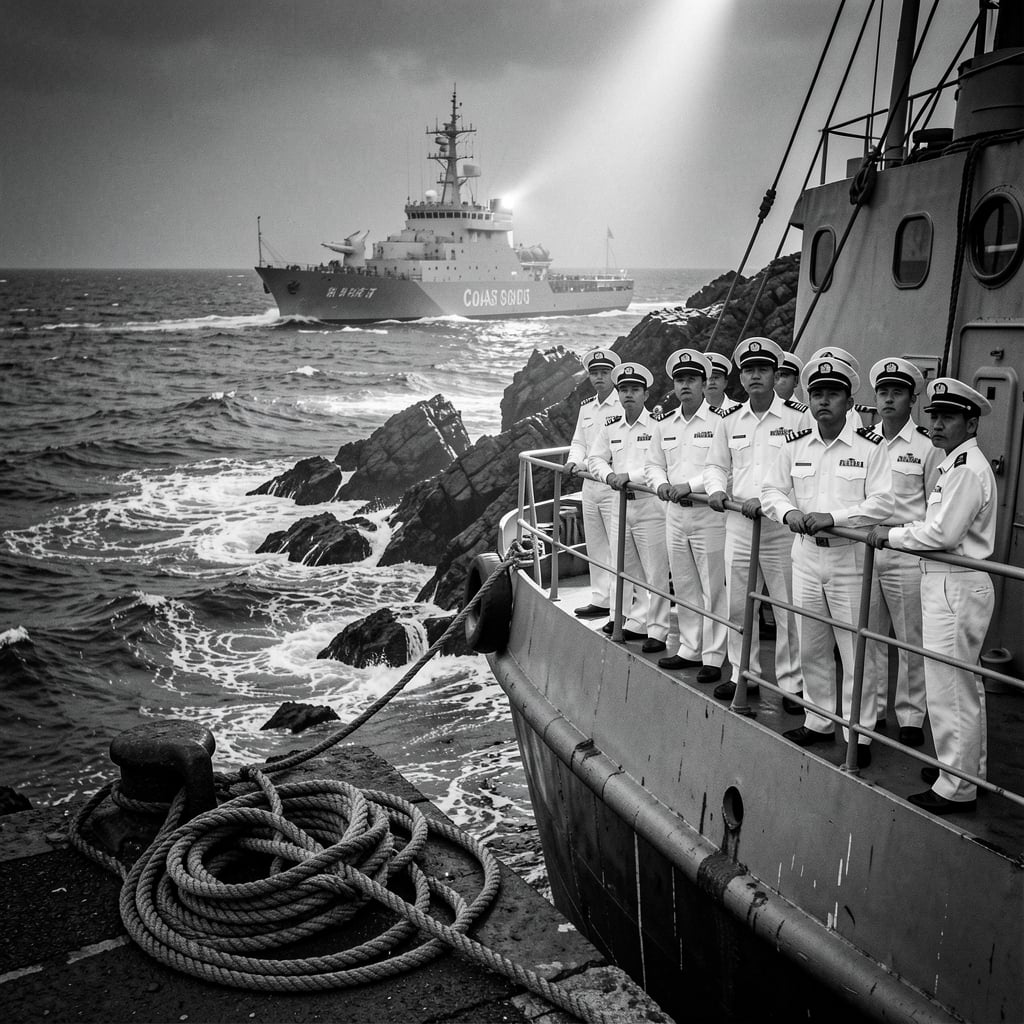
Photos published on the China Defense blog show the China Coast Guard operating Type 271 Landing Ship Medium (LSM) vessels. The post describes these hulls as "ancient commissioned back when cassette tapes were still cool," and notes their cargo and personnel capacity: they "can still carry and unload four full‑size tanks or 200 and so troops." The same post asks why a coast guard would operate such ships and sketches a scenario — an island 120 miles east of China occupied by "runaway criminals" — to illustrate why a larger, armored presence might be brought to bear.
Current situation: capability, optics and the question of use
The salient facts from the source are simple. The China Coast Guard reportedly possesses Type 271 LSMs; those vessels have substantial payload and offload capability; and the ship class is described as older but operational. The blog frames the coexistence of a coast guard role and heavy amphibious lift as at least curious, raising the specter of situations where a patrol boat would be insufficient and a show of heavier force would be chosen instead.

This site is the portfolio.
OSINTSights runs on Cloudflare Workers, D1, R2, and Vectorize, with an AI pipeline on Hetzner ARM. Nubivance designed, built, and operates it. We do the same for clients.
See what we buildWhy it matters: perspectives and potential implications
- Technologists and naval analysts: The pairing of an older LSM design with modern coast guard operations invites questions about maintenance, interoperability and mission fit. A platform capable of carrying multiple main battle tanks or an equivalent infantry detachment is, by design, suited for amphibious operations and heavy logistics rather than routine law enforcement patrols. The blog's emphasis on the ships' age also highlights lifecycle and sustainment considerations for such platforms.
- Policymakers and strategists: The presence of heavy landing ships in a coast guard fleet blurs traditional lines between civilian law enforcement at sea and military amphibious capability. Even without additional context, the published capacities — tanks and roughly 200 personnel — suggest the Coast Guard could project a level of force beyond typical constabulary tasks. The blog's hypothetical island scenario underscores how authorities might prefer a larger platform when confronting organized, entrenched actors in littoral or insular settings.
- Users and regional observers: For local populations and maritime communities, the use of an LSM rather than a small patrol craft changes the tenor of an intervention. The blog's phrasing — that sending a patrol boat "feels rude" compared with arriving "with armor" — points to the signaling value of platform choice: escalation in visible capability can alter perceptions of intent and legitimacy on the scene.
- Adversaries and provocateurs: From an opposing perspective, the documented ability to lift armored vehicles and hundreds of personnel could be interpreted as preparation or readiness for amphibious or high‑intensity interdiction missions. Even if the vessels are older, their functional capacities remain relevant to operational planning and deterrence calculus, as the blog implicitly suggests.
Conclusion: a capability that raises questions
The blog post leaves the reader with a terse image: an outdated hull type, still able to haul armor and people, and a rhetorical why about its place in a coast guard fleet. That combination — aging hardware with substantial lift — invites careful questions about mission alignment, signaling and rules for the use of force in maritime contexts. If a patrol boat is too small and a landing ship is too much, where is the middle ground? The photograph and the caption do more than document a vessel; they prompt a strategic question: at what point does coast guard capability become an instrument of power projection rather than constabulary presence?