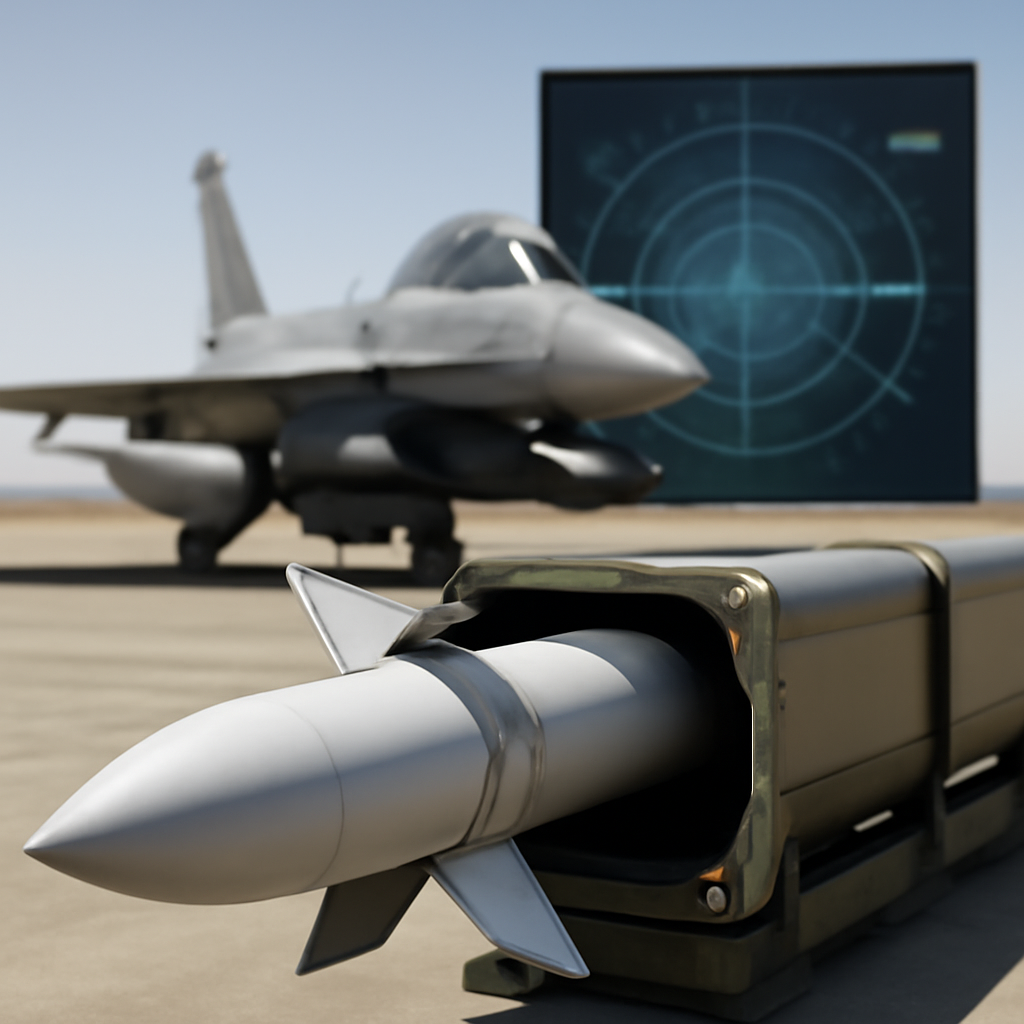
"Aircraft carrier killer," Pakistan Air Force officials have called the CM-400AKG — a blunt phrase that captures both the missile’s intended shock value and the doctrinal shift its users describe. What the label hides is a weapon that is neither a traditional cruise missile nor a simple guided rocket, but a solid‑fuel, air‑launched, quasi‑ballistic weapon that reaches its highest velocity in a steep terminal dive.
Design and flight profile: rocket boost, high-altitude arc, steep terminal dive
The CM-400AKG, developed by the China Aerospace Science and Industry Corporation (CASIC), derives from the SY-400 guided rocket family. It is powered by a single solid‑fuel rocket burn that propels the weapon upward; the missile then coasts on a ballistic‑like arc before executing a steep, high‑speed terminal dive toward its target. That descent is where the weapon reaches Mach 4–5 terminal speeds, concentrating kinetic energy to compress a defender’s reaction window.
This flight profile separates the CM-400AKG from ramjet‑powered cruise missiles: it is not a sustained‑flight cruise missile but an air‑launched quasi‑ballistic missile. That difference has tactical implications — defenders must engage high‑angle, high‑velocity inbound threats rather than the low‑altitude, sea‑skimming threats other anti‑ship missiles present.
Seeker options and mission flexibility
The missile can be fitted with two primary seeker types: an imaging infrared/TV seeker for anti‑ship and land‑attack roles, and a passive radar seeker for suppression of enemy air defences (SEAD) and anti‑radiation missions. That dual‑role flexibility distinguishes the CM-400AKG from most comparable weapons, and the passive radar configuration is central to the weapon’s reported use in the May 2025 India‑Pakistan conflict.

Audit-ready is a season. It shouldn't be.
Evidence in spreadsheets, controls drifting between audits, frameworks multiplying on flat headcount. Nubivance runs continuous compliance on Rapid7 Cyber GRC - SOC 2, HIPAA, ISO 27001, PCI, CMMC.
End the scrambleOperators and platform integration: Pakistan, Serbia, and the PLAAF listing
The Pakistan Air Force (PAF) is the CM-400AKG’s primary and longest‑standing operator. Pakistan’s Ministry of Defence Production confirmed procurement of 60 units in 2017–2018, and the JF‑17 Thunder is the missile’s designed stand‑off launch platform, able to carry two CM-400AKGs on underwing pylons. Video from January 2024 confirmed that the Chengdu J‑10CE can also carry the weapon.
In March 2026 Serbia became the second confirmed export operator, with images showing a MiG‑29SM+ carrying two CM-400AKGs. That integration was enabled by universal pylons supplied by the China National Aero‑Technology Import & Export Corporation (CATIC) and marks the first European deployment of the weapon. The People’s Liberation Army Air Force (PLAAF) is also listed as an operator in public materials, though detailed public information on its employment is limited.
Combat employment in May 2025: SEAD role and contested claims
The CM-400AKG reportedly saw its first combat use during the May 2025 India‑Pakistan conflict. Pakistani accounts, amplified by Chinese state media and reported by outlets such as Army Recognition, say a JF‑17 launched a CM-400AKG with a passive radar seeker against an Indian S‑400 Triumf radar at Adampur and that the strike was successful. Indian sources, including the Indian Air Force account reported in Vishnu Som’s book The Sky Warriors: Operation Sindoor Unveiled, state that roughly 60 CM-400AKG missiles were launched toward the Adampur S‑400 complex over four days but that none hit the battery; the S‑400, supported by Barak‑8 and Akash systems, reportedly intercepted or deflected the inbound missiles.
Neither side’s claims has been independently verified as of May 2026. What is analytically significant is doctrine: the PAF’s use of an anti‑ship weapon in a SEAD/anti‑radiation role represents a deliberate adaptation of the CM‑400AKG’s passive radar seeker to target high‑value air‑defence systems, exploiting the missile’s steep‑dive profile to reduce radar operators’ “shutdown‑or‑die” decision window.
Specifications and the unresolved performance gap
Public figures for the CM-400AKG diverge sharply. CASIC and AVIC marketing materials presented at air shows in 2013 and 2016 listed a range of 100–240 km, a terminal speed of Mach 4–4.5, a 150 kg blast or 200 kg penetration warhead, a diameter of 400 mm, and a weight of roughly 910 kg. The AVIC video also claimed accuracies of 50 m CEP with INS/GNSS alone and 5–10 m CEP with an active terminal seeker.
After the May 2025 conflict, PAF officials quoted in AirForce Monthly (November 2025) reported markedly different performance: a 400 km range, Mach 5 terminal speed, and a terminal locking range of 30 km. Whether that discrepancy reflects an upgraded variant, conservative pre‑conflict marketing, or wartime overstatement remains unresolved in the public record as of May 2026.
What this means for the PAF, Serbia, and Indian air‑defence planners
- Pakistan Air Force: The CM‑400AKG provides a high‑speed stand‑off option that complements sea‑skimming threats and fills a niche in Pakistan’s strike doctrine; reported wartime use and post‑conflict specifications will likely influence follow‑on procurement and tactics.
- Serbian Air Force / Belgrade: Integration onto MiG‑29SM+ fighters demonstrates cross‑platform adaptability and broadens Serbia’s high‑speed strike options, leveraging universal pylon interfaces to mount Chinese munitions on Russian‑designed airframes.
- Indian air‑defence planners: The missile’s SEAD employment and steep‑dive profile underline the need to address high‑angle, high‑speed inbound threats in addition to low‑altitude sea‑skimming missiles — a dual‑axis problem that complicates fleet and site defence priorities.
The CM‑400AKG is now a fielded, exportable element of a multi‑vector anti‑ship and SEAD architecture. Its rising operator list and contested combat employment have already shaped procurement and doctrine in South Asia and beyond. The most concrete open question remaining in public sources is simple and strategic: which of the divergent performance claims — CASIC’s pre‑conflict figures or the PAF’s post‑conflict disclosures — will be confirmed by subsequent sightings, sales, or battlefield evidence?
Source: Quwa — CM-400AKG Air-Launched Anti-Ship and Anti-Radiation Missile



