"The CM-302 travels at Mach 2.5 to 3, carries a 250 kg warhead, and has a range of approximately 280 km." That blunt specification, published in manufacturer and defense reporting, captures why this Chinese export missile is reshaping regional anti-ship postures: speed, reach, and a low terminal profile designed to compress a defender's decision window.
Design and performance: ramjet propulsion, guidance, and engagement timeline
The CM-302 is an export supersonic anti-ship cruise missile manufactured by the China Aerospace Science and Industry Corporation (CASIC). It uses an integrated ramjet/booster propulsion system with a liquid direct-flow air-breathing engine fed by four air intakes to sustain supersonic cruise speeds of roughly Mach 2.5–3 throughout most of its flight. Speeds of up to Mach 4 have been reported at high altitude for family variants.
Officially advertised performance includes a range of approximately 280 km and a conventional high-explosive warhead of about 250 kg. Guidance combines an inertial navigation system aided by China’s BeiDou satellite navigation for mid-course flight, an active radar-homing seeker in the terminal phase, and an in-flight data-link channel to update target information. The missile follows a sea‑skimming approach in its terminal phase to reduce detection and reaction time; one assessment cited in reporting estimates a ship has roughly 45 seconds to detect, track and engage the missile after it appears over the radar horizon. CASIC has claimed a hit probability near 90 percent for the CM-302.
Development lineage and export constraints: YJ-12 roots and MTCR-aligned limitations
The CM-302 is the export variant of the PLA’s YJ-12 family and traces its developmental lineage back through Chinese adaptations of Soviet-era designs. Studies link the evolution from the Soviet Kh-31P through China’s YJ-91 to the larger YJ-12 programme; the YJ-12 entered PLA service prior to its public appearance and was displayed in the 2015 China Victory Day Parade.
Significantly, the export CM-302 differs from PLA YJ-12 variants. U.S. Department of Defense reporting (2023) places PLA YJ-12 ranges at 460–500 km and warheads up to 500 kg—nearly double the CM-302’s 280 km and substantially heavier payload. The CM-302’s reduced range and warhead size align with China’s export-control norms broadly consistent with Missile Technology Control Regime (MTCR) Category I thresholds.

Audit-ready is a season. It shouldn't be.
Evidence in spreadsheets, controls drifting between audits, frameworks multiplying on flat headcount. Nubivance runs continuous compliance on Rapid7 Cyber GRC - SOC 2, HIPAA, ISO 27001, PCI, CMMC.
End the scrambleOperators and deployments: Pakistan, Algeria, and reported Iran talks
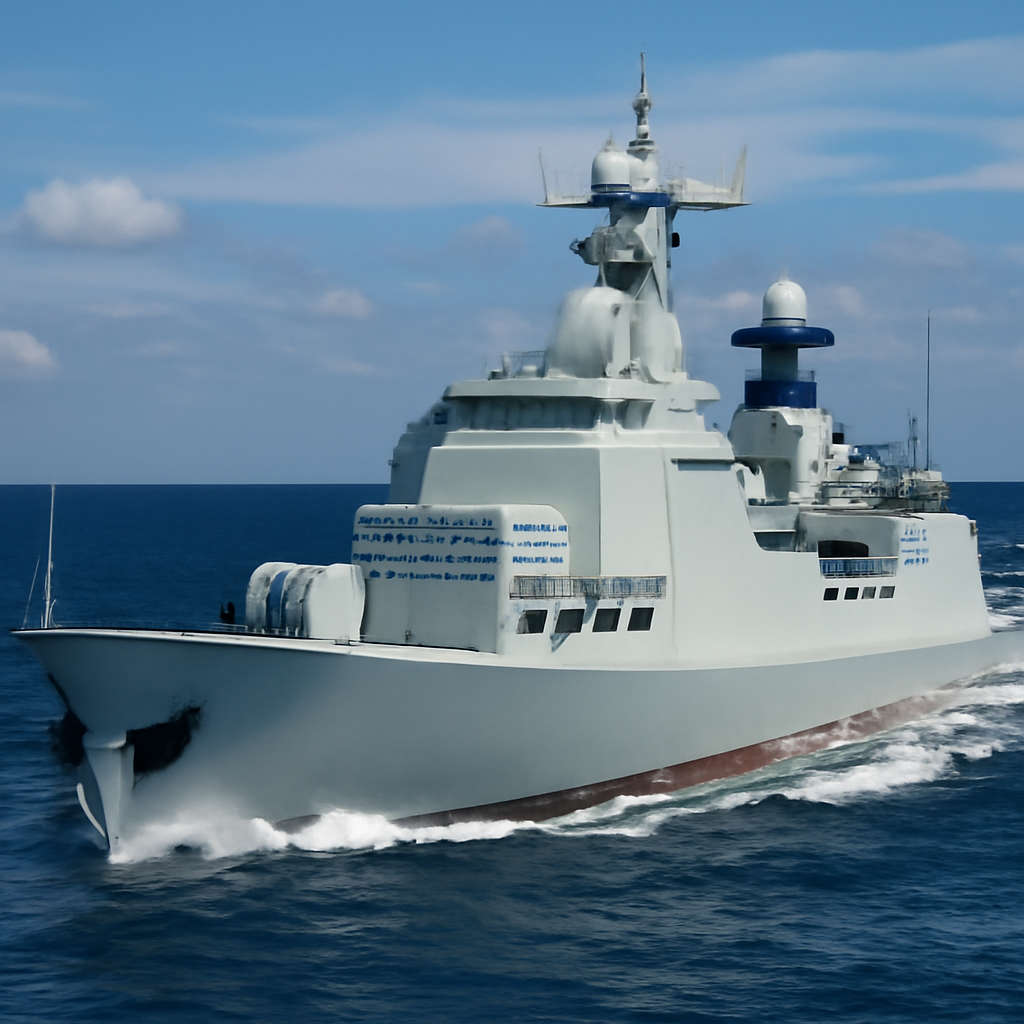
Confirmed operators include the Pakistan Navy and Algeria. Pakistan’s four Type 054A/P Tughril-class frigates—PNS Tughril (F261), PNS Tabuk (F262), PNS Tipu Sultan (F263), and PNS Taimur (F264)—were delivered between 2021 and 2023 and are the Pakistan Navy’s first operational vessels armed with a supersonic-cruising ASCM. Each Tughril-class ship is fitted with a dual two‑cell CM-302 launcher configuration (two launchers with two missiles each), replacing the earlier C-802’s 120 km reach with the CM-302’s 280 km standoff.
Algeria operates a land‑based coastal‑defence variant mounted on transporter‑erector‑launchers (TEL), and the IISS Military Balance 2024 identifies Algeria as the only confirmed land‑based CM-302 operator outside China. Public details on Algeria’s deployment scale and exact configurations remain limited.
In February 2026, Reuters reported—citing six sources—that Iran was close to finalizing a CM-302 purchase from China after talks that accelerated following the June 2025 Israel‑Iran conflict; Chinese Foreign Ministry spokespeople categorically denied the report. If executed, such a transfer would extend the missile’s reach into the Persian Gulf and adjacent chokepoints, according to assessments cited in reporting.
Tactical and strategic implications: compressed kill chains and multi-axis threats
The CM-302’s combination of supersonic cruise, sea‑skimming terminal flight and active radar homing compounds the defensive challenge. The short reaction window compresses the defender’s kill chain—detection, tracking, weapon allocation and intercept—into seconds. Layered naval defenses (area SAMs, point‑defence SAMs, CIWS, and electronic countermeasures) must each perform within a contracted timeline; failure or delay at any layer magnifies risk to the fleet.
For the Pakistan Navy, the CM-302 sits alongside other systems to form a multi-axis anti‑surface concept: the CM-302’s sea‑skimming supersonic threat paired with the SMASH anti‑ship ballistic missile’s high‑altitude hypersonic terminal profile. Such parallel threats require different intercept geometries and defensive postures. Historical doctrinal commentary cited in the reporting emphasizes destroying strike aircraft at range and networking targeting data across a fleet to avoid facing sea‑skimming supersonic missiles in flight.
What this means for Pakistan Navy, Algeria’s National Navy, and global maritime trade
- Pakistan Navy: The CM-302 provides a generational step from subsonic C-802s to supersonic, longer-range ASCM capability on the Tughril-class frigates, expanding stand‑off options while coexisting with nascent indigenous efforts and complementary systems (SMASH, Harbah).
- Algeria’s National Navy: Deploying a land‑based CM-302 coastal variant marks the first Chinese supersonic ASCM in North African coastal defence, signaling a move toward higher-speed, longer‑range coastal deterrence despite limited public detail on force structure.
- Global maritime trade and energy markets: Analysts cited in reporting view potential CM-302 proliferation—particularly a completed Iran purchase—as strengthening anti‑access/area‑denial control over key shipping chokepoints with implications for commercial shipping and oil markets.
Outlook: The CM-302 has entered an export niche once dominated by Russian designs, offering a third supersonic option alongside the P-800 Onyx family and the BrahMos. With confirmed sales to Pakistan and Algeria and reported talks with Iran, the missile is altering regional anti‑ship calculations by pairing high speed, sea‑skimming profiles and satellite‑aided guidance within an export‑constrained performance envelope. How widely it spreads—and how defenders adjust tactics, sensors and engagement doctrines—will determine whether the CM-302 remains a tactical disruptor or becomes a strategic fixture.