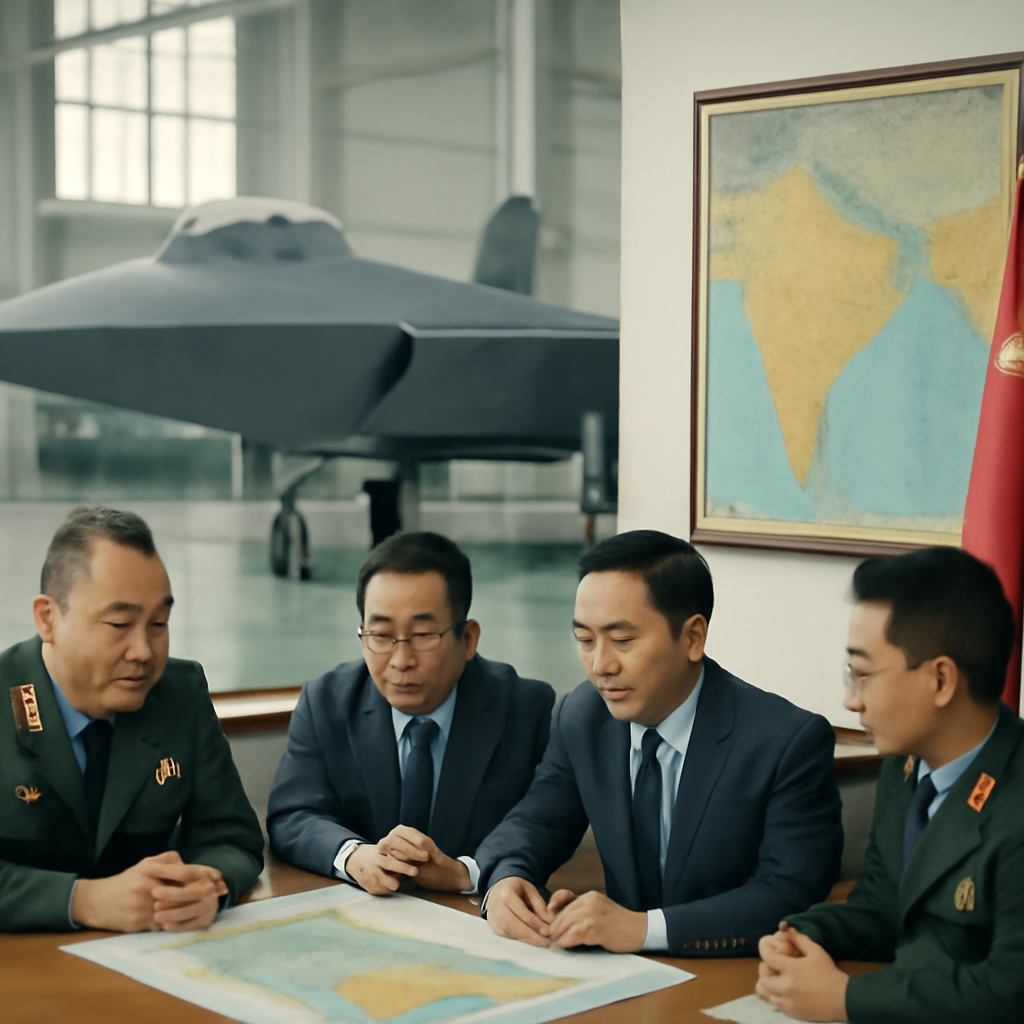
To date, no contract has been signed, nor has a single J-35 fighter been delivered to Pakistan.
Why 40 J-35s would matter — and why Beijing is cautious
Rumors since 2024 that Pakistan might soon acquire roughly 40 Chinese-made fifth-generation J-35 fighters have resurfaced, but the sale has not progressed beyond speculation. If it did, the source material makes clear, the acquisition would be a strategic game-changer: neither Pakistan nor India currently fields fifth‑generation fighters, and 40 J-35s would materially alter the balance of power on the Indian subcontinent.
China, however, has reasons to restrain itself. Beijing has long backed Pakistan economically and militarily to help balance India, yet the source explains that giving Islamabad a decisive edge risks upsetting a fragile regional equilibrium and could increase the likelihood Islamabad would seek to change the territorial status quo in Kashmir. For a Beijing focused on other core interests, dragging itself into a sharper India–Pakistan confrontation would be an unwelcome outcome.
China’s own military needs: the J-35 and the PLAN
The J-35 is not a marginal export item for China; it is the only Chinese fifth‑generation fighter capable of carrier operations and has become central to the People’s Liberation Army Navy (PLAN) Air Force. The aircraft’s trajectory began as a privately funded project by Shengyang Aircraft Corporation, later attracting PLA interest and eventual induction by both the air force and the navy.
With three aircraft carriers already in service, a fourth under construction, and plans for up to five more, the PLAN needs J-35s to outfit carrier air wings. The source warns that production has not yet reached the levels required to equip existing carriers fully. Selling whole squadrons abroad now — even a single export squadron — could weaken carrier air power at a time when China considers the PLAN’s ability to match U.S. naval capabilities urgent.

Audit-ready is a season. It shouldn't be.
Evidence in spreadsheets, controls drifting between audits, frameworks multiplying on flat headcount. Nubivance runs continuous compliance on Rapid7 Cyber GRC - SOC 2, HIPAA, ISO 27001, PCI, CMMC.
End the scrambleOperational risk: U.S. technicians, mixed fleets, and technology leakage
Another constraint is operational security. Pakistan operates about 75 U.S.-made F-16s that require routine maintenance by U.S. technicians, a recurring presence at Pakistani airbases. Placing sensitive Chinese technology — even export variants of the J-35 — in close proximity to foreign technicians raises concerns about technological leakage.
The source notes that export J-35s would be downgraded, but many core features would remain. Even small disclosures, such as a radar signature or other attributes, could yield advantages to the United States and its allies in future conflicts. The J-35’s sensitivity distinguishes it from previous exports like the older J-10, where any espionage would have posed a more limited risk.
Pakistan’s affordability problem: fiscal crisis and defense trade‑offs
Economic constraints also weigh heavily. Pakistan’s brief recovery a year earlier has been largely undone: higher oil and gas prices and a collapse in remittances after the Israel–U.S. war on Iran in February pushed the country back into what the source describes as “three highs and one low”: high debt, high inflation, high deficit, and low growth. More than half of tax revenue is devoted to debt servicing, leaving limited fiscal space for other functions, including defense.
Even if Beijing were willing to sell 40 J-35s, the source argues Pakistan could not readily afford purchase and sustainment costs without diverting scarce resources. Theoretically, Beijing could offer loans as it did for J-10s; in practice the source judges Beijing lacks sufficient strategic incentive now to finance such a transaction.
What this means for Pakistan, China, and U.S. technicians
- Pakistan: The source shows Pakistan is already training pilots for the J-35, indicating preparations are underway. But fiscal limits mean Islamabad would struggle to buy and maintain large numbers of these fighters without external financing.
- China (PLA/PLAN): Beijing must prioritize equipping its carriers with J-35s to meet perceived naval competition needs; exporting large numbers now would slow that buildup and heighten strategic risk.
- U.S. technicians and the United States: Continued U.S. maintenance roles at Pakistani bases create an operational overlap that, according to the source, raises the prospect of sensitive technology being exposed to foreign personnel — a factor Beijing reportedly accounts for when weighing any sale.
The source concludes that while an immediate sale is unlikely, it is not impossible. Two scenarios could prompt Beijing to change course: India acquiring fifth‑generation fighters, decisively shifting the regional balance; or Pakistan suffering a decisive setback in conflict with India. In either eventuality, the source says, China could step in — perhaps with discounts or loans — to prevent a strategic loss and preserve influence. For now, Beijing’s competing priorities — equipping its carriers, avoiding escalation in South Asia, and guarding its most advanced aviation technology — leave the prospect of 40 J-35s in Pakistani service on hold.