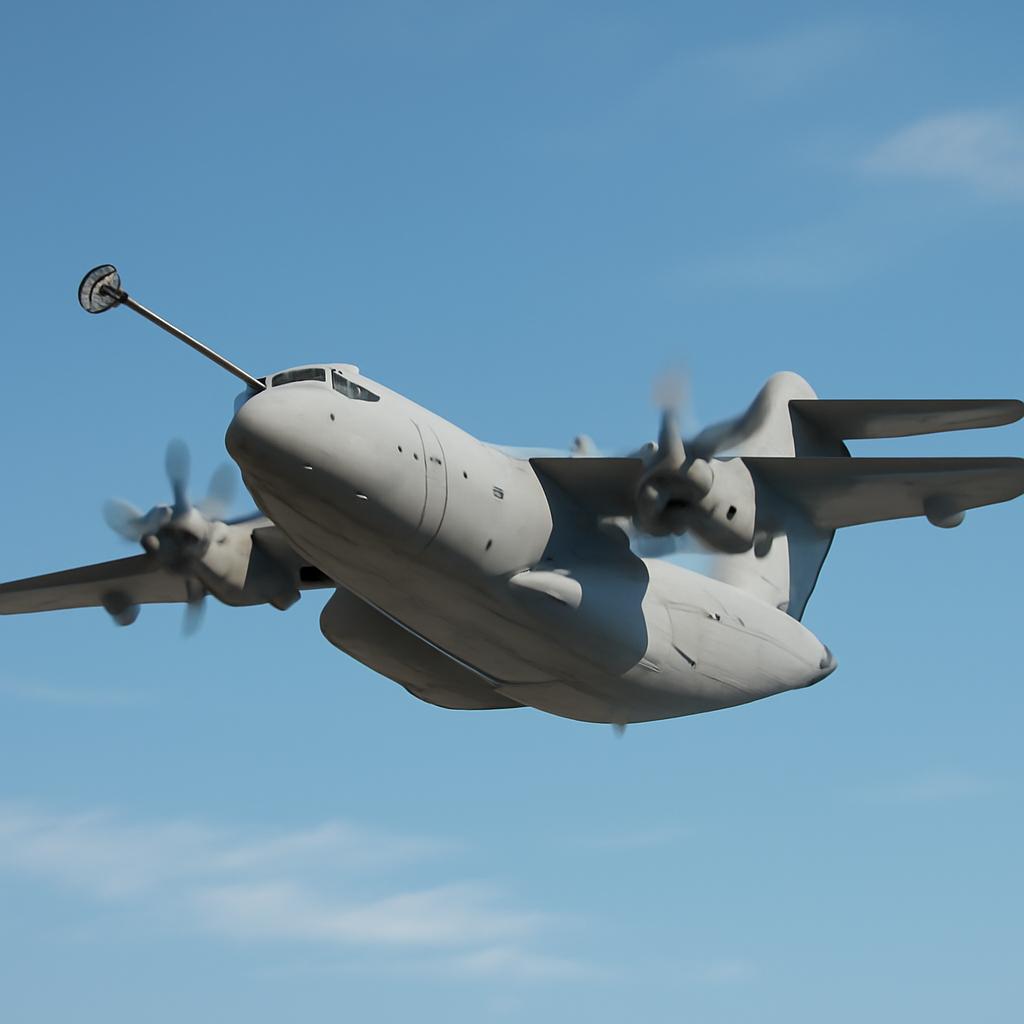
Friday, May 15, 2026 — New Y‑15 military transport aircraft were photographed in flight fitted with a mid‑air refueling probe, a capability the older Y‑9 does not possess.
May 15, 2026 sighting: Y‑15 with a probe in the skies
The image captured on May 15, 2026 shows a next‑generation Y‑15/T‑30 family turboprop transport carrying a mid‑air refueling probe. The photograph — published as a “photo of the day” by the blog that reported the sighting — is notable because the probe is not present on the existing Y‑9 tactical turboprop, according to the same reporting. The visual confirmation places the Y‑15 squarely in the category of next‑generation tactical transports being tested or fielded with capabilities beyond traditional short‑range logistics roles.
How the Y‑15 fits the PLAAF transport picture
The blog’s commentary frames the Y‑15 as following the Y‑9’s evolution: not merely a conventional tactical transporter, but a platform that can be adapted for specialized “high‑noon” missions across services. In that account, the Y‑15’s evident refueling capability signals a shift in function — extending range or on‑station time for missions where the older Y‑9’s lack of probe would be a limiting factor.

This site is the portfolio.
OSINTSights runs on Cloudflare Workers, D1, R2, and Vectorize, with an AI pipeline on Hetzner ARM. Nubivance designed, built, and operates it. We do the same for clients.
See what we buildY‑20’s pace, and the PLAAF’s overall prioritization
The same reporting contrasts the rapid development and steady entry of Y‑20 four‑engine “fat bird” transports with a more measured growth of the turboprop fleet. It notes that the PLAAF places far greater priority on the Y‑20 despite its higher cost and heavier maintenance burden, citing visible activity around the PLAAF’s 13th and 4th Transport Aviation Divisions, both home to Y‑20 units. That emphasis on the strategic jet transport is presented as a deliberate doctrinal choice by the service.
Operational signals: MOOTW, Tibet reinforcement, and overseas trips
The blog ties the Y‑20’s prominence to doctrinal use cases it says China has demonstrated in practice: missions of military operations other than war (MOOTW), rapid reinforcement of remote regions such as Tibet, and deployments to friendly countries. In that context, the commentary suggests that China’s expanding Y‑20 fleet — moving fast and often — contrasts with the tactical turboprop force, which the author characterizes as growing more slowly and being used selectively.
How the PLAAF, procurement leaders, and regional planners will respond
- The PLAAF: The service is portrayed as prioritizing high‑speed, long‑range strategic lift via the Y‑20 while also exploring specialized roles for turboprops; the Y‑15’s probe implies an intent to expand the turboprops’ mission set rather than simply increase basic transport numbers.
- Procurement leaders and force planners: The account suggests they will weigh the Y‑20’s rapid expansion against the practicality of converting turboprops into missionized platforms. The Y‑15’s probe could factor into decisions about whether to invest in specialized variants rather than larger quantities of older airframes like the Y‑9.
- Regional planners and observers: Photographable changes such as the Y‑15’s refueling probe offer a concrete indicator that tactical‑class aircraft are being equipped for extended operations — an observable datum for analysts tracking how airlift capabilities are being distributed between strategic and tactical roles.
The sighting of a mid‑air refueling probe on a Y‑15 does not overturn the broader pattern reported by the blog: the Y‑20 remains the PLAAF’s near‑term priority. But it does sharpen an abiding point in that commentary — that the real value of the turboprop line may lie less in raw lift and more in specialized, missionized roles. The probe-equipped Y‑15 is the clearest signal yet in that direction, and how often it appears in active deployments will be the concrete measure of whether the platform is being adapted for sustained operational use or retained for limited specialist tasks.