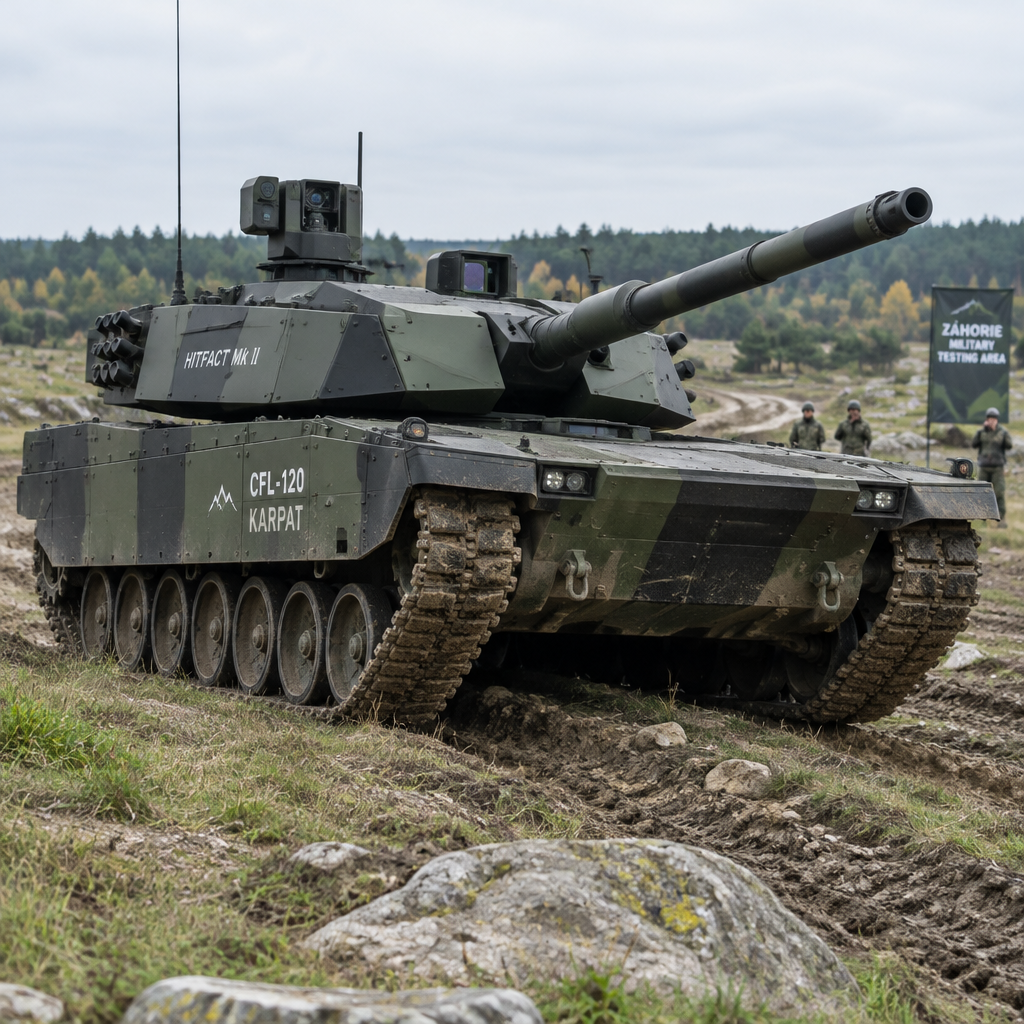
The CFL-120 Karpat made its first public dynamic appearance yesterday at Slovakia’s Záhorie Military Testing Area, demonstrating off‑road mobility and the firing of its main gun — a moment intended to show how a 120mm cannon can be married to a much lighter tracked chassis.
Design, partners, and the 120mm HITFACT Mk II turret
The Karpat is a product of a Slovak‑Turkish partnership that brings together Slovakia’s Czechoslovak Group (CSG), Turkey’s FNSS, and Italy’s Leonardo. It mounts Leonardo’s HITFACT Mk II turret — a 120mm cannon system — on FNSS’s tracked Kaplan platform. The HITFACT Mk II is already fielded on other vehicles in different configurations; a background video cited by the developer shows it on a Centauro 2 8×8 Mobile Gun System.
The vehicle reportedly weighs around 35 tons, substantially less than modern main battle tanks. The turret’s 120mm gun is manually loaded, which requires a four‑person crew, though an autoloader could potentially be introduced later. CSG, MSM Land Systems, and Leonardo have signed a memorandum of understanding to cooperate on promotion, sales, and production of the HITFACT Mk II turret for the Karpat program.
Mobility and logistics versus protection constraints
The Karpat’s lighter weight is framed as an advantage for countries unable to field or transport 60–70+ ton main battle tanks. The vehicle’s smaller logistical footprint and its ability to traverse infrastructure that cannot support heavier tanks are cited as attractions; FNSS has previously suggested the vehicle could cost around a third of a modern MBT, although final acquisition costs will depend on configuration, protection, and support packages.
But the same reduced weight constrains how much passive protection can be fitted. In its basic form the Karpat notably lacks an active protection system (APS), though FNSS says there is scope to add one. Explosive reactive armor (ERA) is listed as another possible add, but that too increases weight and erodes the “lighter tank” advantage the design seeks to deliver.

This site is the portfolio.
OSINTSights runs on Cloudflare Workers, D1, R2, and Vectorize, with an AI pipeline on Hetzner ARM. Nubivance designed, built, and operates it. We do the same for clients.
See what we buildSurvivability amid drones, loitering munitions, and advanced anti‑tank weapons
The Karpat’s arrival coincides with a battlefield environment the source describes as increasingly hostile to armor. The proliferation of drones, loitering munitions, and advanced anti‑tank guided weapons has changed how armored vehicles operate: persistent aerial surveillance and relatively inexpensive attack drones can make movement difficult, expose vehicles beyond the immediate frontline, and create threats traditional armor was not designed to address.
The source notes that heavy MBTs still retain capability when used inside combined‑arms formations — with infantry, artillery, drones, electronic warfare, air defense, and other supports — but their employment is more complicated and losses are costlier. A lighter vehicle like the Karpat reduces transport burdens but does not, by itself, resolve growing survivability challenges such as top‑attack ATGMs, mines, and drone strikes.
Market comparisons and program lessons: M10 Booker, VT‑5, Sabrah, Kaplan MT
The Karpat is pitched into a crowded and cautious market. The article points to the canceled U.S. M10 Booker program as a cautionary comparison: Booker aimed to provide deployable protected direct‑fire support for units that could not move with MBTs, but ran aground on questions of weight, cost, utility, and force‑structure fit.
Competing lightweight armored options include China’s VT‑5, Israel’s Sabrah, and FNSS’s Kaplan MT (also known in cooperation with Indonesia as Harimau). Most of those use 105mm guns; the Karpat’s 120mm armament is a notable distinction, but that larger gun brings tradeoffs in ammunition storage, loading, turret integration, and overall limits imposed by a 35‑ton vehicle compared with a conventional MBT.
The Karpat is reportedly competing in Slovakia against the BAE Systems Hägglunds CV90120 for a light tank requirement. The article cites the Leopard 2A8’s recent unit cost — about $30–35 million apiece in orders noted — as a comparison point for why some buyers seek cheaper alternatives to a modern MBT.
What this means for Slovakia, Indo‑Pacific buyers, and European militaries
- Slovakia: The Karpat offers a possible path to replace Cold War‑era T‑72s and newer Leopard 2A4s where full modern MBT purchases are seen as unaffordable; the vehicle is already competing domestically against the CV90120.
- Indo‑Pacific buyers: The Karpat’s lighter weight and tracked mobility could appeal in mountainous, island, or infrastructure‑constrained theaters where transporting 60–70+ ton tanks across archipelagos is difficult. FNSS’s existing Kaplan MT footprint with Indonesia could support regional outreach.
- European militaries: Where bridge classifications, transport constraints, and cost limit conventional MBT deployment, a lighter tracked vehicle with direct‑fire capability may be useful for niche roles — but European buyers must weigh survivability tradeoffs in drone‑dense operating environments.
The Karpat is an unusual engineering compromise: a 120mm cannon on a roughly 35‑ton tracked chassis, backed by established industrial partners and a memorandum of understanding to promote the turret. It surfaced publicly this year — debuting at IDEB 2026 and proving mobility and gunnery at Záhorie — at a moment when buyer appetite for new armored categories is tempered by the hard lessons of drone saturation and rising anti‑tank lethality. Whether that mix of mobility, firepower, and lower cost produces committed customers willing to accept the survivability tradeoffs is the central question the Karpat now faces.