The PLAAF may have some 500 J-20s in service now, with examples assigned to at least 14 operational units and three training bases, according to one estimate.
New images show a firefighting mock-up circulating on Chinese social media
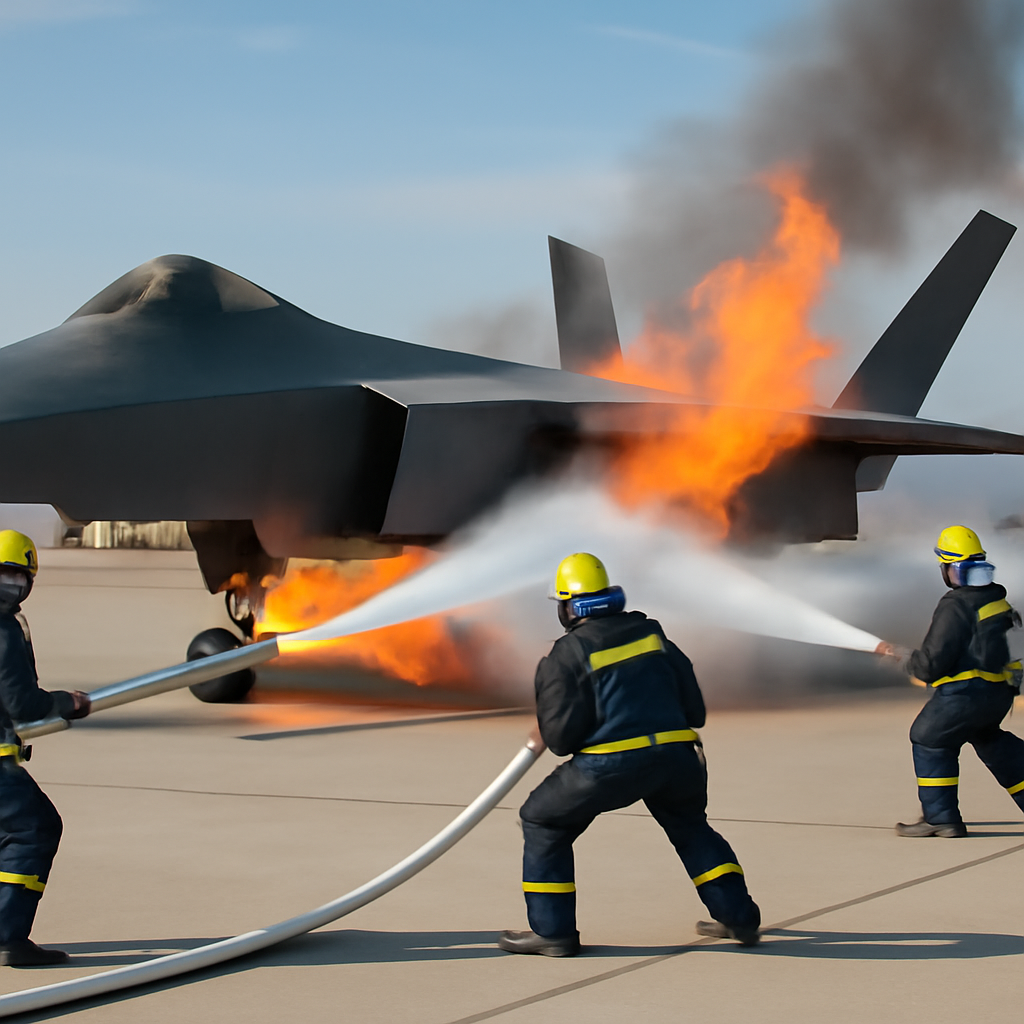
Images circulating on Chinese social media now show a full-scale aircraft fire trainer that resembles, in broad strokes, the J-20 family of fighters. Where and when the photographs were taken is not immediately clear from the posts, and markings on the tarmac visible in the images do not match the aprons at Lintao Air Base or at Jining Qufu Airport.
Close-up shots in the circulation show airfield firefighters using the trainer in active drills and hosing down the mock-up, indicating it is being used as a reusable training aid rather than as an operational aircraft.
How the trainer relates to the objects seen at Lintao Air Base (2022) and Jining Qufu Airport (2025)
The newly shared ground-level photos align more closely with the broadly similar but distinct object photographed at Jining Qufu Airport in 2025. Both the Jining object and the circulating trainer share a modified diamond-like delta planform, canards, and twin vertical tails. The trainer's cockpit configuration also appears closer to the newer J-35 design.
By contrast, the shapes photographed at Lintao Air Base in 2022 differed: they had differently shaped wings and longer, more slender noses. That difference leaves open at least two possibilities — that the Lintao shapes served a different purpose, or represented a different mock-up or decoy design.

Audit-ready is a season. It shouldn't be.
Evidence in spreadsheets, controls drifting between audits, frameworks multiplying on flat headcount. Nubivance runs continuous compliance on Rapid7 Cyber GRC - SOC 2, HIPAA, ISO 27001, PCI, CMMC.
End the scrambleAircraft fire trainers: what they are and why they look like aircraft
Aircraft fire trainers deliberately mimic the general silhouette of real aircraft and can range from purpose-built systems to repurposed hulks of retired planes. Their design intent is straightforward: to give airfield firefighting teams a reusable, realistic target for drills. The source notes such trainers are in widespread use globally by both national militaries and civilian fire departments.
The article illustrates that these aids can be made to represent fighters or airliners and cites U.S. examples: a U.S. military trainer roughly in the shape of an F/A-18 Hornet and a subscale trainer in the shape of an F-35 at Hill Air Force Base in Utah, underscoring the variety and reuse of such devices.
Implications for PLAAF training, sustainment, and safety
TWZ reports that the PLAAF’s real J-20 fleet is expanding. The estimate of roughly 500 J-20s assigned across at least 14 operational units and three training bases, and projections that the fleet could reach 1,000 airframes by 2030 if production continues, point to growing demands for pilot and ground-crew training, maintenance, and sustainment.
As more modern fighters enter service — the article also references other advanced Chinese types such as the J-36 and J-XDS, various combat drones, and pilotless flying wings — routine sortie rates and the logistical footprint increase. TWZ notes that larger fleets and higher operational tempos naturally raise the risk of accidents and the consequent need for realistic firefighting and emergency-response training.
What this means for analysts, airfield firefighters, and aviation observers
- Analysts: Expect some previously unexplained imagery of fighter-like shapes to be clarified by ground-level photos of mock-ups or trainers; not every unusual outline indicates a new operational airframe.
- Airfield firefighters and training planners: The proliferation of realistic trainers matches a practical need tied to larger modern-fighter fleets — reusable, silhouette-accurate aids provide cost-effective ways to rehearse high-risk emergency responses.
- Aviation observers and photographers: Variations among mock-ups, decoys, and real prototypes mean silhouette-based identifications should be treated cautiously; the Lintao shapes remain distinct and could represent different mock-ups, decoys, or other uses.
The Jining Qufu Airport object from 2025 now appears to be definitively a firefighting trainer; the 2022 shapes at Lintao, however, are not resolved by these new images and could still represent other full‑scale mock-ups or decoys. The broader pattern is clear: as China’s inventory of advanced, varied aircraft grows, so too will the infrastructure to support them — including more trainers and training exercises that can briefly produce ambiguous imagery.
Special thanks to Andreas Rupprecht (@RupprechtDeino) for bringing the images to attention. Contact details in the source point to the author at joe@twz.com for follow-ups.
Original reporting: The Mystery Of J-20 Fighter-Like Shapes Spotted In China Has Been Solved — TWZ