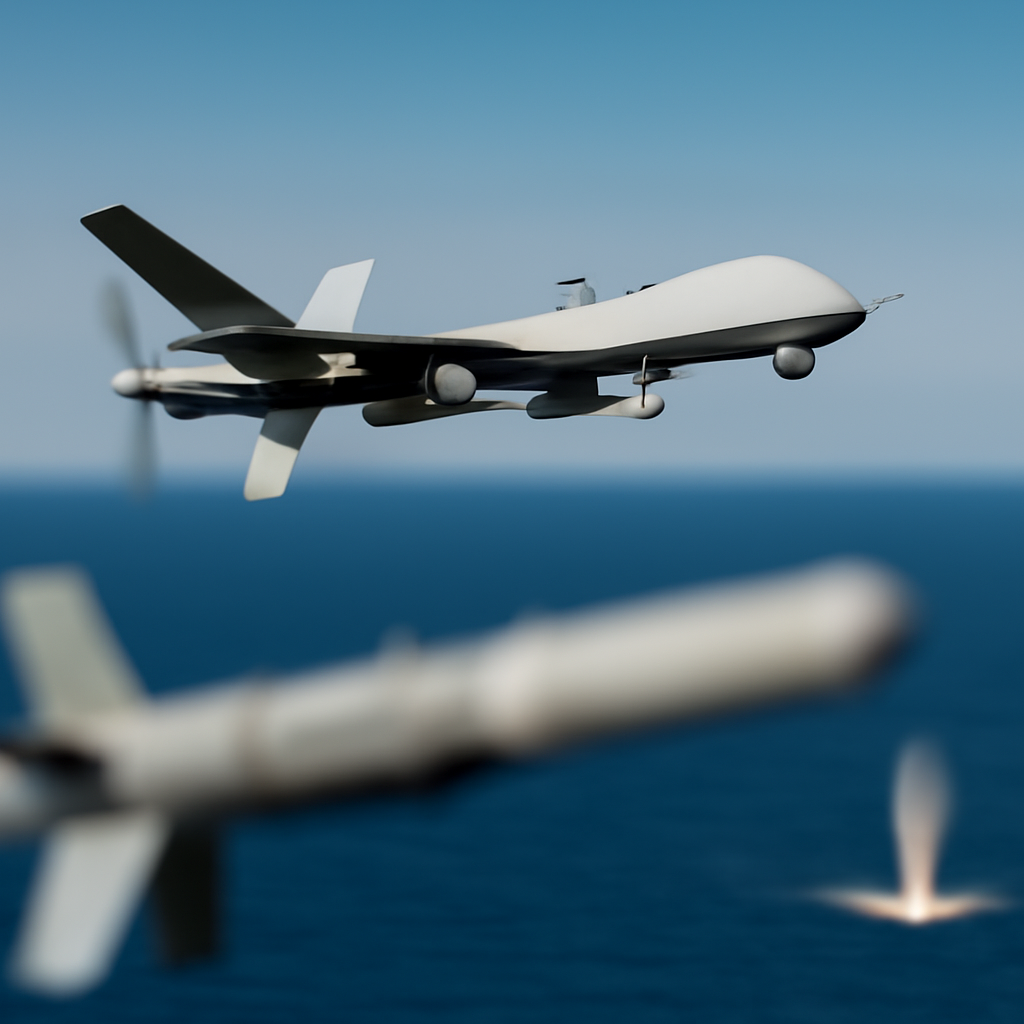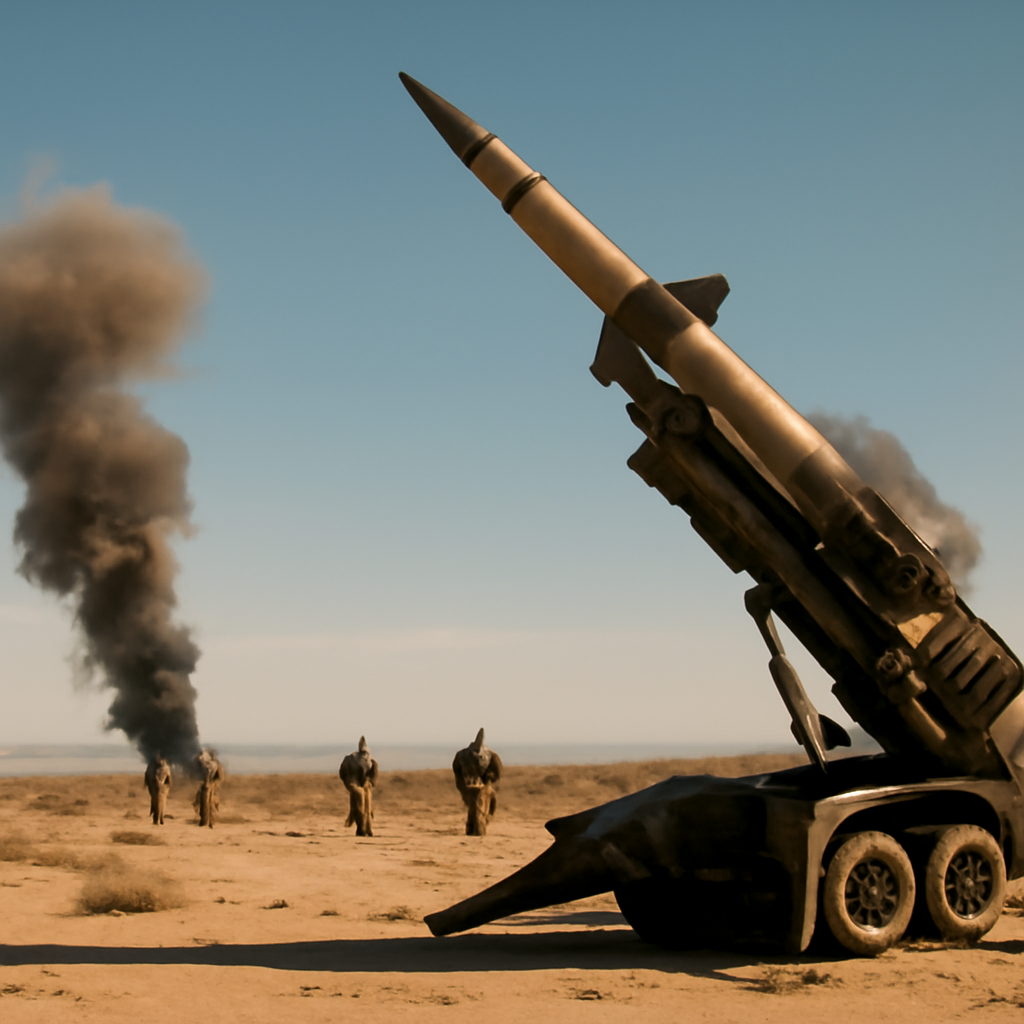
On 05 June 2026, footage aired by state broadcaster CCTV showed an unmanned brigade of the PLA’s 73rd Group Army conducting the first publicly disclosed live-fire trial of a missile whose nameplate read “HQ-16F,” firing from the Gobi Desert more than 1,000 km from the unit’s home garrison in Fujian and intercepting an airborne target at a range of about 50 km.
PLA live-fire trial: distance, conditions, and presentation
The Ministry of Defense did not release an extended technical dossier alongside the broadcast, but CCTV’s published footage emphasized two points: the trial took place in northwestern China’s Gobi Desert and the firing unit was an unmanned brigade of the 73rd Group Army. The program highlighted that the launch was executed over a long transit — more than 1,000 km from the brigade’s Fujian garrison — and that the system was tested amid demanding terrain and electromagnetic interference. A close-up of an on-screen nameplate identified the system as “HQ-16F.”
HQ-16F / HQ-16FE: reported performance and lineage
State media stopped short of publishing formal specifications for the HQ-16F, but the broadcast’s imagery and the visible nameplate tied the system to a family previously shown in export form. In 2022, China Aerospace and Technology Corporation (CASC) displayed an export-oriented model designated HQ-16FE with a stated range of 160 km and an altitude engagement envelope from 15 m to 27 km. Analysts and observers linking the broadcasted HQ-16F to the HQ-16FE point to what the source calls “design improvements” that mark the F/FE versions as a distinct sub-lineage within the HQ-16 family.

Audit-ready is a season. It shouldn't be.
Evidence in spreadsheets, controls drifting between audits, frameworks multiplying on flat headcount. Nubivance runs continuous compliance on Rapid7 Cyber GRC - SOC 2, HIPAA, ISO 27001, PCI, CMMC.
End the scrambleContrast with HQ-16 / LY-80 systems in Pakistan Army and Navy service
Pakistan’s ground and naval forces already operate earlier HQ-16 and LY-80 variants. Those older models have an established engagement range of roughly 40–70 km. By contrast, the HQ-16F/FE line is presented as vastly extending reach — the HQ-16FE’s stated 160 km range and wider altitude envelope are the stark numerical differences highlighted by the source material. The missile family’s “wide assortment of design improvements,” the source reports, collectively position the F/FE variants as a next-generation branch built for longer reach and a different operational envelope than the existing Pakistani inventory.
What this means for the Pakistan Air Force, Pakistan Army, and Pakistan Navy
- Pakistan Air Force (PAF): In 2024 the PAF revealed plans to induct the HQ-16FE into its expanding integrated air defence system, where it will join longer-range systems named in the announcement — the HQ-9BE and the FD-2000. The televised trial of an HQ-16F therefore aligns directly with that 2024 declaration and with the PAF’s stated procurement trajectory.
- Pakistan Army (PA) and Pakistan Navy (PN): Both services operate the older HQ-16/LY-80 variants. The gap in reported ranges — 40–70 km for legacy models versus the published 160 km claim for the FE export model — implies the potential for a significant operational shift if the F/FE line is fielded across services.
- Procurement planners and integrated air-defence architects in Pakistan: The live-fire demonstration, by showing the system’s mobility over long transit and an intercept at roughly 50 km during the broadcast, feeds into Pakistan’s longer-term planning for layered air-defence capabilities with contributions from multiple Chinese manufacturers and system families.
Export dynamics and CASC’s positioning
CASC’s 2022 exhibition of an export-oriented HQ-16FE provided stated performance figures that contrast with Pakistan’s in-service legacy missiles. The PLA’s public test of an HQ-16F in June 2026 reinforces the export narrative: a domestic trial that showcases mobility, electromagnetic robustness, and an intercept at an intermediate range around 50 km. For CASC, the imagery and the nameplate reinforce a product line that the corporation has already presented to foreign buyers; for potential recipients such as Pakistan, the demonstration functions as both proof of concept and marketing collateral.
Taken together, the June 5 broadcast and the earlier public display of the HQ-16FE map onto a clear procurement trajectory: Pakistan announced intentions to acquire the export model in 2024, and a PLA live-fire two years later made visible a related domestic variant and some of its operational claims. Whether the HQ-16F’s broadcast intercepts and the HQ-16FE’s published 160 km range will translate into rapid fielding across Pakistan’s services will depend on procurement, delivery schedules, and integration work that the available record does not detail; for now, the live-fire stands as a technical milestone in an ongoing China–Pakistan air-defence relationship.
Original story: Quwa — China Test-Fires HQ-16F SAM as Pakistan Eyes Export Model