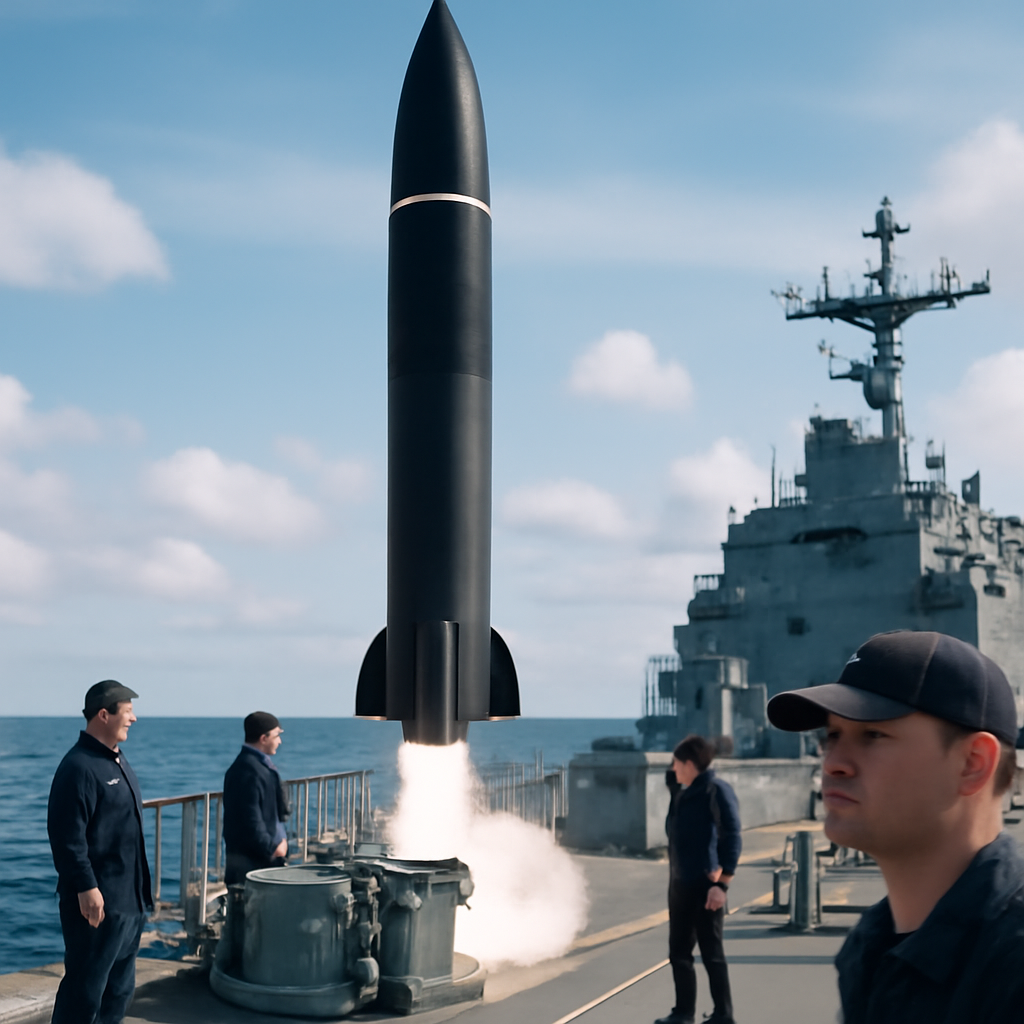
"not aimed at any specific country or target," Beijing said, calling the July 6 launch routine annual training.
What happened on July 6, and how it was framed
On July 6, Chinese state media reported that the navy launched a submarine-launched ballistic missile (SLBM) from a nuclear-powered submarine into the Pacific Ocean. Japanese media reported the impact point fell outside Japan’s exclusive economic zone (EEZ). The U.S. State Department said it had “monitored China’s test launch from a submarine of an unarmed intercontinental-range ballistic missile,” and criticized China’s missile activity as raising concerns about a “rapid and opaque nuclear weapons buildup.” China’s military described the event as routine annual training and released imagery showing both the shorter-ranged JL-2 and the newer JL-3 SLBM.
The JL-3, Jin-class, and the coming Type 096: a qualitative leap
Analysts and Chinese military commentators cited in state media identified the missile tested on July 6 as likely the JL-3. With an estimated range of more than 10,000 kilometers, the JL-3 would extend reach from patrol areas much closer to China’s shores than previous SLBMs. China currently operates Jin-class (Type 094) ballistic missile submarines and is developing the next-generation Type 096, which is expected to be significantly quieter and harder to track. Taken together—a longer-range JL-3 and a quieter Type 096—these systems represent a qualitative step in China’s sea-based nuclear deterrent, potentially complicating tracking, interception, and crisis-era planning by other states.

Audit-ready is a season. It shouldn't be.
Evidence in spreadsheets, controls drifting between audits, frameworks multiplying on flat headcount. Nubivance runs continuous compliance on Rapid7 Cyber GRC - SOC 2, HIPAA, ISO 27001, PCI, CMMC.
End the scrambleRegional reaction: United States, Japan, Australia, and New Zealand
The launch drew immediate pushback across the region. The U.S. State Department’s statement framed the launch as an indicator of China’s opaque nuclear expansion. Japan expressed serious concern after learning only a day prior that China had designated a hazard area for “falling space debris” that included part of Japan’s EEZ south of Wakayama Prefecture’s Cape Shionomisaki; Japan’s Ministry of National Defense clarified the activity was a ballistic missile test roughly 90 minutes before launch. Chief Cabinet Secretary Kihara Minoru said, “China’s military activities, including a lack of transparency, have become a matter of serious concern to Japan and the international community.”
Australian Foreign Minister Penny Wong labeled the test “destabilizing to the region,” citing the rapid pace and insufficient transparency of China’s military buildup. New Zealand Foreign Minister Winston Peters described the test as an “unwelcome and concerning development,” warning against allowing such launches to become routine and saying, “We, like our neighbors in other Pacific countries, have no interest in China using the South Pacific as a testing site for missile capability.”
Timing, exercises, and the Pacific security landscape
The launch carried layered symbolism and timing. It came two days after the United States’ 250th Independence Day and followed China’s September 2024 launch of an intercontinental ballistic missile into the Pacific—events the source ties together as signals that Beijing is increasingly comfortable publicly demonstrating both land- and sea-based legs of its nuclear deterrent. The test occurred only hours after Australia and Fiji announced a new mutual defense pact, and it coincided with the start of China and Russia’s annual “Joint Sea-2026” naval exercise, after which elements of both navies are expected to conduct a joint Pacific patrol. These overlaps, the source notes, reinforced perceptions that Chinese undersea deterrent patrols are becoming an enduring feature of the wider Pacific security environment.
Implications for Japan’s submarine debate and defense options
For Japan the consequences extend beyond the location of this single impact point. The source underscores that China’s advancing undersea nuclear forces are a more direct and permanent feature of the security environment around Japan and the Pacific, with implications for defense of the Nansei island chain, sea lanes, U.S. extended deterrence credibility, and contingency planning around Taiwan. The article says this reality presses Japan toward a long-taboo debate: whether to acquire nuclear-powered submarines armed solely with conventional weapons. Proponents argue nuclear propulsion offers endurance and stealth advantages for tracking Chinese submarines; opponents point to the country’s three non-nuclear principles as a powerful political constraint. The source also notes practical hurdles—decades of training, reactor infrastructure, and enormous investment—and lists interim options: deeper undersea cooperation with the United States and AUKUS partners, and investment in unmanned systems and seabed surveillance.
China’s public demonstration of an increasingly credible sea-based deterrent, the source concludes, is less about where a dummy warhead landed and more about normalizing capability and presence across the Pacific. The July 6 launch, together with other recent tests and exercises, makes the undersea dimension of strategic competition a persistent policy problem for capitals in the region.