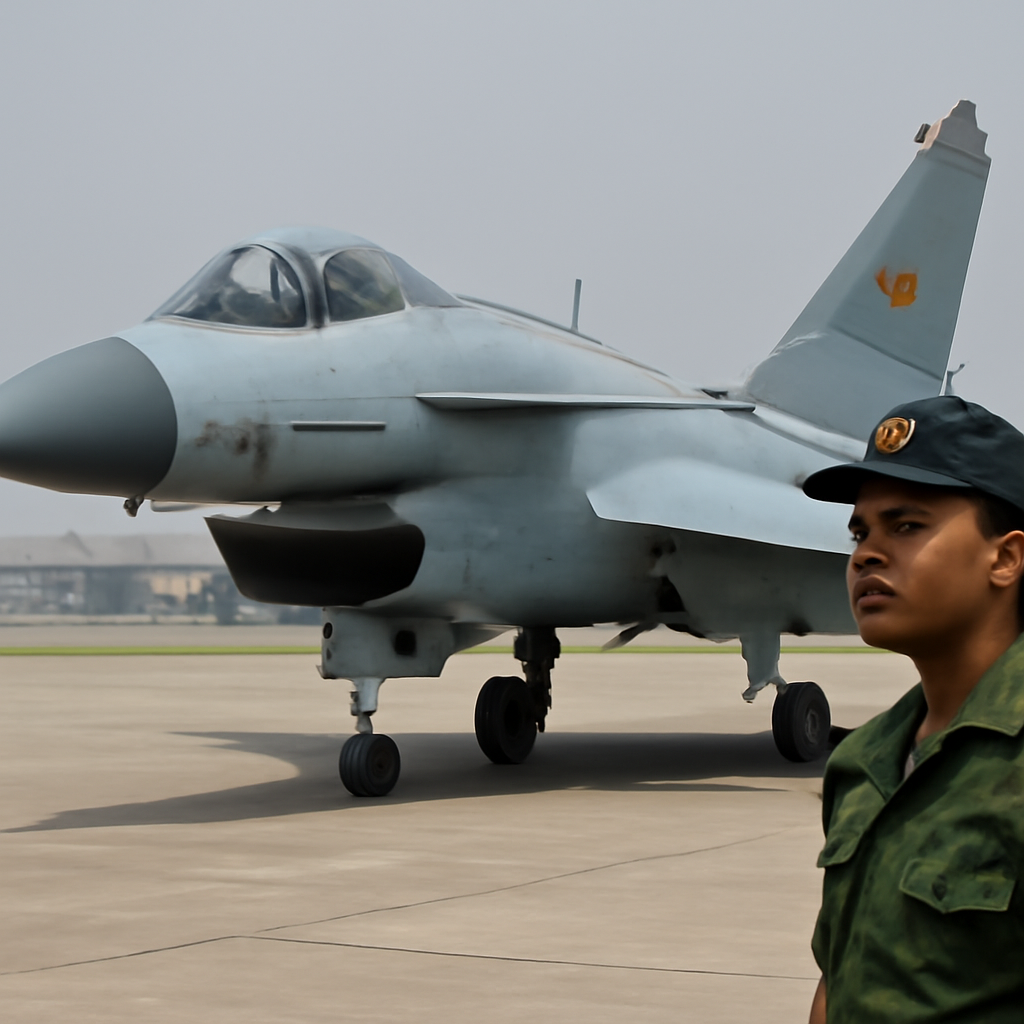
If contracted and delivered, Bangladesh would become only the second confirmed foreign customer of the export version of the J-10C, after Pakistan.
Bangladesh advances toward formal talks with China
Bangladesh is moving toward formal negotiations with China over a potential purchase of J-10CE fighters and attack helicopters. Bangladesh’s Prime Minister’s Information and Broadcasting Adviser, Zahed Ur Rahman, said Tuesday that a government panel is preparing a draft agreement that could pave the way for negotiations with Beijing. The government has not disclosed how many aircraft it intends to acquire, the potential value of the deal, or a delivery schedule; those details are expected to be determined during negotiations. Local reporting has previously pointed to a potential requirement for as many as 24 J-10CEs.
What the J-10CE brings to the table
The J-10CE is a single-engine multirole fighter equipped with an active electronically scanned array (AESA) radar, modern avionics, electronic warfare capabilities, and the ability to employ an expanding range of Chinese precision-guided weapons. The export J-10CE also provides access to weapons such as the PL-15 beyond-visual-range air-to-air missile. Compared with many older fighters still flown by air forces that have historically relied on Chinese or Soviet-designed equipment, the J-10CE represents a substantial capability upgrade.

Audit-ready is a season. It shouldn't be.
Evidence in spreadsheets, controls drifting between audits, frameworks multiplying on flat headcount. Nubivance runs continuous compliance on Rapid7 Cyber GRC - SOC 2, HIPAA, ISO 27001, PCI, CMMC.
End the scrambleCombat visibility: Pakistan and the May 2025 conflict
Pakistan was the first foreign operator of the export J-10CE, and the aircraft attracted intense attention during the May 2025 conflict between Pakistan and India. Pakistan said its Chinese-made fighters were involved in shooting down several Indian aircraft; the precise circumstances, numbers, and tactics remain the subject of competing claims and outside analysis. Regardless of unresolved details, that conflict gave the J-10CE an unusual degree of combat visibility and prompted explicit acknowledgement from Bangladeshi officials that the aircraft’s reported performance during the conflict had attracted attention in Dhaka.
Signals beyond Dhaka: Uzbekistan and other indicators
China’s fighter-export push appears to extend beyond a single potential sale. Uzbekistan has been linked to the J-10CE for months, and imagery showing an aircraft carrying the serial number 1020 with low-visibility tail markings that some observers say resemble the Uzbek flag has generated renewed interest. While unconfirmed, serial numbers in the 101X and 102X ranges have been associated by some observers with a possible Uzbek order. Past reports have circulated that Uzbekistan also intends to acquire 24 J-10CEs, and there have been unverified accounts that J-10s have been seen at Karshi Khanabad Air Base in Uzbekistan. Uzbekistan’s current combat fleet, according to reporting, remains heavily reliant on Soviet-era designs including MiG-29 fighters and Su-25 attack jets.
What this means for the Bangladesh Air Force, the government, and Chinese exporters
- Bangladesh Air Force: The service faces a fighter fleet made up largely of Chengdu F-7 variants and smaller numbers of MiG-29s. Maintaining aging Soviet-designed fleets increasingly presents challenges in airframe life, avionics, spare parts, weapons, and overall readiness — factors the J-10CE would directly address if procured.
- The government of Bangladesh: Officials are advancing formal negotiation steps and will have to decide quantity, cost, and delivery timing during talks with Beijing. A draft agreement prepared by a government panel is the near-term step identified by the administration’s adviser.
- Chinese exporters and Beijing: The J-10CE sits within a broader Chinese push to offer modern military equipment across land, sea, and air categories and to package platforms with weapons, training, support, and integrated systems. The J-10CE’s status as an operational, export-capable fighter — contrasted with China’s more advanced stealth designs such as the FC-31/J-35 family, which are portrayed as costlier or more uncertain — gives Beijing an option to sell a mature, available fighter to customers replacing older fleets.
Bangladesh’s move toward negotiation formalizes a choice many countries face: replace aging, maintenance-challenged aircraft with a mature export fighter from China, or delay replacement while weighing cost, capability, and political trade-offs. The next concrete milestones to watch are the government panel’s draft agreement, the opening of negotiations with Beijing, and any formal statement on quantities, price, or delivery timing.