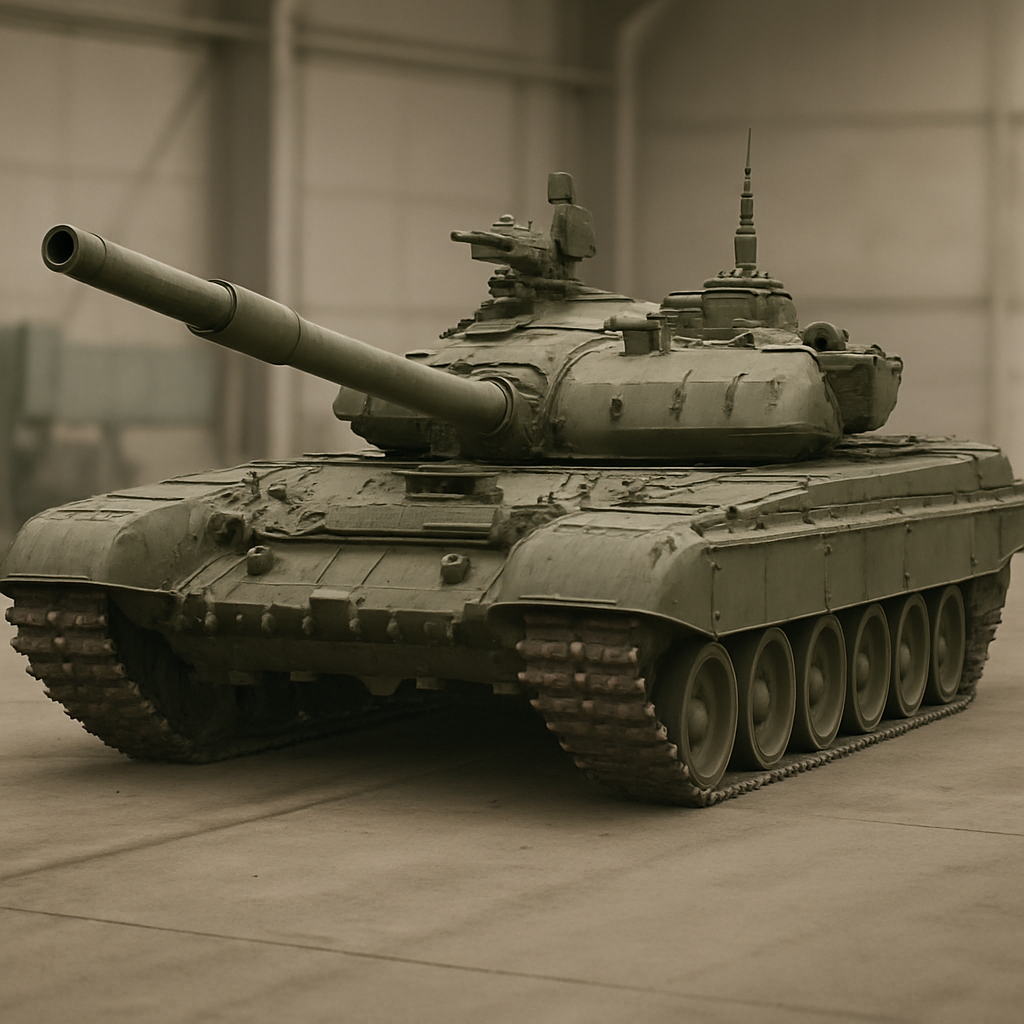
Romania imported 31 T‑72 Ural‑1 tanks in 1977–78 — and, according to several Chinese accounts, a number of those were quietly transferred to China for evaluation, where they were reportedly given the PLA code name "Type 64."
How the 1969 Zhenbao clash set a clear priority
The drive to understand and match Soviet tank design dated back to the 1969 border clash at Zhenbao Island. There, the Soviet T‑62 demonstrated "clear technological superiority" over Chinese armor. The PLA captured one of those vehicles — a T‑62 recorded as turret number 545 — which was recovered, studied, and reverse‑engineered. That single event, the source says, "deeply influenced Chinese armored development until the late 1990s," setting a long‑running imperative to obtain and analyze later Soviet designs.
The T‑72 represented a generational leap
When the Soviet Union unveiled the T‑72 on 7 November 1977 during the 60th Anniversary parade in Moscow, observers in China and the West were surprised. The tank’s combination of composite armor, a 125 mm smoothbore gun, and an autoloader amounted to "a generational leap" beyond the T‑62 that the PLA had previously analyzed. That capability jump fed a renewed sense of urgency in Beijing to obtain examples of the T‑72 for study.

Audit-ready is a season. It shouldn't be.
Evidence in spreadsheets, controls drifting between audits, frameworks multiplying on flat headcount. Nubivance runs continuous compliance on Rapid7 Cyber GRC - SOC 2, HIPAA, ISO 27001, PCI, CMMC.
End the scrambleThe Romanian conduit and the "Type 64" program
China’s path to T‑72 access ran through third parties. India’s licensed production of the T‑72M in the 1980s increased the prospect that China might face the type in future conflicts, and Romania — which had imported 31 T‑72 Ural‑1 tanks in 1977–78 and tried to reverse‑engineer the design into the TR‑125 — provided an apparent supply opportunity. After Romania’s TR‑125 effort stalled and many T‑72s were placed in storage, "it seems that a number of these tanks were quietly transferred to China for evaluation/further reverse‑engineering."
To preserve secrecy, the PLA reportedly assigned the code name "Type 64" to the acquired vehicles. According to the accounts cited in the source, these tanks were allegedly disassembled, tested, and analyzed in depth, furnishing Chinese engineers with direct technical insight into late‑1970s Soviet armor technology.
From pieces on a bench to influence on a parade
Those technical lessons, the source ties to a prolonged modernization effort spanning the 1970s through 1990. The capture of the T‑62 (turret number 545), the study of acquired MiG‑23s (noted in the source as a famous transfer of six fighters from Egypt to China in 1978), and the possible acquisition of Romanian T‑72s combined to shape Chinese armored development. By the time the Type 98 (WZ‑123) was unveiled on 1 October 1999, its "overall layout, armor philosophy, and fire‑control concepts clearly reflected lessons drawn from decades of studying Soviet third‑generation tank design," the source reports.
What this means for the PLA, Indian military planners, and Chinese armor engineers
- The PLA: The accounts imply a deliberate, long‑term technical program — the clandestine study and disassembly of foreign tanks under the "Type 64" rubric — intended to close capability gaps exposed in 1969 and later by third‑generation Soviet designs.
- Indian military planners: India’s licensed production of the T‑72M in the 1980s is cited in the source as a strategic stimulus for China’s interest, because it raised the likelihood that PLA forces could meet that tank in future engagements.
- Chinese armor engineers and the defense industrial base: The source links hands‑on study — disassembly, testing, reverse‑engineering — to doctrinal and technical outcomes visible three decades later in the Type 98 (WZ‑123), suggesting a trajectory from imported hardware to domestic design choices in layout, armor approach, and fire‑control systems.
The chain from a captured T‑62 (turret number 545) in 1969, through surprise at the T‑72’s 1977 debut, to reported Romanian transfers and a secret "Type 64" program sketches a decades‑long engineering response rather than a single procurement decision. The source paints a picture of incremental learning: collect a foreign system, take it apart, test it, and fold those lessons into domestic designs — a process whose imprint the Type 98 (WZ‑123) parade appearance in 1999 makes visible.
For readers who want to examine the original account, the source is available here: https://china-defense.blogspot.com/2026/04/type-64-soviet-t72-in-china.html