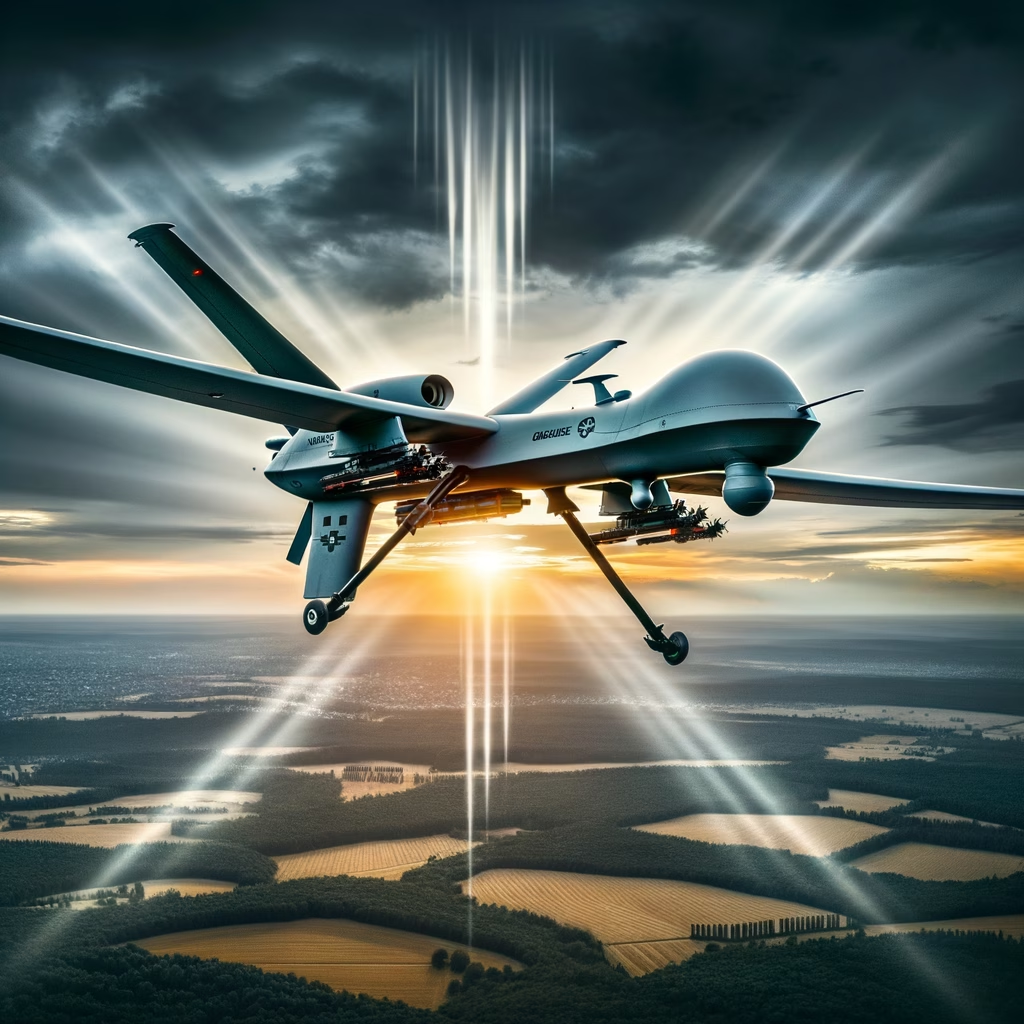
“In the fog of modern warfare, information is as vital as ammunition.” This assertion, echoed by defense analysts worldwide, finds new resonance on the eastern front of Ukraine, where a novel piece of military technology is quietly altering the calculus of conflict. The introduction of Ukraine’s new reconnaissance-strike drone, dubbed the “Bulava,” represents not just a step forward in unmanned systems but a calculated response to a relentless adversary proficient in electronic warfare and layered air defense.
For over a year, the battlefield in Ukraine has been defined by the contest between evolving military technologies and strategic ingenuity. The Russian military’s extensive use of electronic jamming and sophisticated air defense networks has posed significant challenges to Kyiv’s efforts to monitor and disrupt enemy operations. Traditional reconnaissance and strike methods have increasingly become vulnerable, prompting Ukrainian forces to innovate under pressure.
The Bulava drone is engineered precisely to meet these challenges. Manufactured by a Ukrainian defense company with experience in drone technology, the Bulava is a reconnaissance-strike platform that combines real-time intelligence gathering with precision offensive capability. It can penetrate contested airspace and evade electronic countermeasures designed to blind and neutralize drones. Once on target, it delivers strikes against high-value Russian positions and equipment deep behind enemy lines.
Evidence of its efficacy has emerged from front-line reports. According to statements released by the drone manufacturer, the Bulava has already been deployed in active combat zones and has successfully destroyed several Russian military assets. Independent analysis from open-source intelligence corroborates increased disruption in Russian logistical chains and command posts coinciding with the drone’s operational timeline.
From a technological perspective, the Bulava embodies a sophisticated fusion of stealth, autonomy, and precision. Its design reflects lessons learned from the proliferation of unmanned aerial vehicles (UAVs) in recent conflicts, where adaptability and resilience against electronic warfare have proven decisive. As Dr. Serhiy Malov, a Kyiv-based defense technology expert, notes, “The Bulava’s ability to operate under heavy electronic jamming while delivering pinpoint strikes marks a significant advancement in Ukraine’s UAV capabilities.”
Policymakers and military strategists are watching the deployment closely. The introduction of such a drone forces a recalibration of the tactical environment. For Ukrainian forces, it offers a potential force multiplier, enabling more effective disruption of Russian supply lines and command structures without risking manned aircraft or ground troops. Conversely, Russian military planners must now contend with a tool that can bypass their sophisticated defenses, complicating their operational security.
Yet, the use of reconnaissance-strike drones like the Bulava also raises broader questions about escalation and the future of warfare in contested airspaces. The integration of autonomous or semi-autonomous systems capable of lethal action brings ethical, strategic, and legal considerations to the forefront. Furthermore, as Dr. Malov cautions, “The proliferation of such systems will likely drive both sides to intensify electronic warfare and counter-drone technologies, potentially leading to an arms race in unmanned and AI-assisted weaponry.”
For the soldiers on the ground, the drone’s impact is tangible. Ukrainian commanders have access to actionable intelligence faster and can strike targets with greater precision, reducing collateral damage and increasing operational effectiveness. The psychological impact on Russian forces—who must now factor in an unseen, agile threat capable of striking without warning—cannot be underestimated.
In the grander scheme, the emergence of the Bulava underscores the shifting nature of contemporary conflict, where battles are increasingly fought in electromagnetic and digital domains as much as in physical terrain. This development adds another layer to the complex, protracted struggle between Ukraine and Russia, illustrating the dynamic interplay between technology and strategy.
As the Bulava continues its missions over contested territory, one is left to ponder: in a war where every advantage counts, can technology alone alter the tide, or will it ultimately be the human will and resilience behind the controls that determine the outcome?




