Britain’s F-35 Fleet Faces a Ground Capability Gap Amid Strategic Reassessment
In a development that has caught military strategists off guard, the British Ministry of Defence has disclosed that its fleet of F-35B stealth fighters will remain incapable of launching long-range missiles against ground targets until the early 2030s. As tensions simmer around the globe, this announcement raises significant questions about the United Kingdom’s air combat readiness and its ability to project power in a rapidly evolving strategic environment.
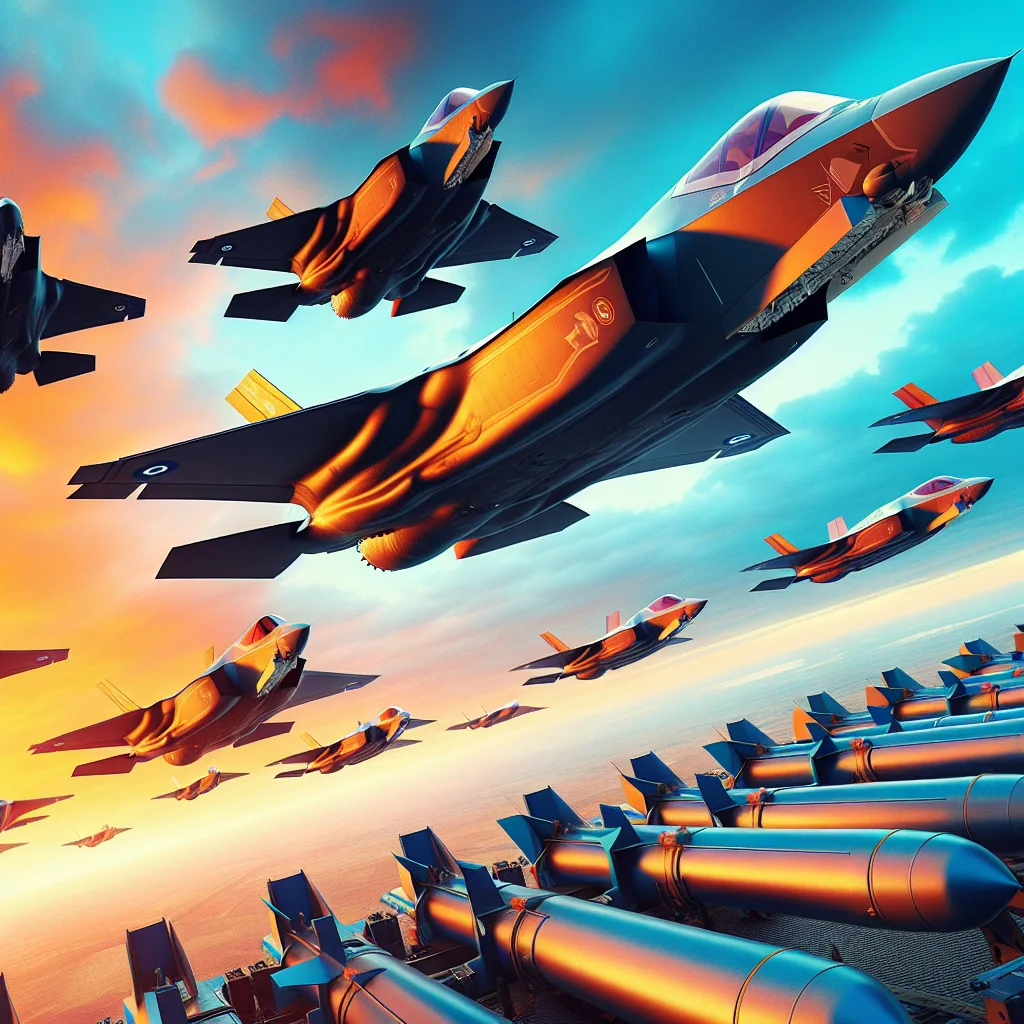
The image circulating online—a high-resolution snapshot of F-35 aircraft poised for action—belies the operational reality confronting Britain’s cutting-edge air force. While known for its advanced stealth and sensor fusion capabilities, the F-35B’s delayed ground missile functionality has stirred debate within defence circles about future mission profiles and budgetary priorities.
Historically, the United Kingdom has been at the forefront of modern military aviation. Since the adoption of advanced platforms such as the F-35B, British defence planners have sought to align technology upgrades with evolving geopolitical realities. However, as reported by The Telegraph on May 20, recent briefings confirm that an operational gap remains: the critical ability to deliver long-range, ground-attack missile strikes will not materialize until the technological enhancements slated for the 2030s are fully integrated.
This situation is not merely a technical hiccup but reflects the intricate balance between cutting-edge development and the unyielding march of global military challenges. Defence Procurement Minister Maria emphasized that the delay is due not to design flaws but to a broader strategic recalibration. The ministry’s commitment to next-generation systems remains intact even as lawmakers and military experts weigh the real-world implications of such capability gaps.
The current framework for the F-35B’s ground attack armament is rooted in both technological ambition and an evolving understanding of modern warfare. Despite its advanced stealth capabilities and sensor integration—which provide an edge in air-to-air engagements and intelligence gathering—the aircraft’s inability to deploy long-range missiles in support of ground operations has prompted a reexamination of its intended role on the modern battlefield.
Defence analysts have long noted that rapid technological innovations often run ahead of the doctrinal shifts needed to exploit them fully in combat scenarios. The F-35B, designed for a multipurpose role, now faces a critical transition point where integration challenges intersect with emerging strategic imperatives. As global tensions rise, with competitors recalibrating their own military capabilities, the United Kingdom’s delayed ground strike capability may constrain its operational flexibility in potential hot spots.
Policy experts suggest that this operational delay could have several far-reaching implications:
- Strategic Balance: Without a reliable long-range ground missile capability, the UK risks uneven force projection, a gap that adversaries may exploit in regional conflicts or crisis scenarios.
- Alliance Dynamics: As NATO and other allied forces contend with a rapidly changing threat landscape, Britain’s contribution relies on interoperable and timely capabilities. A delay in one nation’s systems can reverberate through alliance planning and operational readiness.
- Budgetary and Industrial Considerations: Extended development timelines often come with increased costs. The interplay between advanced research, production challenges, and evolving threat assessments underscores a broader debate over defence spending priorities.
Experts from reputable institutions such as the Royal United Services Institute (RUSI) and the International Institute for Strategic Studies (IISS) have stressed that such delays—while not uncommon in advanced military procurement—demand a careful recalibration of expectations. Observers note that while the F-35B’s state-of-the-art technology underpins many core missions, its full spectrum of intended capabilities is contingent on overcoming persistent technical and integration barriers.
One of the nuanced challenges in managing this capability gap is balancing short-term operational needs with the long-term benefits of innovation. British defence officials have often pointed to the F-35 program’s iterative development model, wherein incremental improvements are expected to come online over the aircraft’s lifespan. However, as the new timeline pushes critical ground-attack functions into the next decade, strategic planners must contend with interim vulnerabilities that could shape both domestic and international security policies.
Moreover, this delay resonates beyond the immediate realm of military technology. It encapsulates broader debates about the pace of modernisation, the interplay of national security priorities, and the risks associated with relying on complex, multi-role systems in times of escalating global tension. As nations invest in emerging technologies—from hypersonic weapons to artificial intelligence—the integration timelines of platforms like the F-35B become a litmus test for broader defence-industrial policies.
The British government has, in parallel, directed attention to alternative systems and interim measures that could mitigate these short-term limitations. Collaborations with international partners, an emphasis on adaptable tactics, and increased investment in complementary assets are all on the strategic agenda. Yet, the fundamental issue remains: in an era of rapid technological change and unpredictable global developments, even a brief operational gap can have outsized consequences.
Looking ahead, defence analysts caution that while the long-range missile capabilities may be deferred, the strategic recalibration prompted by this delay could lead to innovative solutions. The development of countermeasures, redundancy in other systems, and an increased emphasis on joint-force operations may help bridge the gap temporarily. International observers will be watching how the United Kingdom adjusts its tactical doctrines and whether allied nations perceive this as a recalibration of power projection capabilities.
In a world where military readiness is increasingly synonymous with technological sophistication, the British F-35B’s shortfall serves as a reminder that even the most advanced systems face the dual challenges of innovation and integration. As policymakers juggle fiscal constraints with the demands of an uncertain global security environment, decisions taken today will reverberate for decades to come.
Ultimately, the F-35B’s evolving role in the Royal Air Force’s arsenal raises a broader question: can a nation recalibrate its military capabilities rapidly enough to keep pace with an ever-shifting strategic landscape? The answer, seasoned analysts suggest, lies as much in bureaucratic resolve and industrial innovation as it does in the cold, hard calculus of global power politics.



