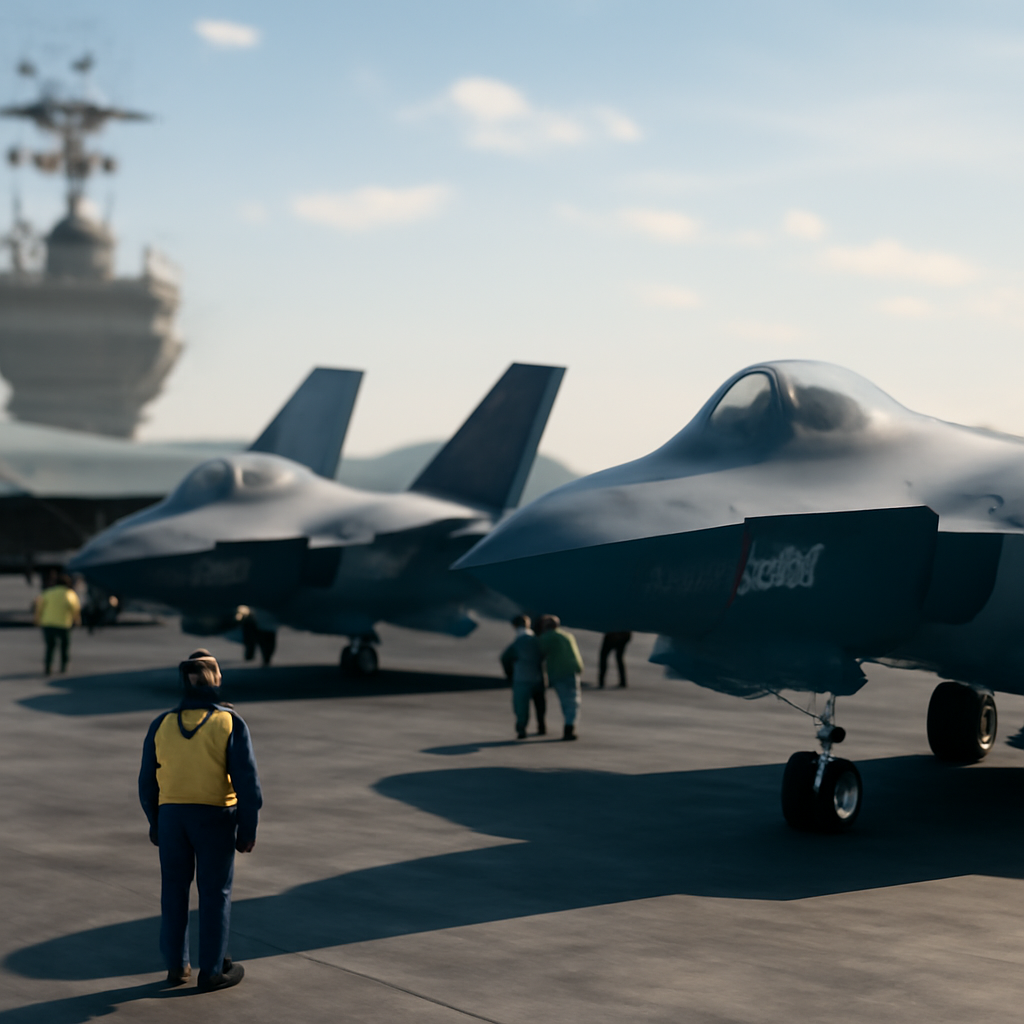
$20 billion: that is the approximate value of the contract the Pentagon announced on September 29, 2026, awarding Boeing the full‑scale development phase of the U.S. Navy’s F/A‑XX sixth‑generation carrier‑based fighter.
The $20 billion award and Pentagon terms
The Department of Defense’s press release describes the contract as covering the “full‑scale development phase” of F/A‑XX and says it includes procurement of “multiple test aircraft for ground, airworthiness, systems, and weapons integration testing.” The release frames F/A‑XX as a strategic investment: Michael P. Duffey, Under Secretary of War for Acquisition and Sustainment, said, “The F/A‑XX is a critical pillar in our commitment to maintaining peace through strength. F/A‑XX will dominate contested airspace, extend operational reach, and deliver a decisive combat advantage for the warfighter.”
Boeing’s winning design and classified technical details
Boeing was selected over Northrop Grumman in the competition; Lockheed Martin reportedly was eliminated earlier, in March 2025. Boeing’s public materials include a new rendering of its F/A‑XX proposal and a separate, earlier rendering for the Air Force’s F‑47. Boeing’s own press release notes that “technical and programmatic details” about the aircraft “remain classified under U.S. national security and export laws.” Steve Parker, President and CEO of Boeing Defense, Space & Security, said in a statement: “It’s an honor to be selected to produce the Navy’s first sixth – generation platform,” and added that the company is “ready to execute this critical program.”

This site is the portfolio.
OSINTSights runs on Cloudflare Workers, D1, R2, and Vectorize, with an AI pipeline on Hetzner ARM. Nubivance designed, built, and operates it. We do the same for clients.
See what we buildIndustrial capacity and the parallel F‑47 program
The F/A‑XX decision unfolded against sustained debate about U.S. industrial capacity. The Pentagon had moved to freeze the F/A‑XX program in June 2025; three months earlier Boeing had won a separate U.S. Air Force competition to produce what is now called the F‑47. U.S. military officials had argued the industrial base lacked capacity to support two next‑generation fighters simultaneously. Air Force Gen. Dale White, the service’s Direct Reporting Portfolio Manager for Critical Major Weapon Systems, reiterated concerns about industrial capacity two weeks before the Navy award, and said those concerns were “not unique” to F/A‑XX and F‑47.
Boeing’s announced advantage in the contest rests in part on its ability to “leverage design work it has already been doing in relation to the F‑47 program, as well as relevant production experience and supply chains.” Boeing has publicly defended its readiness to “build multiple concurrent future combat aircraft franchise programs,” and its press release highlights a major expansion of facilities in St. Louis, Missouri that the company says supports both programs.
CNO Adm. Daryl Caudle on operational need and threat environment
Senior Navy officials had been vocal about preserving F/A‑XX even after the Pentagon’s 2025 pause. Adm. Daryl Caudle, Chief of Naval Operations, argued repeatedly that the service needed a sixth‑generation fighter to address evolving threats. In January he said, “I know these things are expensive, and I know the defense industrial base is compressed, but we have got to figure out how to walk and chew gum here with aircraft.” He warned that some countries “will gain capability that the F‑18 [F/A‑18E/F Super Hornet] will not match against,” and added, “our ability to fly with impunity with our existing airframes is fleeting.” Caudle concluded bluntly: “So, if I don’t start building that [F/A‑XX] immediately, you’re not going to get it for some time.”
The Navy’s justification also ties F/A‑XX to broader carrier air‑wing evolution: the service is “increasingly solidifying its vision for new carrier‑based Collaborative Combat Aircraft (CCA) drones,” and the Pentagon’s press release states F/A‑XX will be “interoperable with manned and unmanned platforms such as Collaborative Combat Aircraft (CCA) and increase the capability of every CCA it teams with.”
What this means for Boeing, the Navy, and the Air Force
- Boeing: The company stands to synchronize work across F/A‑XX and F‑47 lines and to expand facilities in St. Louis. Boeing also received a separate Navy contract valued at $16,667,607 to support final shutdown of the F/A‑18E/F Super Hornet and EA‑18G Growler production line.
- The Navy: The service plans F/A‑XX to “augment and eventually replace legacy F/A‑18E/F Super Hornets and EA‑18G Growlers beginning in the 2030s, and operate alongside the F‑35C,” per the Pentagon release. Navy leaders see the program as a keystone for carrier‑based power projection and for teaming with CCAs.
- The Air Force: The parallel F‑47 program remains a live constraint in the record. Officials and industry spokespeople discussed the risk of competing demands on production capacity; how closely Boeing’s two designs share common elements and supply chains will be central to whether both programs can proceed as planned.
The award closes a fraught chapter in which the Pentagon temporarily froze F/A‑XX, Congress intervened to keep the competition alive, and Navy leaders pressed its urgency — all while questions about industrial capacity persisted. The public record now documents two immediate, concrete unknowns: how closely Boeing’s F/A‑XX design shares “DNA” with the F‑47, and whether Boeing’s stated investments in facilities and supply chains will resolve the capacity concerns voiced by senior acquisition managers. The Navy has not announced a formal designation for the aircraft, and Boeing’s release reiterates that many technical details remain classified.
Original reporting: TWZ — Boeing Wins F/A‑XX Next Generation Navy Stealth Fighter Contract (Updated)