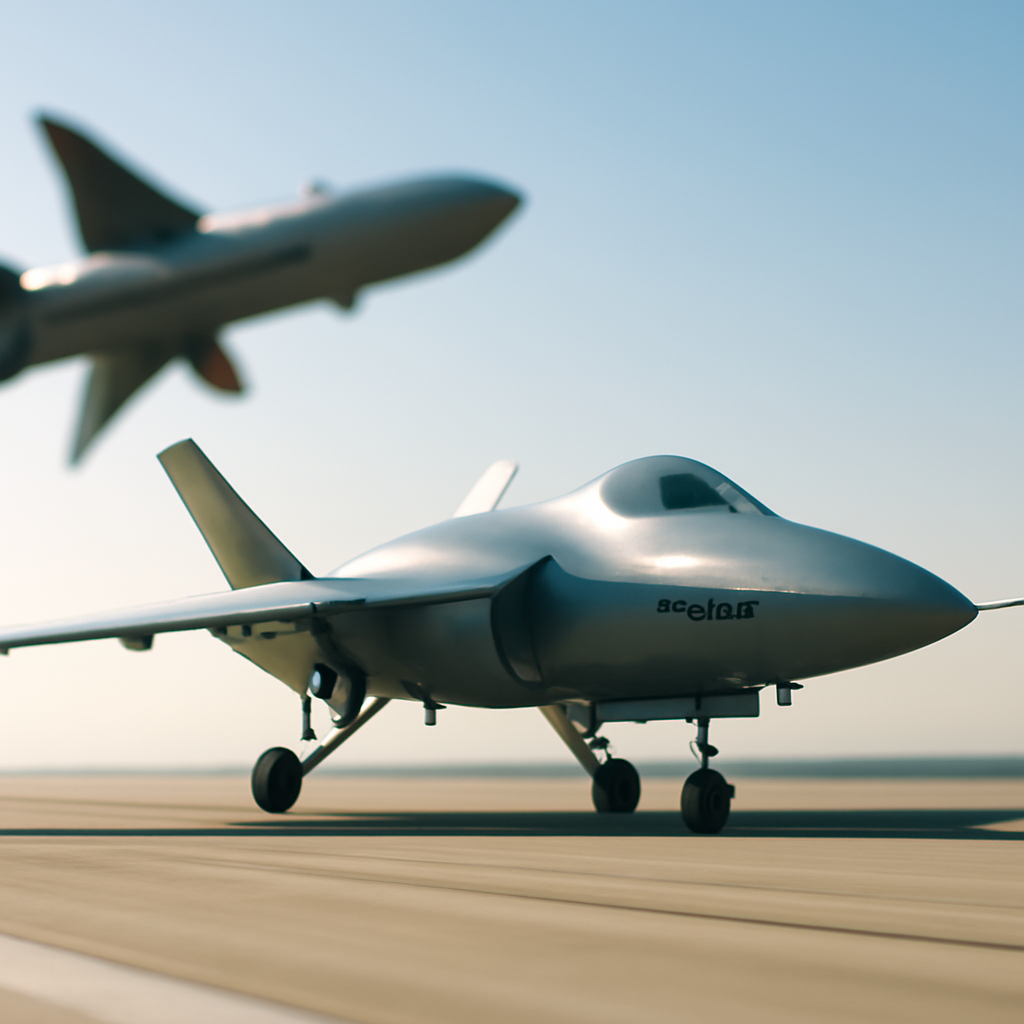
"Bull’s Eye" accuracy, Baykar said, after its Bayraktar Kızılelma fired a Roketsan JET-230 supersonic air‑to‑ground missile and struck a target from a range of more than 120 km.
Baykar’s S2 flight and the first supersonic air‑to‑ground firing
Baykar announced on 13 July that the Kızılelma serial production airframe S2 conducted the company’s first firing of a supersonic air‑to‑ground weapon. S2 departed the Akıncı Flight Training and Test Centre at Çorlu on 8 July, transited to the 5th Main Jet Base Command at Merzifon, and on 11 July took off carrying two JET‑230s under its wings before turning toward a target over the sea. The company said the missile hit from a range of over 120 km.
What the JET‑230 is and how it fits into Roketsan’s 230 mm family
The JET‑230 is the newest member of Roketsan’s 230 mm aeroballistic family. Roketsan markets earlier members such as the TRG‑230 — a ground‑launched guided rocket fired from multi‑barrel launchers with ranges of 20 to 70 km — and an air‑launched conversion called the İHA‑230, sold for export as the UAV‑230. The UAV‑230 is roughly 3.4 m long, about 225 kg in mass, carries a 42 kg warhead, and uses satellite‑aided inertial guidance; Roketsan quotes its range as more than 150 km. Roketsan’s literature explains that the JET‑230’s reach depends on the speed and altitude at which it is released, and that a jet cruising near Mach 0.9 gives the weapon significantly more separation energy than a turboprop.

This site is the portfolio.
OSINTSights runs on Cloudflare Workers, D1, R2, and Vectorize, with an AI pipeline on Hetzner ARM. Nubivance designed, built, and operates it. We do the same for clients.
See what we buildHow the 120 km shot compares with advertised figures and prior firings
Roketsan advertises the JET‑230 with an envelope exceeding 200 km. The 120 km engagement Baykar reported sits inside that advertised envelope and below the 155 km result achieved by the İHA‑230 when fired from the turboprop Bayraktar Akıncı in November 2024. Neither Baykar nor Roketsan has said whether launch conditions for the Kızılelma test were conservative for a first integration firing, or whether the JET‑230’s 200 km figure depends on a launch profile this test did not replicate. Roketsan notes that release energy is limited by the missile’s engine, and the Kızılelma itself flies on a Ukrainian turbofan; Türkiye is developing a domestic replacement to close that dependency.
Kızılelma’s broader weapon set and operational context
The Kızılelma carries ASELSAN’s MURAD active electronically scanned array (AESA) radar and the TOYGUN electro‑optical targeting system. Before integrating the JET‑230, the aircraft had already fired ASELSAN’s TÜBİTAK SAGE Gökdoğan air‑to‑air missile and munitions including TOLUN, TEBER‑82 and LGK‑82. The Gökdoğan shot, taken off Sinop on 29 November 2025, made the Kızılelma the first unmanned aircraft to destroy a jet‑powered aerial target with a beyond‑visual‑range missile, Baykar said. Baykar plans to operate the type from the amphibious assault ship TCG Anadolu and the future MUGEM carrier. Roketsan’s general manager Murat İkinci told the Dubai Airshow in November 2025 that the Kızıl elma would also carry the 300 ER — a 900 kg air‑launched ballistic missile quoted at over 500 km — and the EREN loitering munition.
How Baykar, Roketsan, and export partners may act next
- Baykar: The company has positioned the Kızılelma for rapid operational entry; Selçuk Bayraktar has said the type will enter the Turkish inventory and begin operations in 2026. Baykar also moved beyond prototype testing by flying the S2 serial production airframe for the JET‑230 integration.
- Roketsan: The firm’s marketing of the 230 mm family ties range claims to launch conditions. Roketsan’s literature and remarks emphasize that faster, higher‑flying platforms will extend reach, a technical point that frames future demonstration and integration work.
- Export partners and customers: Baykar signed the Kızılelma’s first export contract in May at SAHA 2026 with Indonesia’s Republikorp Group — 12 aircraft with options for 48 more, deliveries from 2028, and a planned local production facility. Baykar reported $2.2 billion in drone exports in 2025 and holds export agreements with 39 countries. The Pakistan Air Force, already a Baykar customer for TB2 and Akıncı platforms, figures in related industrial ties: Baykar Technologies Pakistan was spun out of work at the National Aerospace Science and Technology Park and is reportedly in talks over an assembly plant.
Conclusion
Baykar’s announcement that a production Kızılelma airframe fired a JET‑230 to a “Bull’s Eye” at over 120 km marks a step in weapons integration and a public data point for performance under specific test conditions. The shot sits inside Roketsan’s advertised JET‑230 envelope and below a previous 155 km İHA‑230 result from a turboprop, underscoring Roketsan’s central point that launch platform speed and altitude materially affect range. For Baykar and Roketsan, the immediate task is translating this integration into operational profiles and exportable performance claims; for foreign buyers and local production partners, the data will feed decisions on purchases, basing and industrial participation as deliveries and further tests proceed.