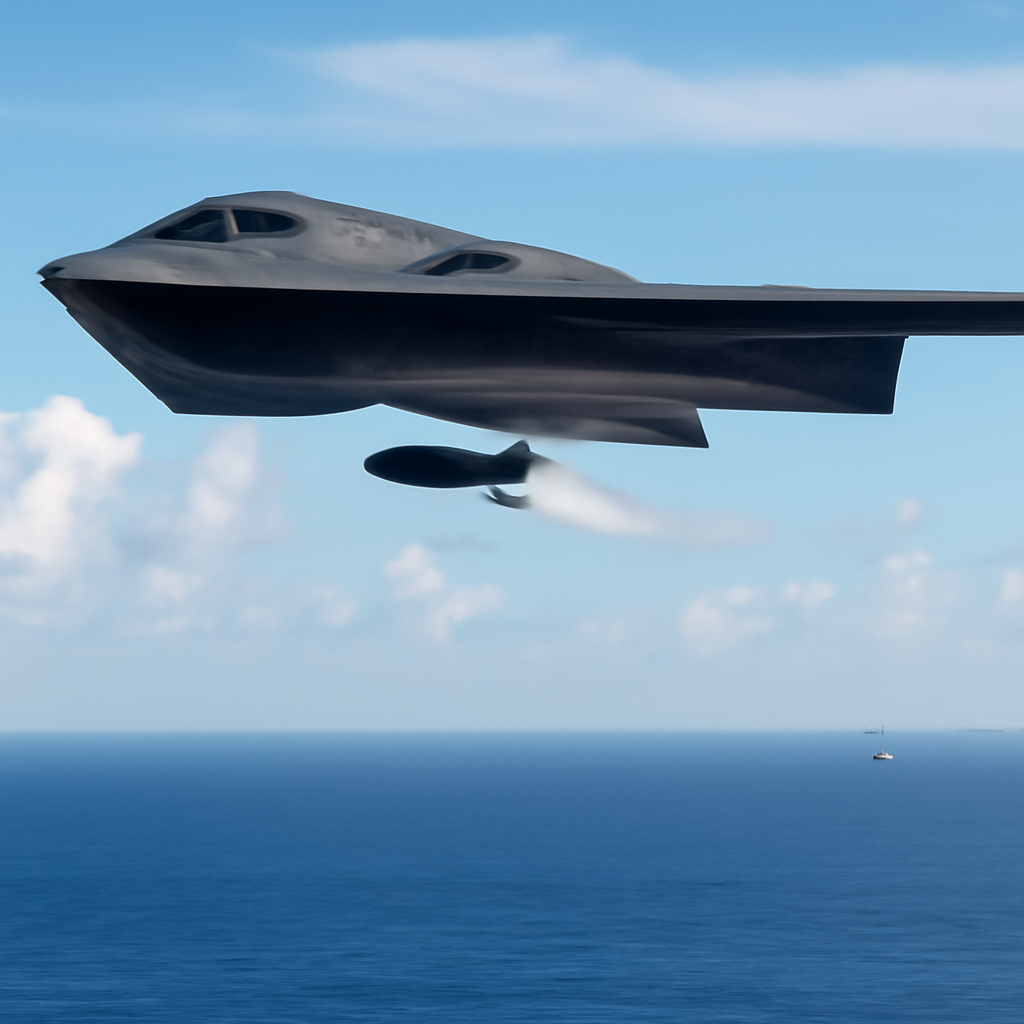
"With the deployment of the LRASM from the B-2 Spirit, the Pacific Air Forces takes a major step forward in countering maritime threats," Pacific Air Forces (PACAF) said in a press release announcing that a U.S. Air Force B-2 bomber fired an AGM-158C Long Range Anti-Ship Missile (LRASM) during a live-fire sinking exercise in the Western Pacific.
What happened at Valiant Shield 2026
PACAF confirmed the live-fire Sinking Exercise (SINKEX) took place north of the Mariana Islands as part of Exercise Valiant Shield 2026. The B-2 fired an AGM-158C at the ex-USS Juneau, an Austin-class decommissioned amphibious warfare ship that was sunk roughly 200 nautical miles off the coast of Guam. U.S. and allied forces employed a range of munitions against the Juneau over the weekend; an unnamed Japan Maritime Self-Defense Force submarine appears to have delivered the final blow with a heavyweight torpedo. PACAF characterized the broader exercise as an opportunity to integrate forces across services and allies to produce "precise, lethal, and overwhelming multi-domain effects."
What PACAF and Air Force officials said
PACAF framed the event as a high-end innovation milestone that reinforced the U.S. military’s commitment to safeguarding national interests and maintaining global security. Air Force Gen. Kevin B. Schneider, head of PACAF, said the B-2’s performance "underscores the US military’s commitment to adaptability and flexibility" and that prioritizing counter-maritime strike operations helps maintain a decisive edge.
When asked for details, Air Force Global Strike Command told TWZ that specifics about the integration of LRASM onto the B-2 were classified, and AFGSC also declined to say whether the SINKEX represented any kind of first for the bomber.

This site is the portfolio.
OSINTSights runs on Cloudflare Workers, D1, R2, and Vectorize, with an AI pipeline on Hetzner ARM. Nubivance designed, built, and operates it. We do the same for clients.
See what we buildLRASM on the B-2: capability and context
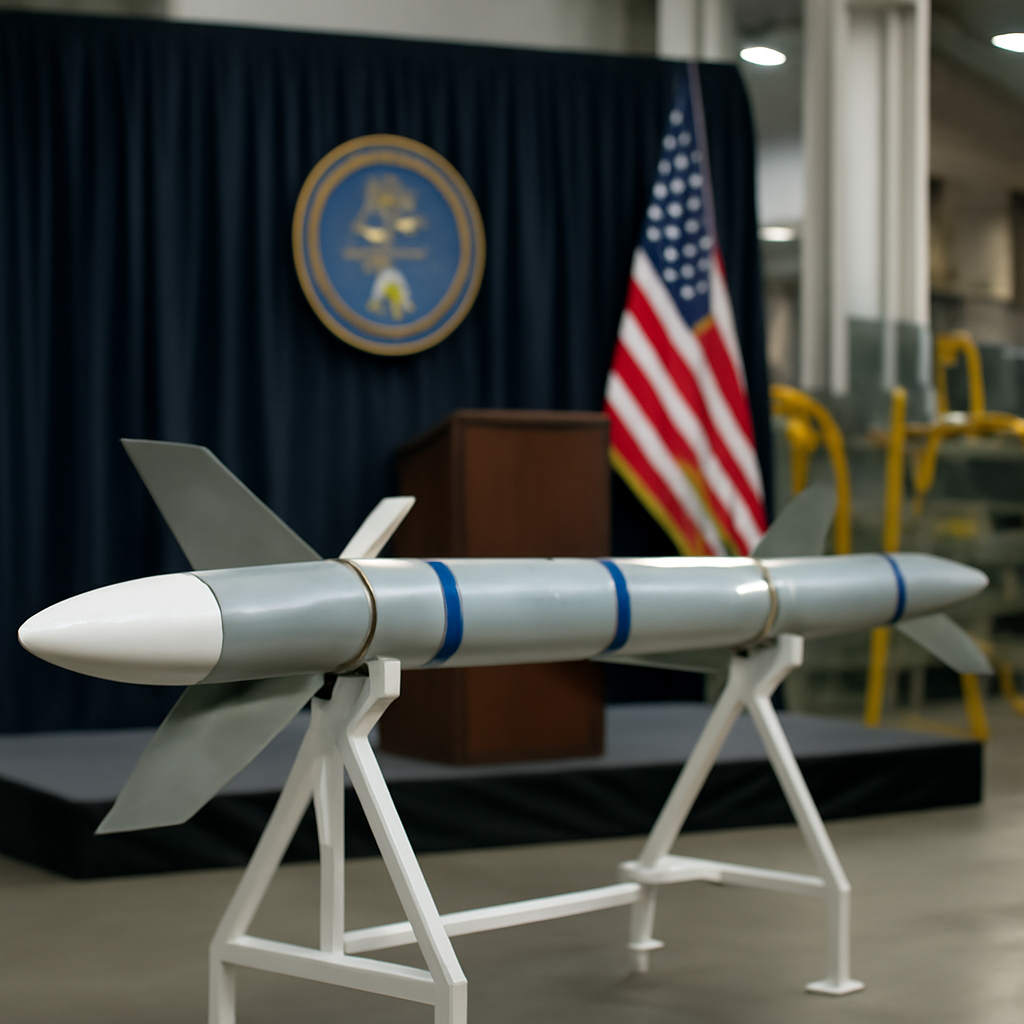
The AGM-158C LRASM is a derivative of the JASSM family. The B-2 was already known to carry the baseline AGM-158A JASSM and the AGM-158B JASSM-Extended Range; the bomber can carry up to 16 AGM-158As and "is very likely capable of carrying the same number" of JASSM-ERs and LRASMs because they share the same general form factor. PACAF’s announcement is the first public confirmation that the highly stealthy LRASM has been fired from a B-2 in the Pacific.
LRASM combines GPS-assisted inertial navigation with on-board route planning linked to an electronic support measures (ESM) package. It can alter course in response to detected enemy radio-frequency emissions and its imaging infrared seeker guides terminal engagement without emitting detectable RF signals, rendering the seeker immune to radio-frequency jamming. LRASM also features an in-flight datalink for threat updates and cooperative behavior with other LRASMs. Existing versions are reported in open materials to have a range roughly between 200 and 300 miles; a C-3 variant in development is expected to offer a longer reach—around 600 miles—along with "C++ software, [an] enhanced BLOS Weapons Data Link, [and] advanced survivability," according to Navy budget documents.
Budget signals and other integration work
The Pentagon’s Fiscal Year 2027 budget proposal, as reviewed in public documents, does not explicitly list LRASM integration on the B-2. The budget does, however, list cleared LRASM launch platforms that include the Navy’s F/A-18E/F Super Hornet and the Air Force’s B-1 bomber. Public work to integrate LRASM has been underway for other platforms—F-15E Strike Eagle, F-15EX Eagle II, F-16C/D Viper, certain F-35 variants, and the P-8A Poseidon—and budget documents mention plans for the B-52 as well.
The Air Force has also pursued other B-2 anti-ship options, including "Quicksink" precision-guided anti-ship bombs using JDAM kits; test drops were highlighted in cooperation with the Royal Norwegian Air Force in 2025.
What this means for Pacific Air Forces, the U.S. bomber force, and the People's Liberation Army Navy (PLAN)
- PACIFIC AIR FORCES: PACAF will likely present the capability publicly as a way to reinforce deterrence messaging in the Indo-Pacific; its release framed the firing as a "major step forward" in countering maritime threats.
- U.S. BOMBER FORCE: For the Air Force and bomber planners, the pairing of a highly survivable, penetrating platform with a stealthy anti-ship missile extends the force’s ability to engage high-value maritime targets from long range; the service also views this integration as relevant to future operations with the forthcoming B-21 Raider.
- PEOPLE’S LIBERATION ARMY NAVY (PLAN): The public disclosure can be read as a signal aimed at Beijing, given commentary in the reporting that pairs the capability against the PLAN’s carrier and large amphibious ship force concentrations.
Pairing LRASM with the B-2 converts a low-observability penetrator into a penetrating, fleet-killing delivery system capable of engaging multiple ships from hundreds of miles away, while retaining missile-level survivability features such as passive imaging seekers and cooperative engagement. The Air Force’s longer-term bomber plans—already publicly tied to a future fleet of B-21 Raiders that will be smaller than the B-2 but purchased in larger numbers—mean the operational and strategic questions raised by this integration are likely to echo through force-planning discussions for years.
Read the original TWZ story: https://www.twz.com/air/air-force-discloses-b-2-can-launch-stealth-anti-ship-missiles-in-surprise-announcement