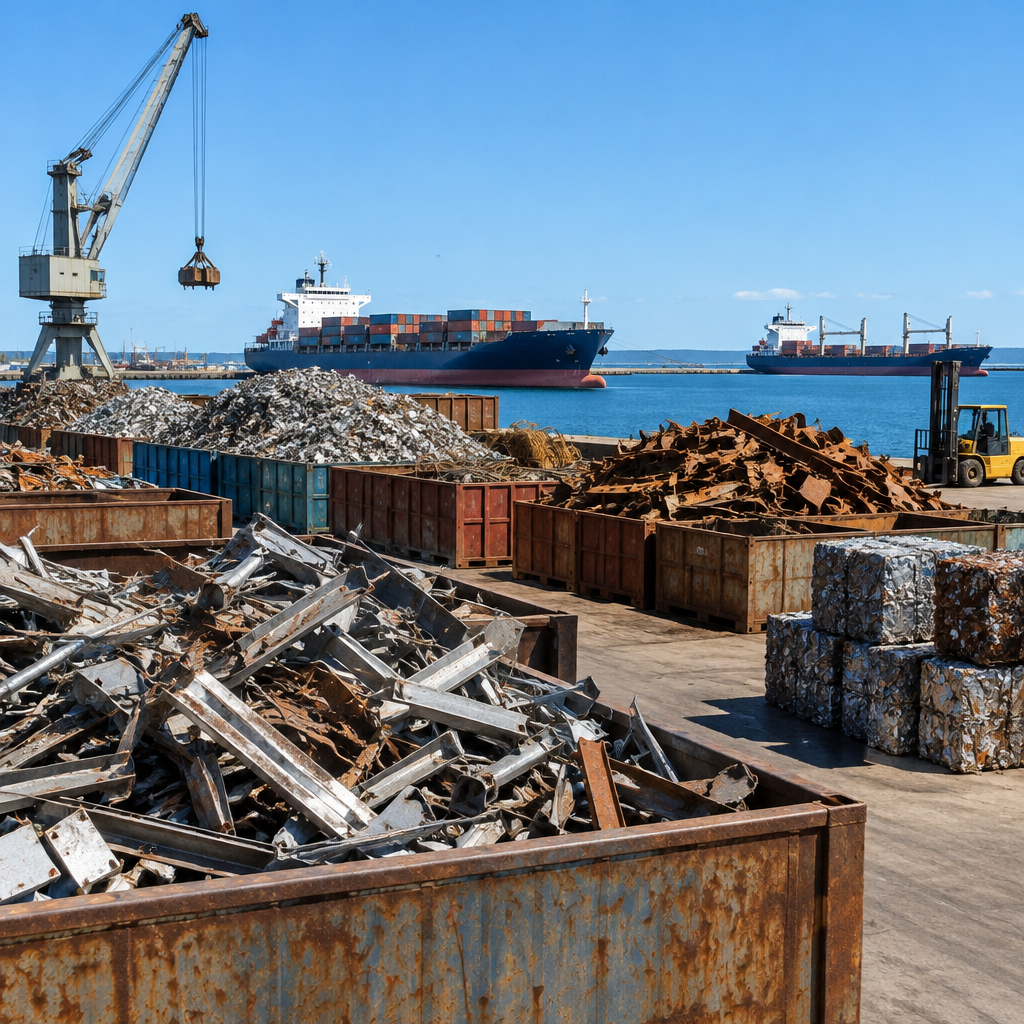
Australia exported 2.55 million tonnes of ferrous scrap in 2025–26 — the most in any year since at least 2017–18.
Ferrous and non‑ferrous export figures, 2025–26
That 2.55 million tonnes of ferrous scrap was part of a much larger outbound flow of metal. In 2025–26 Australia’s scrap exports were worth A$4.58 billion; non‑ferrous metals accounted for only 16 percent of the weight but 67 percent of the value — A$3.05 billion. Copper scrap — about 113,000 tonnes — earned A$1.23 billion, and aluminium scrap earned A$1.43 billion. A tonne of copper scrap was worth about 18 times a tonne of ferrous scrap. China alone took roughly a third of the non‑ferrous value, followed by India and South Korea.
Steelmaking trends and supply resilience
Steelmaking is shifting worldwide toward electric arc furnaces (EAFs), which run largely on scrap. EAFs made about 30 percent of the world’s crude steel in 2025. Unlike large iron‑making blast furnaces, EAFs are smaller, act in effect as recycling plants, and can be dispersed. That dispersal matters: Australia’s domestic steel supply is concentrated in a few large plants built around iron‑making blast furnaces, a concentration that invites disruption. In September the government ruled out funding a restart of Whyalla’s 60‑year‑old blast furnace, leaving BlueScope’s Port Kembla works with the country’s only operating iron‑making blast furnace.

Audit-ready is a season. It shouldn't be.
Evidence in spreadsheets, controls drifting between audits, frameworks multiplying on flat headcount. Nubivance runs continuous compliance on Rapid7 Cyber GRC - SOC 2, HIPAA, ISO 27001, PCI, CMMC.
End the scramblePolicy levers: processing rules and the Recycling Modernisation Fund
Policy choices could keep more metal in Australia without outlawing exports. The government already tracks scrap exports by metal and destination but publishes little on how much scrap of each grade is generated and processed domestically. The same processing rules that require waste glass, plastics, tyres and paper to be processed before export could be extended to unprocessed car and white‑goods scrap, keeping it at home for shredding and sorting. Processed scrap could still be exported where local mills could not use it all: exports are about five times the extra scrap the Australian Steel Institute expects local mills to need.
The Recycling Modernisation Fund currently shares the cost of new recycling plants with state governments and industry and has focused mainly on glass, plastics, tyres and paper. Opening the fund to metal would help pay for shredders and sorting lines. For copper and aluminium the missing piece is local remelting and refining, so high‑grade scrap becomes metal here rather than overseas.
Australian Steel Institute proposal and the counterargument
The Australian Steel Institute wants exports of unprocessed scrap steel banned. The source argues a ban would be the wrong tool: it would hand a few domestic buyers a captive supply; it would push down prices paid to collectors and small yards, reducing incentives to recover metal; and it would do nothing to capture the value of copper and aluminium, where most of the export value lies. A policy focused instead on better data, targeted processing requirements and investment in local re‑processing capacity is presented as an alternative.
What this means for defence planners, local mills, and scrap collectors
- Defence planners: Defence production — shipbuilding, armoured vehicles and military‑base construction — depends on a reliable steel supply. The current concentration of iron‑making blast furnaces and the Whyalla funding decision mean planners face a supply chain with single points of failure unless domestic scrap and EAF capacity are expanded.
- Local mills and steelmakers: The Australian Steel Institute expects local mills to need another 500,000 tonnes of scrap a year within three years. Processed scrap held in country and greater EAF capacity would make that supply more available and resilient.
- Scrap collectors and small yards: A ban on unprocessed exports risks lowering the prices collectors receive and reducing incentives to recover metal. Rules that require pre‑processing and investment in local shredding and sorting lines would keep revenue flowing to collectors while improving domestic feedstock quality.
There is a stark mismatch in Canberra’s treatment of metals: copper and aluminium sit on the Strategic Materials List, and green‑steel measures appear in programs such as Future Made in Australia, yet government lists and strategies do not explicitly account for the metal already lying above ground in cables, cars, buildings and machinery. Recycled aluminium, for example, takes about 95 percent less energy to produce than primary metal — a fact that underlines the strategic value of recovered metal.
If scrap is now a contested global resource, Australia’s current posture — treating minerals in the ground as strategic and the metal above it as something to ship — looks increasingly at odds with both market and security realities. The concrete steps suggested by this analysis are narrow and practical: better data on grades and domestic processing, processing rules that keep unprocessed scrap onshore for sorting and shredding, expansion of the Recycling Modernisation Fund to include metal, and policies that recognise recovered steel, copper and aluminium as legitimate domestic supply. Those choices would determine whether Australia imports resilience or manufactures it at home.