"To succeed, there must be moves beyond ad hoc coordination and clear, long-term demand signals necessary to attract and train the specialised talent required for this mission," said USSC Director of Foreign Policy and Defence Dr Lavina Lee in the centre’s June report.
Funding, partners and the GWEO mandate
Launched in 2024, Australia's Guided Weapons and Explosive Ordnance (GWEO) effort is intended to create sovereign production for guided missiles and munitions. The country's 2026 National Defence Strategy (NDS) sets aside between 26 and 36 billion Australian dollars (AU$26–36 billion; US$18.16–25.14 billion) for the effort, although the NDS and its integrated investment plan provide limited detail on how the funding will be allocated.
The program currently lists four official partners: the Australian arm of Norwegian firm Kongsberg, France’s Thales, and U.S. firms Lockheed Martin and Raytheon. Two local companies have been named as “Enterprise and Support Partners.” Oversight of the enterprise has been the responsibility of a designated GWEO Group; its former head, Air Marshal Leon Phillips, said he was proud of the organisation’s achievements when he left the post in September.
Concrete milestones: rockets, motors and export-firsts
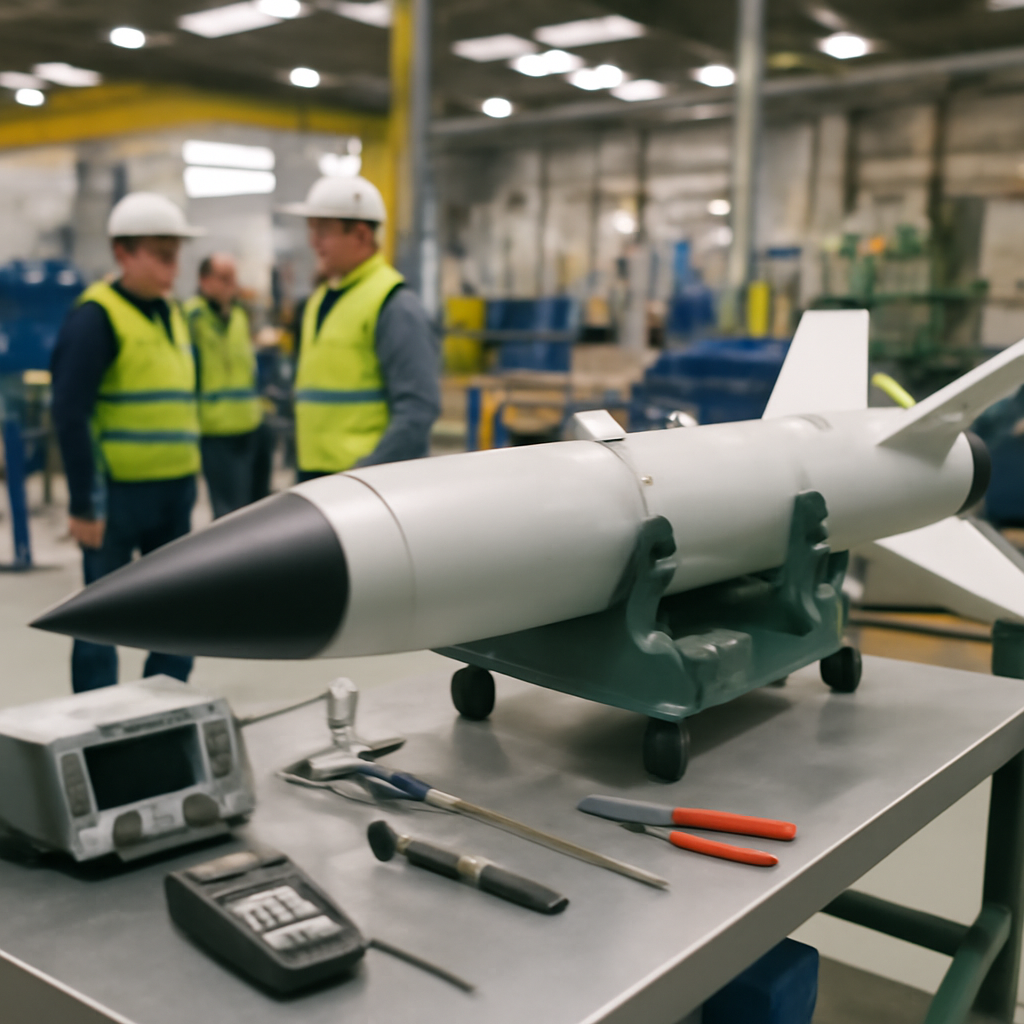
Despite open questions about resourcing and workforce, GWEO has reached several tangible milestones. Australia has test-fired locally produced Lockheed Guided Multiple Launch Rocket System (GMLRS) rockets and found local industry partners to produce GMLRS components. The program has entered an agreement to develop and produce Precision Strike Missiles and aims to be the first export customer for the AIM-260 Joint Advanced Tactical Missile (JATM).
Separately, Australian industry has developed and tested an indigenous solid-rocket motor, and plans are in place for local manufacture of Kongsberg’s Naval Strike Missile and Joint Strike Missile — steps ASPI described as building “domestic industrial foundations.”

The cyber insurance questionnaire just landed. Now what?
SOC 2, HIPAA, insurance renewals - someone has to own security strategy. Nubivance provides fractional CISO leadership without the full-time salary.
Get a security leadASPI’s diversification warning
The Australian Strategic Policy Institute (ASPI) cautioned in April that a large proportion of munitions being produced under GWEO are U.S. in origin, and that U.S. manufacturers are already struggling to meet demand. ASPI and Australia’s NDS both recommended diversifying supply chains; ASPI specifically named South Korea, Britain and Germany as offering “credible technology transfer pathways for components and complete weapons that could reduce dependence.”
Workforce risk flagged by the United States Studies Centre
The United States Studies Centre (USSC) at the University of Sydney described Australia’s industrial workforce planning for GWEO as “largely neglected” in its June report. The USSC singled out three structural problems: deferred responsibility, ambiguous demand signals, and ad hoc, incremental coordination across industry, state governments and training providers.
The report also noted that Australia’s technical workforce tends to be geographically immobile for “preference and circumstance,” and urged quicker, better-coordinated decisions on siting GWEO facilities. The USSC argued those moves — clearer, long-term demand signals and coordinated workforce planning — are necessary to attract and train the specialised talent the program requires.
How Kongsberg Australia, the Australian government, and the local technical workforce are responding
- Kongsberg Australia: At the Land Forces exhibition in Perth, Kongsberg Australia announced a Memorandum of Understanding (MoU) with Zone 5 Technologies to “explore collaboration opportunities to provide affordable, mass producible long-range strike and air-defence and anti-drone missiles for Australia and New Zealand.” Kongsberg concluded its acquisition of Zone 5 in June; John Fry, Kongsberg Australia’s managing director, said industry events in the U.S. and Europe demonstrate that “the ability to produce capable and affordable effectors quickly and at scale” is required and that “building resilient supply chains and industrial capacity is critical.”
- The Australian government (Canberra): The GWEO’s trajectory depends on Canberra translating allocated funding into clear siting, procurement and training decisions — the very long-term demand signals the USSC said are missing. The government also oversees the GWEO Group that has been steering the program to date.
- Local technical workforce: The USSC warned that attracting and training specialised talent will require coordinated action because many technical workers are geographically immobile. The workforce will be affected most directly by where facilities are sited and by whether industry and governments provide stable, long-term employment signals and training pathways.
Progress under GWEO is unmistakable: test firings, indigenous motor tests, export-first agreements and new industrial linkages such as the Kongsberg–Zone 5 MoU mark concrete steps toward domestic guided-weapons capacity. But the program’s success hinges on two persistent, linked risks the reporting identifies: heavy reliance on U.S.-origin munitions while U.S. suppliers strain to meet demand, and a domestic workforce that requires earlier, clearer commitments on facility siting, training and long-term demand.
The immediate, observable next steps are also plain in the record: Canberra must convert budget lines into specific industry and training plans, partners such as Kongsberg will need to scale local manufacture and supply chains, and Australian authorities will have to act on the USSC’s warning that ad hoc coordination will not deliver the specialised workforce GWEO requires.