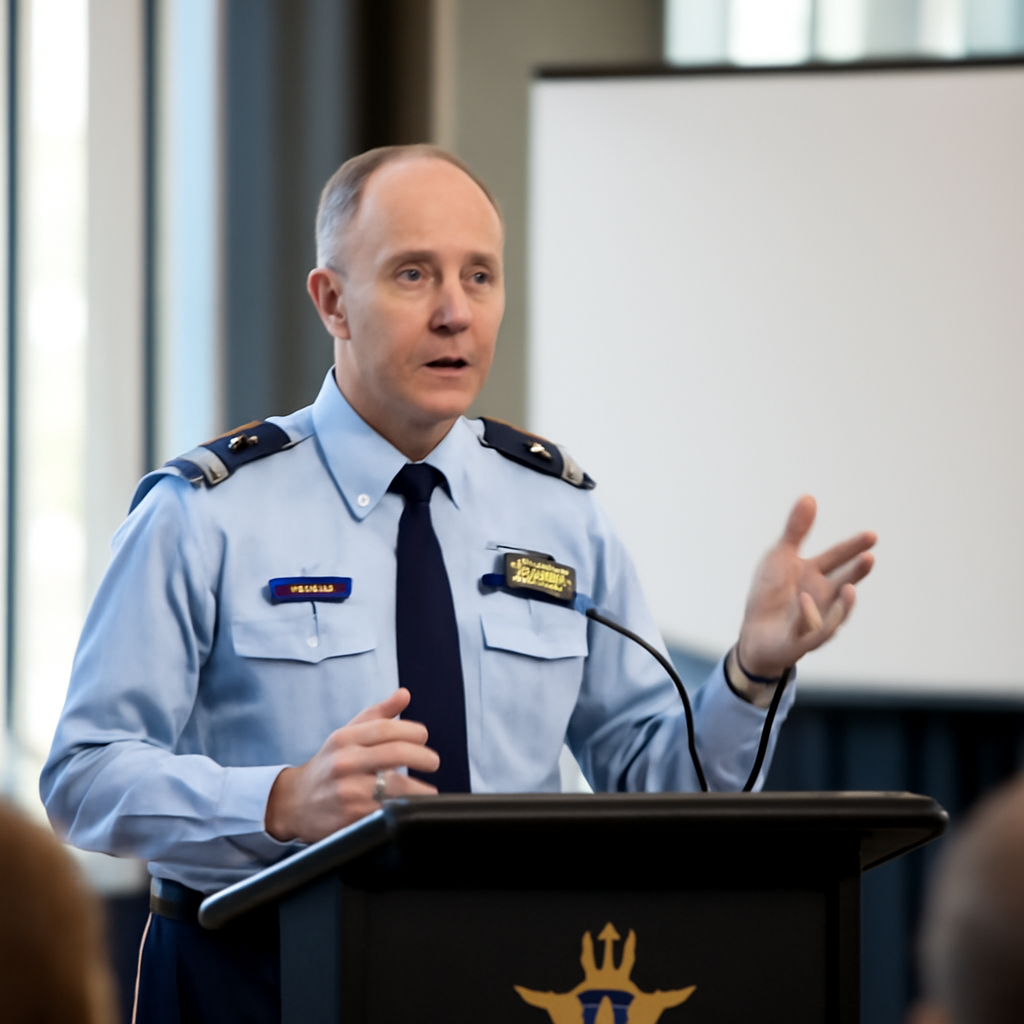
"collective, as the integrated force, the five domains, three services, through joint operations with interagency, allies and partners", Air Marshal Stephen Chappell told a deterrence session at the June 2026 ASPI Defence Conference.
Air Marshal Stephen Chappell’s 6C‑4D construct
At the June 2026 ASPI Defence Conference, Chief of Air Force Air Marshal Stephen Chappell set out an organising phrase for Australia’s emerging deterrence approach: a memorable six‑C framework — capability, credibility, communication, comprehension, collective and cumulative — underpinned by four Ds — disrupt, degrade, destroy and defeat. The formulation has begun to circulate publicly as an implementation approach to the deterrence ambitions already signalled in Australia’s National Defence Strategy.
Capability, credibility, communication and comprehension: the deterrence conditions
The first four Cs map onto longstanding deterrence language used by allies. Capability, credibility and communication have featured in US deterrence doctrine and in NATO’s approach since at least 2016; British doctrine adds comprehension as foundational. These concepts are presented in the source as the conditions that must shape an adversary’s decision‑making: whether Australia has the means (capability), the will (credibility), and whether what is being signalled is understood (communication and comprehension). The source stresses that these elements together determine whether an adversary adjusts its calculations.

This site is the portfolio.
OSINTSights runs on Cloudflare Workers, D1, R2, and Vectorize, with an AI pipeline on Hetzner ARM. Nubivance designed, built, and operates it. We do the same for clients.
See what we buildCollective and cumulative: how Australia intends to implement deterrence
Chappell distinguished the last two Cs as implementation principles rather than conditions. Collective refers to generating deterrence through integration — "the integrated force, the five domains, three services, through joint operations with interagency, allies and partners." Cumulative refers to signalling capability and capacity over time — "all the time, over and over again" — by demonstrating, through training, exercises and operations, the ability to generate and deliver effective airpower with enhanced lethality and survivability, as Chappell explained at the Air and Space Power Conference 2026. The source asserts that collective and cumulative explain how Australia intends to generate and sustain deterrence conditions, not why an adversary would be deterred.
The four Ds as military effects: disrupt, degrade, destroy, defeat
The source separates the four Ds from the Cs by function. Disrupt, degrade, destroy and defeat are characterised as military effects — the capability and capacity being built to deny an adversary its objectives. For deterrence by denial, those effects matter insofar as they convince an adversary it cannot achieve its goals. The analysis in the source emphasises a three‑layer architecture: (1) conditions that make deterrence effective (capability, credibility, communication, comprehension), (2) Australian implementation principles (collective, cumulative), and (3) the military effects available to generate denial (the four Ds). That separation is presented as necessary to translate ambition into strategy, force design, capability development and operational planning.
What this means for strategists, force and operational planners, and allies and partners
- Strategists and force planners: The source warns they need conceptual clarity that separates the conditions Australia seeks to create from the ways it plans to create them and from the military effects that support denial. Without that architecture, planners risk conflating what deters with how to deliver deterrent effects.
- Capability developers and trainers: The cumulative principle directs a continuous signalling posture through training, exercises and operations to show the ability to generate and sustain highly effective airpower with enhanced lethality and survivability.
- Allies and partners: The source urges harmonisation of definitions and functions with the US, Britain and NATO to preserve conceptual interoperability. As Chief of the Defence Force Vice Admiral Mark Hammond said at the ASPI Defence Conference, Australia does not want "to contemplate a strategy of deterrence on our own," making alignment central to collective deterrence.
The proposal in the source argues for analytic clarity: keep the conditions that influence an adversary’s choice distinct from the principles describing how Australia will produce them, and from the military effects that underpin denial. Doing so would, in the source’s terms, translate the National Defence Strategy’s deterrence ambition into implementable steps for those charged with planning, force design and capability decisions. The next concrete task, according to the source, is harmonising the 6C and 4D definitions and functions with allies and partners so combined planning, exercising and operations can proceed without unnecessary conceptual friction.
https://www.aspistrategist.org.au/towards-a-framework-for-implementing-australian-deterrence/



